

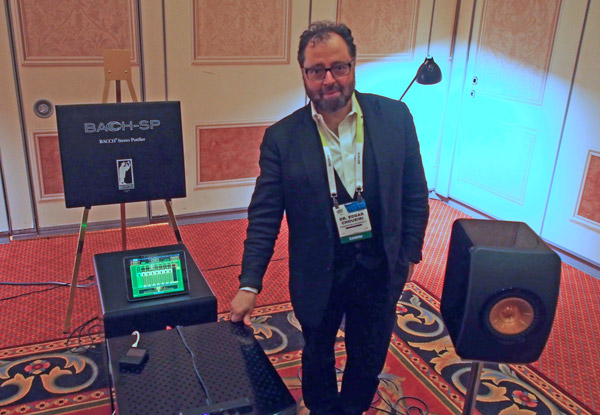
Princeton physics professor Edgar Choueiri is a suave handsome man. He is also a sophisticated art collector, and when he joins you for dinner, the IQ at the table rises dramatically. For his regular day job, he designs plasma rocket engines. Last, but not least, he is the mind and force behind Bacch-SP—a developing company engaged in leading edge virtual reality studies. Dr. Choueiri's audio research focuses on the experience of recorded sound as a fully three-dimensional experience. When Dr. Choueiri gets you in his listening room, in front of his speakers (or anywhere else around the room), prepare to be amazed.
The Doctor's magic 3D experience begins while a pair of tiny in-ear microphones are calibrating the system to compensate for the dimensions of your ear canals, the shape of your outer ears, and your location in the room. This information is what enables the individualized crosstalk cancellation filters to do their job. Interaural crosstalk, where the sound intended for the left ear also reaches the right, and vice versa, is what makes our experience of stereo music playback, diffuse, inconsistent, often tonally skewed, and the soundstage limited to between the speaker positions. Working like a stereopticon, Edgar's Bacch-SP provides up to a 32dB reduction of interaural crosstalk, not with headphones, but with everyday stereo loudspeakers. And without the coloration that previous solutions, like a physical barrier between the ears, are plagued by.
In addition, as the system can be calibrated for a range of listener positions, the Bacch-SP system uses an infrared camera to track the listener's head position and make real-time adjustments to compensate for the change in the listening sweet spot. In fact, once the system is properly calibrated (which takes only a minute), the listener will experience true 3-D sound even as he or she walks about the room (imagine being able to change your seat at a live concert) and . . . you can even place the speakers next to each other or anywhere in the room and the effect will not be lost!
The price (including infrared tracking cameras, microphones, and a dedicated iPad controller) is $54,000. But this is only the start, in a few years our children will be swimming with the Little Mermaid and racing at Monte Carlo.
John Atkinson Comments: I have not been impressed by earlier attempts at crosstalk cancellation. The result seemed unstable, colored, and was limited to such a small sweet spot that it was impracticable for a comfortable listening experience. But after Edgar Choueiri had calibrated the system for my ears and listening position, and played back some binaurally recorded music over a pair of KEF LS50s reinforced by a subwoofer, I was impressed. Not only did the soundstage now wrap almost to my sides and was not affected by my moving my head from side to side and back and forth, what I found most convincing was that the ambience, the reverberation on the recordings, was now a stable, solid halo around the performers, just as it is in reality.
I played some of my own stereo hi-rez recordings, by plugging the TosLink output of my Astell&Kern AK100 portable player into the Bacch-SP processor and heard the same effect: a stable soundstage no longer anchored to the speaker positions and extended almost to my sides. This is a major step forward in sound reproduction where the inventive use of DSP decouples what we hear from the physical locations of the loudspeakers.
Michael Lavorgna offers more on this unique technology, including more detailed photos, here.
Jason Victor Serinus adds: I, too, found the wrap-around aspects of this system amazing. What threw me off, however, was the perspective, which replicated the sound “from the microphone’s ears.” On the orchestral and choral recordings I auditioned, which were recorded with main mike(s) positioned close to and above the conducting platform, I may have listened from a similar sonic perspective as would a conductor, but it did not ressemble anything I’ve ever heard from a seat farther back in the orchestra. Thus, I was simultaneously fascinated and puzzled by the experience.















