

1915. Marcel Duchamp's nude has already descended the staircase, Arnold Schoenberg's Three Orchestral Pieces, Op.16 have shattered tonality, and the old order is crumbling. World War I is well upon us, bringing with it human-caused suffering and destruction on a scale never before experienced in human history.
It is in 1915 that 30-year old Alban Berg finally heeds the advice of Schoenberg, his longtime mentor, unleashes his talents on full orchestra, and completes his Three Pieces for Orchestra, Op.6. Although the 22-minute composition pays homage to Gustav Mahler (1860–1911) in its use of marches, brass, and percussion, it goes well beyond Mahler's tonal boundaries in its depiction of terror and chaos.
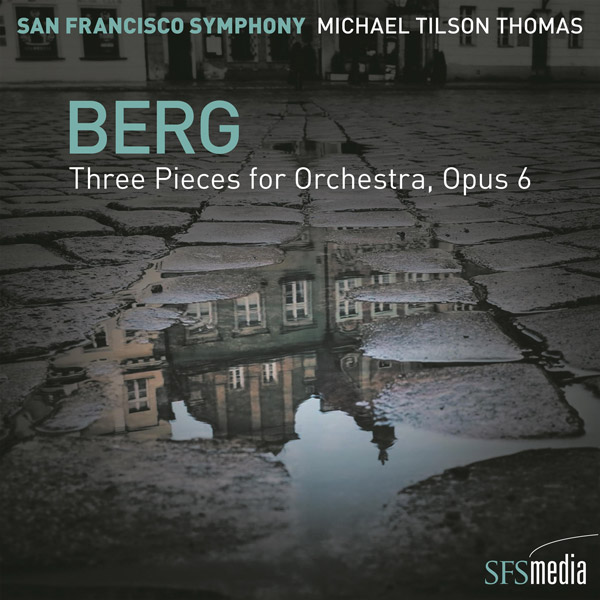
As the San Francisco Symphony's first download-only release–its next, Tchaikovsky's Symphony 6, will reach the Web in March, 2018–the 1929 revision of Berg's Three Orchestral Pieces is available for download in resolutions up to 24/192, and at prices commensurate with its length. Although the recording's soundstage is not as wide as I had expected, it is a sonic stunner. Producer Jack Vad, working closely with Music Director Michael Tilson Thomas, has captured a no-holds-barred intensity of clarity and brilliance that demands to be heard at symphonic volume levels or, if that is not possible, as loud as your system, space, housemates/partner, and neighbors will tolerate.
Both the music and music-making are extraordinary. The first movement (Prelude) starts softly, as though the terror is slowly advancing. Drumbeats, soft at first, and a disquieting melody of sorts that hints at days gone by lead to chords of devastation. Before long, we are immersed in one ominous, anything but holy racket. After a huge outburst, the music subsides into low rumbles and the final soft beat of a single drum.
The second movement, ironically titled Reigen (Round Dance): A little hesitant at first–Light and winged, begins mysteriously, with a semblance of melody. At times grotesque, in a manner that recalls Mahler and presages Shostakovich, it summoned forth, for this listener, images of a fiddler amidst the ruins.
Marsch (March) marks our major step into the void. Initially we may focus on a distant snare drum, or a lonely viola. But much too soon, we are again immersed in fighting and strife. As percussion and brass sound the alarm, you can feel people dying and edifices crumbling. The sound is horrible beyond belief, yet compellingly beautiful in its carefully structured depiction of disorder.
As combat accelerates, the drums go wild. For a short moment, the strife seems to subside. But then, the trumpets cry louder, the drums recommence, and smoke seems to rise from the landscape. At 8:55, the pace further accelerates. Are the troops in retreat, or are they surging forward? Have so many died that all we can hear is a solitary bird, singing in the charred remains of a forest? The sounds of the Vienna of old are heard briefly before the final, terrible resurgence. Never before has the reality of war been conveyed with such honesty. The work's ending is tremendous, thunderous, and inescapable in its finality. Either you must sit in dumb silence or cheer.
For music lovers accustomed to hearing the Kingdom of the Gods (Wagner's Valhalla) or the Kings of Europe (Verdi) expire in grand surges of melody, Berg's 102-year old masterpiece remains deeply unsettling. That's the point. Berg had no interest in the equivalent of Reality TV shows or fake news. Instead, he insisted on conveying the uncensored truth in purely musical terms.
The old is coming around once more. It sounds like this.















