

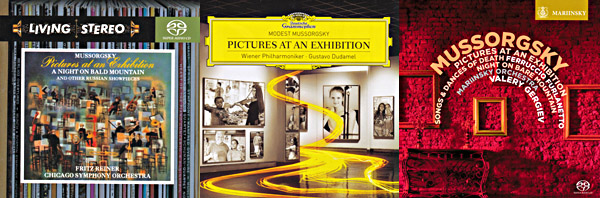
What better way to say goodbye to 2016 than to pop the champagne and blast your way through to the Trump Years with the latest version of a double-whammy warhorse pairing, Mussorgsky's Pictures at an Exhibition and Night on Bald Mountain, from Gustavo Dudamel and the Vienna Philharmonic (Deutsche Grammophon)? After all, there's no getting around the fact that fireworks are fireworks, and that New Year's Eve is a night for same.
Dudamel's conducting of one of the world's greatest symphony orchestras certainly delivers the goods. Heard as a 24/96 download from HDTracks, which offers greater depth, a wider soundstage, and more image solidity and substance than the CD, the performances are colorful, lively, and engaging. Hall resonance is believable, and the emotional content and tempi are right on. Dudamel's lighter-weight "chaser," Tchaikovsky's 7-minute Waltz from Swan Lake, is a welcome bonus, and well-suited for sending you off to beddie-bye after the big pop.
But that's only part of the story. Arkivmusic.com, for example, has 107 audio and video listings for the Ravel orchestration of the work that Dudamel uses, and 154 versions for piano. Night on Bare Mountain, in turn, has 152. How does Dudamel's version compare with other notable hi-rez recordings of this music?
For comparison, I grabbed two other hi-rez recordings of the pairing: the hybrid SACD (Mariinsky) and 24/96 rendition from Valery Gergiev and the Mariinsky Orchestra, released in 2015, and the classic Fritz Reiner/Chicago Symphony Orchestra (RCA Victor/BMG/Sony) pairing from the late 1950s, which is still available as either an analog-to-DSD hybrid SACD or as either a DSD or 24/176.4–24/88.2 PCM download from HDTracks. Besides the fact that each recording has different pairings, with the Reiner the most generous in its bonuses, there are huge differences in sound quality and interpretation.
What Dudamel lacks that both Gergiev and Reiner have in spades is knockout weight in the bass. I don't know to what extent this may be due to the historic timpani of the Vienna Philharmonic, which I believe even have different material on their drumheads, or to the way different sound engineers approach different halls, but there's no getting around the fact that Gergiev and Reiner score major points on the deep end.
Equally uncontestable is that Dudamel's tempi, which are the fastest of the lot in Pictures, and midway between Reiner and Gergiev's on Mountain, are as exciting as Reiner's. Gergiev, on the other hand, comes across as lumbering in places, and smiling in none. In Pictures, his "Il Vecchio Castello" seems overly somber and, frankly, a bit boring. There's not enough delight in "Tuileries [Dispute d'enfants après jeux]," and a distinct lack of scamper in "Ballet des poussins dans leurs coques."
Even Gergiev's final "The Great Gate of Kiev"—that's the one that the most unbridled amongst us will want to play with windows open wide and dogs howling—may be big and bright—the brightest of the three, really, as well as the bassiest—but it also sounds too monumental, like one of those statues that embodies the dreary bottom line of Socialist Realism. Do we really need to think of tanks rolling into Red Square as we ponder the impending Trump-Putin Global Alliance?
The darker and more dismal the music is, the more Gergiev shines. Which is not necessarily what you're seeking on New Year's Eve as you blast the system while the ball falls in Times Square. That is, unless you're my mother, who devoted choice chunks of New Year's Eve and Day to bemoaning the past year's deaths of friends and loved ones. You could always count on her for an upper.
It should also be noted that Gergiev seems to have chosen a different version of Mountain—he translates it as Night on Bare Mountain—than the other men. Truth be told, it falls a bit flat. In the end, I'm as drawn to Dudamel's way with tenderness as I am to his and Reiner's hearty embrace of the rousing romp.
There is, however, one final, albeit somewhat extra-musical plus to Dudamel's performance. In the spirit of El Sistema, to whom he dedicated his first recording with the Vienna Philharmonic 10 years ago, he and the orchestra have again looked to the children who are our future. "In an increasingly polarized world characterized by intolerance and unrest, we as artists feel a renewed obligation to share the values expressed by music as a means for bridging social, political, cultural, generational and economic disparities," he writes in the otherwise minimal liner notes. Working with Superar, an organization in Vienna's underprivileged 10th district that provides free music lessons to about 900 kids from diverse ethnic and cultural backgrounds, Dudamel and the Vienna Phil encouraged the kids to take their instruments into the streets of Vienna and creating their own exhibitions of photographs "every bit as playful and imaginative as Mussorgsky's animations of Viktor Hartmann's original paintings." How cool is that?
Hey, if you're a devoted audiophile, you probably already own the Reiner in multiple LP pressings and masterings, as well as in various CD, SACD, download, and maybe even master tape versions. High time to give Dudamel a try.















