

How Music Works
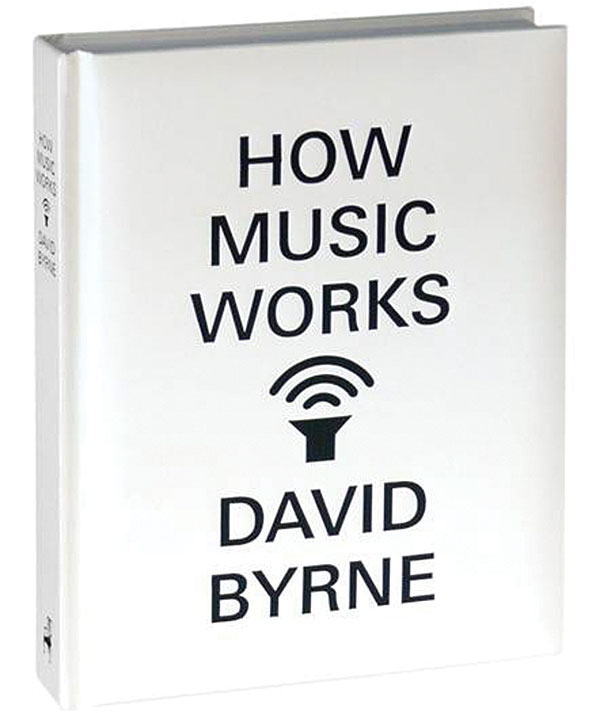
by David Byrne. 352 pages. San Francisco: McSweeney's, 2012. Hardcover, $32. Measuring 7.1" by 1.6" by 9.1" and with an attractive paper-over-board cover, [Talking Heads founder] David Byrne's boldly titled new book resembles the textbooks often found in public-school classrooms. If not for the author's brief lapses into street talk—he uses the word shit just a bit too freely for the youngest readers—one gets the impression that Byrne wouldn't mind having his book taught in elementary school. He quotes from Oliver Sacks's brilliant Musicophilia: "For the vast majority of students, music can be every bit as important educationally as reading or writing." At his best, Byrne writes in a smooth, easy, conversational tone, and supports his ideas with anecdotes from his own career. As such, the book is as much a series of essays as it is an autobiography, and it begins with the time-tested passion and clear-eyed focus you'd expect from someone who's devoted his entire life to making and exploring music. In the book's first several pages, Byrne makes such good sense. "How music works, or doesn't work," he writes, "is determined not just by what it is in isolation . . . but in large part by what surrounds it, where you hear it and when you hear it. How it's performed, how it's sold and distributed, how it's recorded, who performs it, whom you hear it with, and, of course, finally, what it sounds like: these are the things that determine not only if a piece of music works . . . but what it is."
Byrne dismisses the notion that great art emerges from uncontrollable creative urges, and instead argues that artists, unconsciously and instinctively, make their work fit preexisting formats. He writes, "It seems that creativity, whether birdsong, painting, or songwriting, is as adaptive as anything else. Genius—the emergence of a truly remarkable and memorable work—seems to appear when a thing is perfectly suited to its context."
It's strange, then, that Byrne and his editors didn't apply the same thinking to this book. How Music Works lacks overall coherence and vision; it would have benefited from more aggressive editing and a more thoroughly considered structure. There are far too many obvious typos, and worse, there are far too many unsupported ideas, too many loose ends. Had the book been subtitled Assorted Thoughts and Anecdotes, for instance, or maybe even Speaking in Tongues, the reader would have been better prepared for the sometimes fruitless journey, and the author could be forgiven his meandering. As it stands, reading How Music Works is almost like attending a hard-rock performance in a classical-music venue: It feels exciting and even slightly dangerous, but it's also remarkably imperfect and, at times, way too messy. And that's a shame, because when Byrne is at his best, he's got some really interesting ideas.
Musicians, in particular, will find inspiration, encouragement, and wisdom in Byrne's discussions of collaborative songwriting, distribution models, and building a thriving music scene. He outlines costs, provides guidelines, and effectively demonstrates that there's still money to be made in the music industry: "A life in music . . . is indeed still possible."
Certain audiophiles, however, will cringe when Byrne admits to getting rid of his CDs and LPs in favor of MP3s—for the most part, he listens to music on his computer or phone. But while Byrne appreciates the allure of physical media, he hopes its obsolescence will have a benefit: As music becomes more ephemeral, perhaps listeners will again assign greater value to live performance. Further, Byrne muses, "I can be moved to tears by a truly awful recording or a bad copy of a good recording. Would I be moved even more if the quality were higher? I doubt it. So why bother?" Finally, Byrne wonders if "the fuzziness and ambiguity inherent in low-quality signals" actually helps to produce a greater bond between the music and the listener: "an intimacy and involvement becomes possible that perfection might have kept at bay."
Listening intently may not be all it's cracked up to be. Byrne sees greater value in music freed from the rock club or concert hall, allowed to exist "as a constant element in the world, rather than as a finite recording or performance." In turn, the listener can come and go as he or she pleases, and can even become a part of the music. In 2005, Byrne presented Playing the Building, an interactive sound installation that successfully transformed an old warehouse into an instrument: girders as strings, columns as gongs, plumbing as flutes, and so on.
But Byrne is unable to maintain his fiery, provocative pace, and is, alarmingly often, surprised by his own ideas. On p.155, almost halfway through the book, he practically stumbles into an interesting thought: "We don't make music—it makes us. Which is maybe the point of this whole book."
Maybe? Well, is it or isn't it? And, if it is, why did you wait so long to tell us?
Ultimately, How Music Works does more to describe how its author works than to uncover music's peculiar methods; and while the book can be enjoyed if read straight through from beginning to end, casual browsing offers greater rewards: Pick a page and stumble, with Byrne, on one of his many provocative insights.
Just don't expect to learn how music really works. That remains a wonder—same as it ever was, same as it ever was.
by David Byrne. 352 pages. San Francisco: McSweeney's, 2012. Hardcover, $32. Measuring 7.1" by 1.6" by 9.1" and with an attractive paper-over-board cover, [Talking Heads founder] David Byrne's boldly titled new book resembles the textbooks often found in public-school classrooms. If not for the author's brief lapses into street talk—he uses the word shit just a bit too freely for the youngest readers—one gets the impression that Byrne wouldn't mind having his book taught in elementary school. He quotes from Oliver Sacks's brilliant Musicophilia: "For the vast majority of students, music can be every bit as important educationally as reading or writing." At his best, Byrne writes in a smooth, easy, conversational tone, and supports his ideas with anecdotes from his own career. As such, the book is as much a series of essays as it is an autobiography, and it begins with the time-tested passion and clear-eyed focus you'd expect from someone who's devoted his entire life to making and exploring music. In the book's first several pages, Byrne makes such good sense. "How music works, or doesn't work," he writes, "is determined not just by what it is in isolation . . . but in large part by what surrounds it, where you hear it and when you hear it. How it's performed, how it's sold and distributed, how it's recorded, who performs it, whom you hear it with, and, of course, finally, what it sounds like: these are the things that determine not only if a piece of music works . . . but what it is."















