

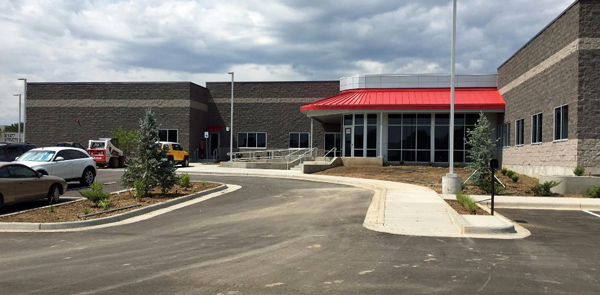
"Our production line was stepping on its own toes," said Boulder Amplifiers' Rich Maez, Director of Sales and Marketing, as he welcomed me into the company's new, massive 23,000 sq. ft. manufacturing and testing plant in Louisville, CO. The move to a huge, brand-new building on 3 acres of land outside Boulder, in an area devoted to light industry, was greeted with sighs of relief by a team that had formerly found itself squeezed into an increasingly over-packed 10,000 sq. ft. facility.
The company was lucky to find the land when it did. It seems that there is almost no warehousing space left in Denver due to legal marijuana-grow operations. Only the prairie dogs who frequent the fields not yet covered by industrial buildings are complaining.
 Boulder Amplifiers, whose product line now includes preamplifiers and digital products, was founded in 1984 as a pro gear manufacturing company. The focus remained on broadcasting and studio recording gear until the mid-1990s.
 "Because we started in the pro industry, we learned the hard way," company founder, President, and chief analog designer Jeff Nelson (above) explained. "Your gear will never be used again if it destroys a recording."
After starting by selling product in Asia, where it was easiest to gain a foothold, Nelson began expanding to the rest of the world. In 1996, Boulder issued its first digital product, the 2020 D/A converter. Its latest digital release, the 2120 D/A converter, came out in October of 2015. The housings for these products are made in Boulder's own metal shop.
Although the tour was quite extensive, there was one space that I was not allowed to enter: the "Skunkworks," where products still under development (as in the 3010 preamp, due early in 2017) are kept from view. But I did learn about many of the existing products in the Boulder line. That includes the 3000 series monoblock amplifiers, which are 368 lb behemoths that come complete with separate, 75 lb granite bases.
Maez explained that after Boulder issued their 2010 series, they had intended to stop there. "We don't have a set timeline for when we replace products," I was told. "When we can make an improvement, we will." But their dealers, who were in contact with high-end buyers who wanted company to take the next step, secretly began taking deposits for what they hoped would be 3000 series amplifiers. When they had accrued sufficient deposits to present a convincing argument, the dealers went ahead with their proposal, and the company listened.
The 3050 mono amplifiers came along four years ago, with the 3060 stereo power amplifier following a year later. The as yet unseen but widely anticipated 3010 preamp will be their mate.
"We needed special lifters for the 3050 monoblocks that we had to make ourselves," said Maez. "But we couldn't find stands that could hold them. That's why we supply the granite bases."
"Because we started in the pro industry, we learned the hard way," company founder, President, and chief analog designer Jeff Nelson (above) explained. "Your gear will never be used again if it destroys a recording."
After starting by selling product in Asia, where it was easiest to gain a foothold, Nelson began expanding to the rest of the world. In 1996, Boulder issued its first digital product, the 2020 D/A converter. Its latest digital release, the 2120 D/A converter, came out in October of 2015. The housings for these products are made in Boulder's own metal shop.
Although the tour was quite extensive, there was one space that I was not allowed to enter: the "Skunkworks," where products still under development (as in the 3010 preamp, due early in 2017) are kept from view. But I did learn about many of the existing products in the Boulder line. That includes the 3000 series monoblock amplifiers, which are 368 lb behemoths that come complete with separate, 75 lb granite bases.
Maez explained that after Boulder issued their 2010 series, they had intended to stop there. "We don't have a set timeline for when we replace products," I was told. "When we can make an improvement, we will." But their dealers, who were in contact with high-end buyers who wanted company to take the next step, secretly began taking deposits for what they hoped would be 3000 series amplifiers. When they had accrued sufficient deposits to present a convincing argument, the dealers went ahead with their proposal, and the company listened.
The 3050 mono amplifiers came along four years ago, with the 3060 stereo power amplifier following a year later. The as yet unseen but widely anticipated 3010 preamp will be their mate.
"We needed special lifters for the 3050 monoblocks that we had to make ourselves," said Maez. "But we couldn't find stands that could hold them. That's why we supply the granite bases."
 Nelson explained that the company now owns four Computer Numeric Control (CNC) machines of various sizes, whose hardware and software constantly improves. "We brought them in as an act of self-defense, because we couldn't achieve the same quality from outside companies as we do in-house," he said. "We can hold tolerances tight by doing the work ourselves. We're one of two companies that Vertec, which does excellent metalwork for many companies in the High End, doesn't bother to approach, because they know we do the work so well on our own."
 Moving on, we next we visited the Blast Chamber. There, Ron Sanders was blasting glass beads onto a model 2160 amplifier heatsink to achieve the finish for which Boulder's housings are known. Anodizing with "nasty chemicals" is done in Denver.
 Next, the "Pick and Place machine," at a cost of $150,000, that uses a vacuum to pick parts up and place them on circuit boards. Boulder, which began using PC boards with surface mounts in 1999, initially had the boards assembled elsewhere. But when those outside establishments began to value quantity over all else, the company shifted to in-house assembly. "We bought the machine as an act of self-defense, to ensure quality," Nelson said.
 After viewing reels of parts and the screens used to create different boards, we moved on to the huge Assembly room. "Everything we can is made in America, including the toroidal transformers," Nelson said. All new models will have Ethernet connections."
 In the Testing Room, one worker was matching resistors. Everything that Boulder manufactures is tested in-house, including transformers and individual components. Nelson stressed that the company's concern for quality is so great that they had to build their own test equipment.
Chatting with Jeff Nelson
In the Testing Room, one worker was matching resistors. Everything that Boulder manufactures is tested in-house, including transformers and individual components. Nelson stressed that the company's concern for quality is so great that they had to build their own test equipment.
Chatting with Jeff Nelson
Before I entered Boulder's huge listening room, Nelson and I sat down for a little chat. It was then I learned that Nelson sang and played keyboards until he discovered that he preferred to spend his time designing equipment. He built his first amp in high school, and has been at it ever since.
Work in the motion picture industry, and then in electronics in Phoenix followed. While spending three years running a recording studio, he found himself most interested in checking out the new equipment.
In the mid 1970s, the owner of Pacific Recorders, who built the best recorders for radio stations, engaged Nelson to develop a broadcast-quality, all-analog cartridge recorder that used a microprocessor and computer. From this assignment was born the Tomcat, which was is use from 1980 through the 1990s.
After Nelson meet Deane Jensen of Jensen Transformers, Jensen became his mentor. While Nelson was working on a power amp, Jensen introduced him to recording engineers all over the country and beyond. Then, in 1982, Jensen helped him get his power amp out to studios (footnote 1).
"People liked what I was doing," Nelson reported. "I brought to the table a bag of tricks from professionals in Southern California who really cared what music sounded like. They weren't all my ideas, but I would parse them and make them work. Soon I had built a 500-watt mono power amp that became quite popular in studios. People in Asia discovered us, and our business expanded organically from Japan to Hong Kong."
Boulder Amplifiers focused on manufacturing what Nelson called "less expensive products" until 1995, when they introduced the 2000 series. "People wanted bigger amps that looked nicer, and they were willing to pay for them," he said. "A bigger amplifier requires a stronger chassis. I'd rather mill a chassis from a solid aluminum block than cut a chassis from metal sheet, because the former is stronger."
"We are going to continue to press on with new products, even as we issue models at lower price points. What exactly that will entail, I have no idea. Right now, our plate is full."
Asked why he sticks to solid-state designs, Nelson declared that tubes sing along. "They add harmonics; they don't reveal them. They're like sitting down to a superb five-course dinner and then putting sugar over everything. That's not the case with solid-state if it's done right.
"My goal is neutrality and bass control rather than colorations, which are the product of distortions. That's why I go into the lab, where you can develop products whose measurements correspond with what you want to hear. When John Atkinson measured our 2110 preamp, he said it was as good as the Audio Precision gear he uses to measure.
"From the start, I did my own lab work, because I wanted to go into the lab and show people I could make it better. To some extent, I've done what I've wanted to do. I've shown I can do it better, and will continue to refine our designs."
 The Listening Room
Boulder's huge listening room measures approximately 28' x 22' x 14' at its longest, widest, and highest dimensions. Its foundation is independent from the rest of the building, and has its own poured concrete footers and piers that extend 30–35 feet down into bedrock. According to Maez, this isolates the room from factory noise and vibration, and keeps the sound of music within the room. The sound room is essentially a room within a room. Its inner walls rest on wooden studs that are built on the isolated foundation, while its outer walls affix to the main building's foundation via separate framing. Inner and outer walls never touch, not even in the doorway, where inner and outer doors are connected to the two different foundations. (Think a psychiatrist's office, only more obsessively built.) Inner walls are made of two layers of drywall, with a layer of green adhesive between them, which achieves constrained-layer damping. None of the inner walls are parallel, with the room tapering slightly from a wider front to a narrower rear, and the ceiling slopes down slightly towards the rear of the room. The rear wall is also broken by an angle, to ensure that it is not parallel to the front wall.
The ceiling is suspended via 18" joists. 12" of fiberglass insulation covers the ceiling, with acoustically transparent, suspended ceiling panels functioning as a whole-room bass trap. Walls have damping panels constructed of 2" thick, medium-density mineral wool. New dedicated damping panels were expected to arrive after my visit. I wanted to take a photo of the whole room, but my flash could not illuminate such a large space.
 The room's reference system is undoubtedly the envy of many an audiophile. How about a SOTA Sapphire Vacuum turntable (N/A), Boulder 2008 phono preamplifier (discontinued, was $38,000), Boulder 1021 network disc player ($24,000), Boulder 2120 D/A converter ($65,000), Boulder-built HP media server, Boulder 2110 preamplifier ($55,000), Boulder 3050 mono amplifiers (1500W/each, $215,000/pair,) Boulder 3060 stereo amplifier (900Wpc, $120,000), and Focal Grande Utopia EM loudspeakers ($180,000/pair at time of purchase).
When I visited, the room was still a work in progress, with more room treatment expected. Nonetheless, I noted that the system nailed the complexity of baritone Matthias Goerne's overtones and undertones—some people call those "micro-tonalities"—like few systems I've heard. I certainly have never experienced a better depiction of the reverberant acoustic around the voice of one of my favorite sopranos, Elly Ameling, on a disc of her singing Schubert in the mid 1970s.
As I went from track to track, and heard songs recorded in different venues at different times, differences in room acoustics were readily apparent. Although the inability of the Boulder network disc player to read the hi-rez layer of my Mahler hybrid SACD meant that ultimate dynamic contrasts were reduced, the dynamics on a CD of pianist Murray Perahia playing Handel were remarkable. The subtlest of changes in dynamics and expression—nuances that all but the best systems miss—were conveyed with breathtaking clarity.
The one thing I missed was the natural liveliness I experience in my own sound room. That liveliness, however, is not Boulder's goal. After the listening session, Nelson shared his intention to deaden the room even further. The reason is simple: his goal for the sound room is not pleasure per se, but rather the ability to hear exactly what Boulder's equipment can convey. The more the sound of the listening room is eliminated from the equation, the better can Nelson's team assess their achievement.
That achievement, without question, is more than laudable. It is stunning.
The room's reference system is undoubtedly the envy of many an audiophile. How about a SOTA Sapphire Vacuum turntable (N/A), Boulder 2008 phono preamplifier (discontinued, was $38,000), Boulder 1021 network disc player ($24,000), Boulder 2120 D/A converter ($65,000), Boulder-built HP media server, Boulder 2110 preamplifier ($55,000), Boulder 3050 mono amplifiers (1500W/each, $215,000/pair,) Boulder 3060 stereo amplifier (900Wpc, $120,000), and Focal Grande Utopia EM loudspeakers ($180,000/pair at time of purchase).
When I visited, the room was still a work in progress, with more room treatment expected. Nonetheless, I noted that the system nailed the complexity of baritone Matthias Goerne's overtones and undertones—some people call those "micro-tonalities"—like few systems I've heard. I certainly have never experienced a better depiction of the reverberant acoustic around the voice of one of my favorite sopranos, Elly Ameling, on a disc of her singing Schubert in the mid 1970s.
As I went from track to track, and heard songs recorded in different venues at different times, differences in room acoustics were readily apparent. Although the inability of the Boulder network disc player to read the hi-rez layer of my Mahler hybrid SACD meant that ultimate dynamic contrasts were reduced, the dynamics on a CD of pianist Murray Perahia playing Handel were remarkable. The subtlest of changes in dynamics and expression—nuances that all but the best systems miss—were conveyed with breathtaking clarity.
The one thing I missed was the natural liveliness I experience in my own sound room. That liveliness, however, is not Boulder's goal. After the listening session, Nelson shared his intention to deaden the room even further. The reason is simple: his goal for the sound room is not pleasure per se, but rather the ability to hear exactly what Boulder's equipment can convey. The more the sound of the listening room is eliminated from the equation, the better can Nelson's team assess their achievement.
That achievement, without question, is more than laudable. It is stunning.
Footnote 1: Dick Olsher reviewed the Boulder 500 amplifier for Stereophile in August 1986 and J. Gordon Holt reviewed the Boulder 500AE amplifier in October 1991, with follow-ups from Lewis Lipnick, Robert Harley, and Steven Stone.
Boulder Amplifiers, whose product line now includes preamplifiers and digital products, was founded in 1984 as a pro gear manufacturing company. The focus remained on broadcasting and studio recording gear until the mid-1990s.
"Because we started in the pro industry, we learned the hard way," company founder, President, and chief analog designer Jeff Nelson (above) explained. "Your gear will never be used again if it destroys a recording."
After starting by selling product in Asia, where it was easiest to gain a foothold, Nelson began expanding to the rest of the world. In 1996, Boulder issued its first digital product, the 2020 D/A converter. Its latest digital release, the 2120 D/A converter, came out in October of 2015. The housings for these products are made in Boulder's own metal shop.
Although the tour was quite extensive, there was one space that I was not allowed to enter: the "Skunkworks," where products still under development (as in the 3010 preamp, due early in 2017) are kept from view. But I did learn about many of the existing products in the Boulder line. That includes the 3000 series monoblock amplifiers, which are 368 lb behemoths that come complete with separate, 75 lb granite bases.
Nelson explained that the company now owns four Computer Numeric Control (CNC) machines of various sizes, whose hardware and software constantly improves. "We brought them in as an act of self-defense, because we couldn't achieve the same quality from outside companies as we do in-house," he said. "We can hold tolerances tight by doing the work ourselves. We're one of two companies that Vertec, which does excellent metalwork for many companies in the High End, doesn't bother to approach, because they know we do the work so well on our own."
Moving on, we next we visited the Blast Chamber. There, Ron Sanders was blasting glass beads onto a model 2160 amplifier heatsink to achieve the finish for which Boulder's housings are known. Anodizing with "nasty chemicals" is done in Denver.
Next, the "Pick and Place machine," at a cost of $150,000, that uses a vacuum to pick parts up and place them on circuit boards. Boulder, which began using PC boards with surface mounts in 1999, initially had the boards assembled elsewhere. But when those outside establishments began to value quantity over all else, the company shifted to in-house assembly. "We bought the machine as an act of self-defense, to ensure quality," Nelson said.
After viewing reels of parts and the screens used to create different boards, we moved on to the huge Assembly room. "Everything we can is made in America, including the toroidal transformers," Nelson said. All new models will have Ethernet connections."
In the Testing Room, one worker was matching resistors. Everything that Boulder manufactures is tested in-house, including transformers and individual components. Nelson stressed that the company's concern for quality is so great that they had to build their own test equipment.
Chatting with Jeff NelsonBefore I entered Boulder's huge listening room, Nelson and I sat down for a little chat. It was then I learned that Nelson sang and played keyboards until he discovered that he preferred to spend his time designing equipment. He built his first amp in high school, and has been at it ever since.
The Listening RoomBoulder's huge listening room measures approximately 28' x 22' x 14' at its longest, widest, and highest dimensions. Its foundation is independent from the rest of the building, and has its own poured concrete footers and piers that extend 30–35 feet down into bedrock. According to Maez, this isolates the room from factory noise and vibration, and keeps the sound of music within the room. The sound room is essentially a room within a room. Its inner walls rest on wooden studs that are built on the isolated foundation, while its outer walls affix to the main building's foundation via separate framing. Inner and outer walls never touch, not even in the doorway, where inner and outer doors are connected to the two different foundations. (Think a psychiatrist's office, only more obsessively built.) Inner walls are made of two layers of drywall, with a layer of green adhesive between them, which achieves constrained-layer damping. None of the inner walls are parallel, with the room tapering slightly from a wider front to a narrower rear, and the ceiling slopes down slightly towards the rear of the room. The rear wall is also broken by an angle, to ensure that it is not parallel to the front wall.
The room's reference system is undoubtedly the envy of many an audiophile. How about a SOTA Sapphire Vacuum turntable (N/A), Boulder 2008 phono preamplifier (discontinued, was $38,000), Boulder 1021 network disc player ($24,000), Boulder 2120 D/A converter ($65,000), Boulder-built HP media server, Boulder 2110 preamplifier ($55,000), Boulder 3050 mono amplifiers (1500W/each, $215,000/pair,) Boulder 3060 stereo amplifier (900Wpc, $120,000), and Focal Grande Utopia EM loudspeakers ($180,000/pair at time of purchase).
When I visited, the room was still a work in progress, with more room treatment expected. Nonetheless, I noted that the system nailed the complexity of baritone Matthias Goerne's overtones and undertones—some people call those "micro-tonalities"—like few systems I've heard. I certainly have never experienced a better depiction of the reverberant acoustic around the voice of one of my favorite sopranos, Elly Ameling, on a disc of her singing Schubert in the mid 1970s.
Footnote 1: Dick Olsher reviewed the Boulder 500 amplifier for Stereophile in August 1986 and J. Gordon Holt reviewed the Boulder 500AE amplifier in October 1991, with follow-ups from Lewis Lipnick, Robert Harley, and Steven Stone.















