

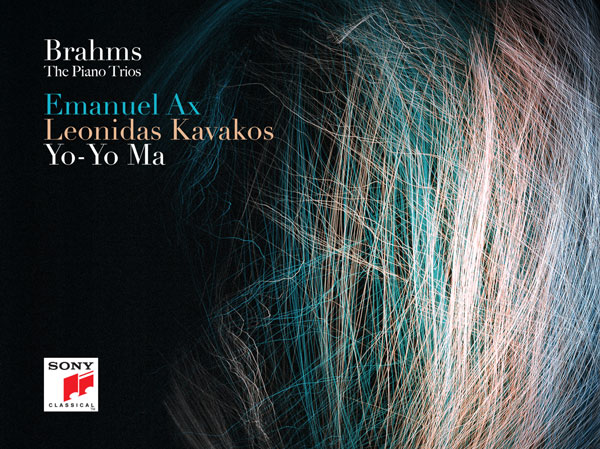
Overflowing with heart, Brahms' three Trios for violin, cello, and piano are amongst the most venerated chamber works in the literature. Completed over a span of 35 years, they reveal Brahms forever true to his love and longing. Again and again it surfaces, expressed through an irrepressible love for melody, Hungarian and gypsy sentiments, romance and drama that sings and sighs at its most vulnerable in this special, two-disc Sony recording of the Brahms Piano Trios from cellist Yo-Yo Ma, pianist Emanuel Ax, and violinist Leonidas Kavakos.
Surprising as it may seem, this seems to be the first time that Ma, age 62, and Ax, age 68, have recorded these works. Together with Kavakos—the young 'un at 50—their trio joins a historic lineage of great musicians on record that includes several iterations of the superb Beaux Arts Trio, and encompasses such illustrious couplings as Istomin Stern & Rose, Rubinstein, Fournier & Szeryng and, in recordings of one or more of the trios, Serkin, Busch & Busch.
As Ax points out in his succinct but telling liner notes, one reason the piano trios are so memorable is that the notoriously self-critical Brahms destroyed most of his chamber works. What survived is exemplary.
Brahms always waited until the time was right before composing, and frequently undertook extensive revision. A case in point is the Piano Trio No.1 in B, Op. 8, which is performed here (as is customary) in the revision Brahms completed 35 years after its initial publication in 1854—the year in which he turned 21. Overflowing with melody, the opening theme is so gorgeous that it can take your breath away. The only thing that may get to you more is the Adagio, which, like so many of Brahms' slower movements, leaves you feeling as though you know the great man's soul.
I auditioned the two-disc set in 24/96 WAV format, and came away feeling that while the tonalities of everyone's instruments was spot on, the recording would not win awards for either transparency or depth. But that matters little when three musicians begin the Piano Trio No.2 in C, Op. 87 with such a mixture of fire, sighs and longing as to suggest that the romantic spirit exemplified by Arthur Rubinstein and other great Brahmsians is alive and well. Many sections of the first movement of the second trio are indescribably beautiful, with contrasts between relaxed and animated passages highlighted to deepen the music's impact.
The sadness of the C major trio's second movement, Andante, is immediate, while the beauty of its middle section makes clear why Brahms has joined Bach and Beethoven as one of the most exalted composers since the Middle Ages. Ax, Ma, and Kavakos go all out in the Finale, bringing the trio to a rousing close.
Trio No.3 in c, Op.101 dates from 1887, when Brahms turned 54. The aching of Brahms' heart is immediately felt in the energetic opening Allegro. By contrast, the second movement includes some delightful scampering figures.
"Gorgeous" is a word I prefer to use sparingly, lest I sound too much like a group of my mother's friends talking about the beauties of one of their son's fiancés, but there's no other way to describe how Brahms expresses sadness with such tenderness in the third movement. The trio's conclusion is as triumphant as the musicianship.















