Cedille Records, the label of The Chicago Classical Recording Foundation, has just released its first three high-resolution FLAC downloads. Available in 24-bit/44.1kHz sampling rate format (as well as 16/44.1 and 256 kbps MP3), complete with accessible liner notes and cover art, the titles are a treasure-trove for classical aficionados and collectors.
First up is Winging It: Piano Music of John Corigliano. Performed by Ursula Oppens, who has achieved legendary status as a new music virtuoso, the CD includes the world premiere recording of Winging It (2008), which the Pulitzer Prize-winning Corigliano wrote for Oppens.
Even newer are Capricho Latino, a disc from violinist Rachel Barton Pine of rare Spanish and Latin American music written solely for the unaccompanied violin; and The Pulitzer Project, performed by the Grant Park Orchestra and Chorus under Carlos Kalmar and Chorus Director Christopher Bell. Pine's disc includes Alan Ridout's Ferdinand the Bull with narrator Héctor Elizondo, and 13 other works by composers familiar and obscure. You can sample a few of the tracks before purchasing.
The Pulitzer Project is a mind-blower, in that it contains world premiere recordings of Pulitzer Prize winning works by William Schuman and Leo Sowerby. Even though Schuman's Secular Cantata No. 2, "A Free Song," a setting of excerpts from Walt Whitman's Drum Taps, earned the very first Pulitzer Prize in Music in 1943, it somehow escaped being recorded until now. The same goes for Sowerby's The Canticle of the Sun, which received the Pulitzer Prize for Music in 1945. Aaron Copland's familiar Suite from Appalachian Spring, which belongs in every collection, completes the program.
Cedille Records, the label of The Chicago Classical Recording Foundation, has just released its first three high-resolution FLAC downloads. Available in 24-bit/44.1kHz sampling rate format (as well as 16/44.1 and 256 kbps MP3), complete with accessible liner notes and cover art, the titles are a treasure-trove for classical aficionados and collectors.
First up is Winging It: Piano Music of John Corigliano. Performed by Ursula Oppens, who has achieved legendary status as a new music virtuoso, the CD includes the world premiere recording of Winging It (2008), which the Pulitzer Prize-winning Corigliano wrote for Oppens.
Even newer are Capricho Latino, a disc from violinist Rachel Barton Pine of rare Spanish and Latin American music written solely for the unaccompanied violin; and The Pulitzer Project, performed by the Grant Park Orchestra and Chorus under Carlos Kalmar and Chorus Director Christopher Bell. Pine's disc includes Alan Ridout's Ferdinand the Bull with narrator Héctor Elizondo, and 13 other works by composers familiar and obscure. You can sample a few of the tracks before purchasing.
The Pulitzer Project is a mind-blower, in that it contains world premiere recordings of Pulitzer Prize winning works by William Schuman and Leo Sowerby. Even though Schuman's Secular Cantata No. 2, "A Free Song," a setting of excerpts from Walt Whitman's Drum Taps, earned the very first Pulitzer Prize in Music in 1943, it somehow escaped being recorded until now. The same goes for Sowerby's The Canticle of the Sun, which received the Pulitzer Prize for Music in 1945. Aaron Copland's familiar Suite from Appalachian Spring, which belongs in every collection, completes the program.
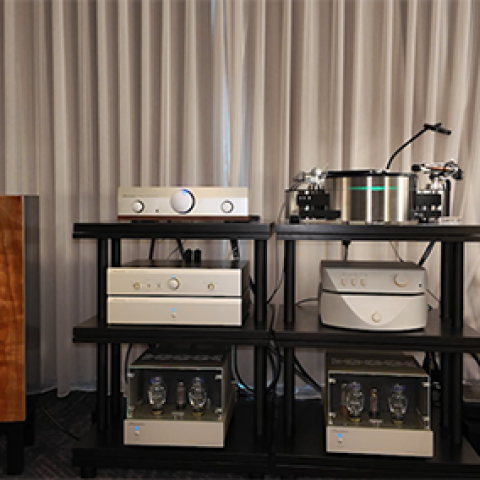
I confess that when I first received the press release touting Cedille's downloads as high-resolution, I considered them half-ass high-res. Wondering if they were worth the extra expense and download time—not that $12 for a 24-bit download or $10 for a full CD quality download is excessive—I shared my concerns with Stereophile editor John Atkinson. John's response was most practical: "Take a listen." First I used Max to burn both the solo piano title track and the two-piano rendition of Corigliano's Chiaroscuro from my CD copy of Winging It to a late model MacBook Pro running OS 10.6.7. Then, using Amarra 2.2 as the music server, and taking advantage of its "cache" (memory play) feature to liberate playback from the compromises of iTunes, I used Wavelength's Wavelink USB-to-S/PIDF converter box and Nordost's Blue Heaven USB and Odin BNC cables to send the signal to a Theta Gen. 8, Series II DAC (upgraded to 24/192 capability) supported by Magico QPods. Next I downloaded the same music in 24/44.1 format, played it back similarly, and went back and forth comparing. Amps were Pass Labs' beautiful-sounding XA100.5 class-A monoblocks, and speakers Eficion F300s equipped with Stillpoints, Nordost Odin jumpers, Stein Speaker Matches, and Bybee Golden Goddess Speaker Bullets. Extra fine-tuning was accomplished by carefully positioning Daisy Mae Doven, our 20 lb. Jack Russell mix, on the carpet.
I posed the question to Bill Maylone, Cedille's Recording engineer since the label's inception in 1989. Maylone began with some sad history. While Cedille began recording all sessions in 24/44.1 format some 11 or 12 years ago, at a time when CDs were all there was (short of vinyl, which some consider very short indeed), they never preserved the 24/44.1 masters once they had converted the material to 16-bit Red Book format. Hence only Cedille's most recent recordings have been preserved in 24-bit format. Even when Cedille began recording in 24-bit, it kept the sample rate at 44.1 kHz. By way of explanation, Maylone states, "You will eventually have to sample-rate-convert it to 44.1 kHz to make the CD. Once you do this, it will sound no different than a recording that was originally made at 44.1 and kept that way through the production process... Because of this, we have typically mastered everything at 44.1 kHz."