

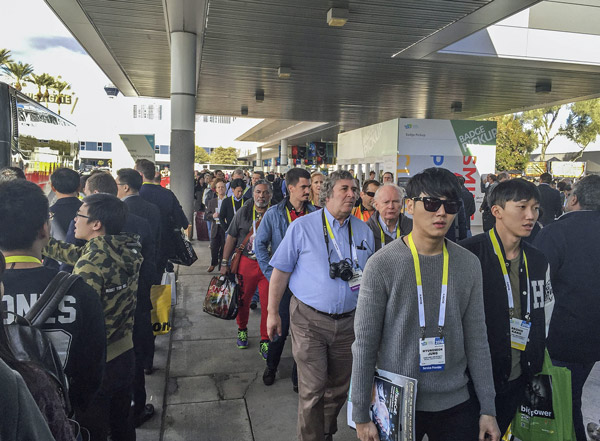
See that huge line? It's a small indication of the huge, multi-national, multi-industry group of CES attendees whose numbers—170,000, if the former CEA (Consumer Electronics Association), now CTA (Consumer Technology Association) counts accurately—set new attendance records.
There's just one thing. That line was not at the Venetian Hotel, where all but a few of what CES dubs the "high-performance audio" exhibits were staged. Instead, it was at the Las Vegas Convention Center. Just about everyone you see had no idea that the High End of the audio industry was holding forth on floors 29, 30, 34, and 35 of the Venetian, because virtually all PR, including the multipage "CES 2016 Attendee Guide" that they received in the mail, failed to mention our existence.
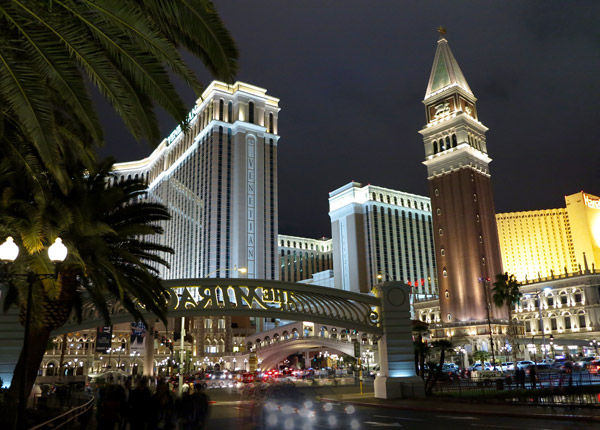 Does that mean that the high-end held forth alone? Not quite. Imagine the surprise—shock, if I may—of discovering, scattered amongst the high-end audio exhibits on both sides of the Venetian Tower's long hallways, a fair number of technology companies. On some hallways, there was an entire block of a dozen or more meeting rooms, completely unrelated to audio.
It wasn't exactly "Where Have All the Flowers Gone," but you get the picture. The high-end companies that did exhibit were as committed as in years past. But there were less of them, far less than before.
Their absence is certainly not due to a declining interest in music. It's a safe bet that a huge number of attendees arrived with tablets, phones, computers, and portable players that held their digital music collections. Many of them returned home to listen to music, increasingly turning to vinyl as well as digital sources. In their spare time—even at work—they share their favorite tracks and videos, get together to listen, and fill the soundtrack of their lives with music. No matter what anyone may say, music is alive to more people than ever in the United States and abroad.
Nonetheless, despite the fact that growing numbers of young American listeners are turning to vinyl and CD quality/hi-rez download and streaming services, most of them are about as aware of what the High End can achieve with sound as Graham Nash was before Jon Iverson made the brilliant move to invite him to CES. How to reach these newbies of all ages with what we have to offer is, as we all know, an uphill climb. Nonetheless, high-end turntable manufacturers at all price points will tell you that business is booming. Check the record pressing plants, and you'll discover a bigger resurgence of vintage and new music vinyl issues than almost anyone other than Michael Fremer ever imagined would be possible at this point in time. No matter who did or did not attend the high-end exhibits in Las Vegas, our industry is beginning to find ways to embrace entire new generations of music lovers who have yet to discover their audiophile nature.
Back to those numbers. The numbers game also affected Stereophile's blogging crew. With one blogger less this time around, we made some hard choices. Doing our best to restrict ourselves to newly introduced or upgraded products, Herb Reichert covered budget gear; Jon Iverson digital; Larry Greenhill mid-price electronics and subwoofers; Bob Deutsch mid-price loudspeakers and turntables; Jason Victor Serinus high-priced and cost-no-object loudspeakers, electronics, and occasionally turntables; and John Atkinson wherever curiosity, obligations, and love for audio and music took him.
For the first time in my memory, cables and accessories, which have usually been my purview, had to be skipped due to time constraints. We deeply regretted this decision. But with a limited number of people, one can do only so much. To those companies who wondered where Jason had gone, I'll do my best to cover you at the next show. Promise.
Skipped by Stereophile as well were most headphone products, which we left for Tyll Hertsens's coverage on InnerFidelity.com. Ditto for turntables, tonearms, and cartridges, which were left to Michael Fremer and AnalogPlanet.com. Kal Rubinson explored multi-channel offerings, and will share his observations in his bimonthly "Music in the Round" column in Stereophile. And whatever computer-based/server-based/desktop / streaming products we could not get to, Michael Lavorgna covered for AudioStream.com and his "Audio Streams" column in Stereophile.
The quality of our collective coverage, I believe, speaks for itself. Each of us has his own voice and style. Except when he accompanied the wonderful Graham Nash, who clearly lit up every room he visited with his spirit and openness to receive, Jon Iverson tends to stick with the facts and reserve comments on sound to future reviews. Herb Reichert, on the other hand, makes most stops on his journey into poetic adventures, mixing visual and verbal art with the audible. And so it goes.
Does that mean that the high-end held forth alone? Not quite. Imagine the surprise—shock, if I may—of discovering, scattered amongst the high-end audio exhibits on both sides of the Venetian Tower's long hallways, a fair number of technology companies. On some hallways, there was an entire block of a dozen or more meeting rooms, completely unrelated to audio.
It wasn't exactly "Where Have All the Flowers Gone," but you get the picture. The high-end companies that did exhibit were as committed as in years past. But there were less of them, far less than before.
Their absence is certainly not due to a declining interest in music. It's a safe bet that a huge number of attendees arrived with tablets, phones, computers, and portable players that held their digital music collections. Many of them returned home to listen to music, increasingly turning to vinyl as well as digital sources. In their spare time—even at work—they share their favorite tracks and videos, get together to listen, and fill the soundtrack of their lives with music. No matter what anyone may say, music is alive to more people than ever in the United States and abroad.
Nonetheless, despite the fact that growing numbers of young American listeners are turning to vinyl and CD quality/hi-rez download and streaming services, most of them are about as aware of what the High End can achieve with sound as Graham Nash was before Jon Iverson made the brilliant move to invite him to CES. How to reach these newbies of all ages with what we have to offer is, as we all know, an uphill climb. Nonetheless, high-end turntable manufacturers at all price points will tell you that business is booming. Check the record pressing plants, and you'll discover a bigger resurgence of vintage and new music vinyl issues than almost anyone other than Michael Fremer ever imagined would be possible at this point in time. No matter who did or did not attend the high-end exhibits in Las Vegas, our industry is beginning to find ways to embrace entire new generations of music lovers who have yet to discover their audiophile nature.
Back to those numbers. The numbers game also affected Stereophile's blogging crew. With one blogger less this time around, we made some hard choices. Doing our best to restrict ourselves to newly introduced or upgraded products, Herb Reichert covered budget gear; Jon Iverson digital; Larry Greenhill mid-price electronics and subwoofers; Bob Deutsch mid-price loudspeakers and turntables; Jason Victor Serinus high-priced and cost-no-object loudspeakers, electronics, and occasionally turntables; and John Atkinson wherever curiosity, obligations, and love for audio and music took him.
For the first time in my memory, cables and accessories, which have usually been my purview, had to be skipped due to time constraints. We deeply regretted this decision. But with a limited number of people, one can do only so much. To those companies who wondered where Jason had gone, I'll do my best to cover you at the next show. Promise.
Skipped by Stereophile as well were most headphone products, which we left for Tyll Hertsens's coverage on InnerFidelity.com. Ditto for turntables, tonearms, and cartridges, which were left to Michael Fremer and AnalogPlanet.com. Kal Rubinson explored multi-channel offerings, and will share his observations in his bimonthly "Music in the Round" column in Stereophile. And whatever computer-based/server-based/desktop / streaming products we could not get to, Michael Lavorgna covered for AudioStream.com and his "Audio Streams" column in Stereophile.
The quality of our collective coverage, I believe, speaks for itself. Each of us has his own voice and style. Except when he accompanied the wonderful Graham Nash, who clearly lit up every room he visited with his spirit and openness to receive, Jon Iverson tends to stick with the facts and reserve comments on sound to future reviews. Herb Reichert, on the other hand, makes most stops on his journey into poetic adventures, mixing visual and verbal art with the audible. And so it goes.
 Before filing this "show wrap," I asked each member of the larger Stereophile team to share his "best of" observations. With a fond adieu until next time, here they are:
Michael Fremer: Best sound: Big Lamm room—Kharma Exquisite Midi Grand speakers, Lamm ML-3 Signature amps, etc.
Most startling, earth-shifting presentation: Bruno Putzeys' compact, stand-mounted Kii Three speakers powered internally by his class-D amp modules—one amp and one DAC per driver (six in all). Deep bass into the mid 30Hz region, sweet, extended highs. $13,900/pair. Amazing.
Second most startling, earth shattering presentation: Andrew Jones's new 3-way, $500/pair ELAC "Mini-TAD" bookshelf speaker featuring a concentric midrange/tweeter. Now young people will have to learn proper speaker placement so prodigious is the bass response.
Finally Digital I Can Dig: "Digititis" was not an invention of "Luddite" analog fans, but a quantifiable, identifiable sonic disease that the MQA process can cure, regardless of the patient's age.
Herb Reichert: 1) PrimaLuna's Kevin Deal played selections from Neil Young's "Live at Massey Hall" double LP. Mr. Deal was powering the beautiful Sonus Faber Amati Futuras ($36,000/pair) with Dialogue Premium KT120/150 amps ($3899 stereo/$7798 mono), and the Dialogue Premium preamp ($3199). He had the ferocious VPI Avenger turntable ($9500) equipped with one of my all-time favorite cartridges: the Kiseki PurpleHeart ($3499) feeding the renowned Manley Steelhead phono stage ($8500).
What can I say? "The warmth of tubes"???? Forget that ridiculousness. This system did small-scale and micro-dynamic information like almost nothing I can remember. The best I can say is; "Midrange, midrange, midrange!" Color and detail out the yin-yang. Extremely not warm or cool. Until Pono, I was never a giant Neil Yong fan—but I am now. Young's voice was pristinely sweet and present. This system gets my vote for Best Sound among the "budget" (cough cough) systems I heard at CES.
2) The new Spendor Audio Systems SP200 loudspeakers ($24,995/pair) are clearly not in my assigned "Budget: Under $5k" territory—they are in Jason's "Cost No Object" realm. So what? These 87dB-sensitive beauties are my nomination for Best Loudspeaker at CES. Call me old fashioned, but these substantial wood-box old school British designs did it all. If I had to retire with only one loudspeaker . . . This Spendor would surely be it!
Michael Lavorgna: The biggest word in computer and digital audio replay at CES 2016 was "-Ready." Roon-Ready and MQA-Ready products captured the most attention mainly because Roon makes file-based playback much better in terms of interfacing with stored and streamed music libraries and MQA makes digital music sound much, much better.
My personal favorite rooms for listening to and enjoying music included DeVore Fidelity featuring the wonderful totaldac and the DeVore gibbon Xs which I have in-barn further, and which was further enhanced by sitting next to Graham Nash; the MSB room, which sounded simply stunning; and the Bluesound/MQA demo of The Doors' "Riders on the Storm", a song I've been listening to for nearly 40 years. This was the best-sounding digital version I've ever heard by a very long shot, played back through a $1199 server/DAC/MQA decoder (and cheap interconnects!).
Jon Iverson: 1) MQA is obviously of interest to audiophiles and a very impressive technology. I had a discussion with one of the engineers about challenges on the supply side, which includes music production and mastering. Recording industry adoption of MQA will be key I think, since the public is not exactly clamoring for better offerings because they don't sound "good enough."
Human behavior on the mass-market level will likely dictate how something like this rolls out, and if the supply of music includes MQA going forward, they'll have a shot. In other words, I think wide availability of MQA-endowed albums is more likely to attract consumers to the format, who will then start to buy equipment with decoders, than the idea that consumer demand for buying MQA optioned decoders will encourage the labels to finally adopt it. Hope it works either way though!
2) All-in-one digital streaming solutions have caught on in a big way with the mass market, Sonos being the prime example. To see several companies come up with high-end, Sonos-like products seems a no brainer. They'll just have to prove why they cost more for the same basic functionality.
3) Roon-Ready illuminated signs appeared in several rooms at CES. This is a development I whole-heartedly support, simply because I think using Roon is better for music. If manufacturers stick to hardware and recognize that Roon leapfrogged everyone on the software side, the consumer will win all over, and everyone will have much more fun with music.
Before filing this "show wrap," I asked each member of the larger Stereophile team to share his "best of" observations. With a fond adieu until next time, here they are:
Michael Fremer: Best sound: Big Lamm room—Kharma Exquisite Midi Grand speakers, Lamm ML-3 Signature amps, etc.
Most startling, earth-shifting presentation: Bruno Putzeys' compact, stand-mounted Kii Three speakers powered internally by his class-D amp modules—one amp and one DAC per driver (six in all). Deep bass into the mid 30Hz region, sweet, extended highs. $13,900/pair. Amazing.
Second most startling, earth shattering presentation: Andrew Jones's new 3-way, $500/pair ELAC "Mini-TAD" bookshelf speaker featuring a concentric midrange/tweeter. Now young people will have to learn proper speaker placement so prodigious is the bass response.
Finally Digital I Can Dig: "Digititis" was not an invention of "Luddite" analog fans, but a quantifiable, identifiable sonic disease that the MQA process can cure, regardless of the patient's age.
Herb Reichert: 1) PrimaLuna's Kevin Deal played selections from Neil Young's "Live at Massey Hall" double LP. Mr. Deal was powering the beautiful Sonus Faber Amati Futuras ($36,000/pair) with Dialogue Premium KT120/150 amps ($3899 stereo/$7798 mono), and the Dialogue Premium preamp ($3199). He had the ferocious VPI Avenger turntable ($9500) equipped with one of my all-time favorite cartridges: the Kiseki PurpleHeart ($3499) feeding the renowned Manley Steelhead phono stage ($8500).
What can I say? "The warmth of tubes"???? Forget that ridiculousness. This system did small-scale and micro-dynamic information like almost nothing I can remember. The best I can say is; "Midrange, midrange, midrange!" Color and detail out the yin-yang. Extremely not warm or cool. Until Pono, I was never a giant Neil Yong fan—but I am now. Young's voice was pristinely sweet and present. This system gets my vote for Best Sound among the "budget" (cough cough) systems I heard at CES.
2) The new Spendor Audio Systems SP200 loudspeakers ($24,995/pair) are clearly not in my assigned "Budget: Under $5k" territory—they are in Jason's "Cost No Object" realm. So what? These 87dB-sensitive beauties are my nomination for Best Loudspeaker at CES. Call me old fashioned, but these substantial wood-box old school British designs did it all. If I had to retire with only one loudspeaker . . . This Spendor would surely be it!
Michael Lavorgna: The biggest word in computer and digital audio replay at CES 2016 was "-Ready." Roon-Ready and MQA-Ready products captured the most attention mainly because Roon makes file-based playback much better in terms of interfacing with stored and streamed music libraries and MQA makes digital music sound much, much better.
My personal favorite rooms for listening to and enjoying music included DeVore Fidelity featuring the wonderful totaldac and the DeVore gibbon Xs which I have in-barn further, and which was further enhanced by sitting next to Graham Nash; the MSB room, which sounded simply stunning; and the Bluesound/MQA demo of The Doors' "Riders on the Storm", a song I've been listening to for nearly 40 years. This was the best-sounding digital version I've ever heard by a very long shot, played back through a $1199 server/DAC/MQA decoder (and cheap interconnects!).
Jon Iverson: 1) MQA is obviously of interest to audiophiles and a very impressive technology. I had a discussion with one of the engineers about challenges on the supply side, which includes music production and mastering. Recording industry adoption of MQA will be key I think, since the public is not exactly clamoring for better offerings because they don't sound "good enough."
Human behavior on the mass-market level will likely dictate how something like this rolls out, and if the supply of music includes MQA going forward, they'll have a shot. In other words, I think wide availability of MQA-endowed albums is more likely to attract consumers to the format, who will then start to buy equipment with decoders, than the idea that consumer demand for buying MQA optioned decoders will encourage the labels to finally adopt it. Hope it works either way though!
2) All-in-one digital streaming solutions have caught on in a big way with the mass market, Sonos being the prime example. To see several companies come up with high-end, Sonos-like products seems a no brainer. They'll just have to prove why they cost more for the same basic functionality.
3) Roon-Ready illuminated signs appeared in several rooms at CES. This is a development I whole-heartedly support, simply because I think using Roon is better for music. If manufacturers stick to hardware and recognize that Roon leapfrogged everyone on the software side, the consumer will win all over, and everyone will have much more fun with music.
 Tyll Hertsens: Front and center in Sennheiser's booth were four virtual audio listening stations featuring prototypes of current laboratory work intended to get headphone sound out of your head. Three-dimensional audio is coming, but big roadblocks remain in place for headphone makers, as an entire ecosystem of aural display technologies (head tracking, higher bandwidth to the headphones, etc.) must be developed. Katrin Huss, Sennheiser's Director of Consumer and Business Insights, agreed the display was fun and captivating for listeners, but additionally hoped it would act as an invitation to industry players to begin the serious dialog and developments needed to commercialize this powerful new technology.
Robert (Bob) Deutsch: Award for Best Sound and Most Advanced Technology: Bang & Olufsen BeoLab 90. Larry has a blog item on this, with a contribution from me here.
Besides that, I'm a sucker for the fake Venetian ambience of St. Mark's Square in The Venetian.
Kal Rubinson: Two speakers, one at each end of the size/price continuum, impressed me. One was the ELAC Uni-Fi UB5 ($500/pair). Because of the Uni-Fi concentric tweeter/midrange, Andrew Jones is able to create a true 3-way speaker in a pint-pot enclosure. The result is a midrange clarity that very few 2-ways can muster. The capper was a rendering of the last movement of the Copland Symphony 3 that was more than credible—it was astounding for such a small speaker. Modest in price, only.
The other was the B&O Beolab 90 ($80,000/pair). To celebrate their 90th Anniversary, B&O let designer Geoff Martin pull out all the stops, instead of giving him a design/function/price spec. The result is a real departure from traditional thinking that, with its 18 drivers, 14 power amps and prodigious DSP, results in a speaker which tests well and sounds great. (My report on my its development is in Stereophile's October 2015 issue.)
Larry Greenhill: I found DACs and their smartphone apps installed in most high-end audio components, both solid-state and tube products, something I hadn't noticed at earlier CES shows. Several high-end component manufacturers introduced new products that were considerably less expensive than their flagship line (by factors of 3–5 times), with many of the same design features.
The biggest technical standout for me was the live presentation of Bang & Olufsen's Blue Sky, $80,000/pair BeoLab 90 loudspeaker system, which uses 18-driver floorstanding enclosures and 18 channels of DACs and internal amplifiers, all working to focus the direct sound to the listener and filling in gaps between the three main drivers. The effortless sonics were even better than the technical chat, producing wide soundstages, and powerful bass.
Thiel introduced the most technically advanced subwoofer system in a beautiful rosewood contoured cabinet, easily the best-sounding and best-looking subwoofer I saw at the show. VAC's Kevin Hayes announced the development and implementation of his iQ bias regulation to optimize sonics and tube life in his amplifiers. Kii Audio's Model 3 speakers, slightly larger than most bookshelf two-way systems, reminded me of the BeoLab90 in a much more compact package (6 drivers, 6 DACs, 6 NCore class-D amplifiers per cabinet) at one-fifth the price.
Great musical selections and sound was present in many exhibit rooms I visited including (in alphabetical order) Audio Research, Bang & Olufsen, Bryston, Harman/Mark Levinson, VAC, and VTL. Finally, one highlight was the presence of the Quad Electrostatic loudspeaker at the show, which had been missing for several years because of the lack of an importer for the United States. Yes, CES 2016 was a superb show, reassuring me that high-end audio is healthy and growing.
John Atkinson: In no particular order, MBL, dCS, Vivid, VTL, YG Acoustics, Synergistic, CAT/SAE, big Lamm room, MSB, Vandersteen, MQA. And Lori Lieberman performing live in the On a Higher Note suite.
Tyll Hertsens: Front and center in Sennheiser's booth were four virtual audio listening stations featuring prototypes of current laboratory work intended to get headphone sound out of your head. Three-dimensional audio is coming, but big roadblocks remain in place for headphone makers, as an entire ecosystem of aural display technologies (head tracking, higher bandwidth to the headphones, etc.) must be developed. Katrin Huss, Sennheiser's Director of Consumer and Business Insights, agreed the display was fun and captivating for listeners, but additionally hoped it would act as an invitation to industry players to begin the serious dialog and developments needed to commercialize this powerful new technology.
Robert (Bob) Deutsch: Award for Best Sound and Most Advanced Technology: Bang & Olufsen BeoLab 90. Larry has a blog item on this, with a contribution from me here.
Besides that, I'm a sucker for the fake Venetian ambience of St. Mark's Square in The Venetian.
Kal Rubinson: Two speakers, one at each end of the size/price continuum, impressed me. One was the ELAC Uni-Fi UB5 ($500/pair). Because of the Uni-Fi concentric tweeter/midrange, Andrew Jones is able to create a true 3-way speaker in a pint-pot enclosure. The result is a midrange clarity that very few 2-ways can muster. The capper was a rendering of the last movement of the Copland Symphony 3 that was more than credible—it was astounding for such a small speaker. Modest in price, only.
The other was the B&O Beolab 90 ($80,000/pair). To celebrate their 90th Anniversary, B&O let designer Geoff Martin pull out all the stops, instead of giving him a design/function/price spec. The result is a real departure from traditional thinking that, with its 18 drivers, 14 power amps and prodigious DSP, results in a speaker which tests well and sounds great. (My report on my its development is in Stereophile's October 2015 issue.)
Larry Greenhill: I found DACs and their smartphone apps installed in most high-end audio components, both solid-state and tube products, something I hadn't noticed at earlier CES shows. Several high-end component manufacturers introduced new products that were considerably less expensive than their flagship line (by factors of 3–5 times), with many of the same design features.
The biggest technical standout for me was the live presentation of Bang & Olufsen's Blue Sky, $80,000/pair BeoLab 90 loudspeaker system, which uses 18-driver floorstanding enclosures and 18 channels of DACs and internal amplifiers, all working to focus the direct sound to the listener and filling in gaps between the three main drivers. The effortless sonics were even better than the technical chat, producing wide soundstages, and powerful bass.
Thiel introduced the most technically advanced subwoofer system in a beautiful rosewood contoured cabinet, easily the best-sounding and best-looking subwoofer I saw at the show. VAC's Kevin Hayes announced the development and implementation of his iQ bias regulation to optimize sonics and tube life in his amplifiers. Kii Audio's Model 3 speakers, slightly larger than most bookshelf two-way systems, reminded me of the BeoLab90 in a much more compact package (6 drivers, 6 DACs, 6 NCore class-D amplifiers per cabinet) at one-fifth the price.
Great musical selections and sound was present in many exhibit rooms I visited including (in alphabetical order) Audio Research, Bang & Olufsen, Bryston, Harman/Mark Levinson, VAC, and VTL. Finally, one highlight was the presence of the Quad Electrostatic loudspeaker at the show, which had been missing for several years because of the lack of an importer for the United States. Yes, CES 2016 was a superb show, reassuring me that high-end audio is healthy and growing.
John Atkinson: In no particular order, MBL, dCS, Vivid, VTL, YG Acoustics, Synergistic, CAT/SAE, big Lamm room, MSB, Vandersteen, MQA. And Lori Lieberman performing live in the On a Higher Note suite.
 Jason Victor Serinus: In all matters MQA, I'm on the same page as the two Michaels and Jon. All of us who heard the without/with comparisons can't wait until Tidal and the major labels come on board. MQA may not be the best thing since the invention of Swiss Cheese, but who listens to Swiss Cheese?
I haven't yet begun to use Roon, but will install it in the week ahead. Everyone I know who uses it tells me that the way to avoid library filing ruin is with Roon.
My two favorite high-priced spread exhibits were across from the Venetian, in the off-site Mirage suites. There, speakers were not constrained by space considerations, and music had the space it needed to bloom. John Quick's dCS/D'Agostino/Wilson/Stromtank/Transparent room and Philip O'Hanlon's Luxman/Vivid rooms were at the top of my list. Both sounded great, with the color saturation and unforced clarity of the dCS/D'Agostino/Wilson/Stromtank/Transparent gear unprecedented in my experience.
Of the rooms I wish I could have spent more time in, pride of place goes to EgglestonWorks/dCS/D'Agostino/Transparent and Raidho/Aavik/Ansuz. Of exhibits I wish I could have indulged in, Bang & Olufsen, VTL/Wilson (which John Atkinson tells me sounded just wonderful), MSB, YG Acoustics, Chord, Dynaudio, and Audio Alchemy come to mind.
If there's one long held observation I re-affirmed from spending four days with the high-priced spread, it's that cost is not necessarily an indication of quality. I'll let my blogs do the talking in that regard. And, on that note, away we go.
Jason Victor Serinus: In all matters MQA, I'm on the same page as the two Michaels and Jon. All of us who heard the without/with comparisons can't wait until Tidal and the major labels come on board. MQA may not be the best thing since the invention of Swiss Cheese, but who listens to Swiss Cheese?
I haven't yet begun to use Roon, but will install it in the week ahead. Everyone I know who uses it tells me that the way to avoid library filing ruin is with Roon.
My two favorite high-priced spread exhibits were across from the Venetian, in the off-site Mirage suites. There, speakers were not constrained by space considerations, and music had the space it needed to bloom. John Quick's dCS/D'Agostino/Wilson/Stromtank/Transparent room and Philip O'Hanlon's Luxman/Vivid rooms were at the top of my list. Both sounded great, with the color saturation and unforced clarity of the dCS/D'Agostino/Wilson/Stromtank/Transparent gear unprecedented in my experience.
Of the rooms I wish I could have spent more time in, pride of place goes to EgglestonWorks/dCS/D'Agostino/Transparent and Raidho/Aavik/Ansuz. Of exhibits I wish I could have indulged in, Bang & Olufsen, VTL/Wilson (which John Atkinson tells me sounded just wonderful), MSB, YG Acoustics, Chord, Dynaudio, and Audio Alchemy come to mind.
If there's one long held observation I re-affirmed from spending four days with the high-priced spread, it's that cost is not necessarily an indication of quality. I'll let my blogs do the talking in that regard. And, on that note, away we go.

Does that mean that the high-end held forth alone? Not quite. Imagine the surprise—shock, if I may—of discovering, scattered amongst the high-end audio exhibits on both sides of the Venetian Tower's long hallways, a fair number of technology companies. On some hallways, there was an entire block of a dozen or more meeting rooms, completely unrelated to audio.
Before filing this "show wrap," I asked each member of the larger Stereophile team to share his "best of" observations. With a fond adieu until next time, here they are:
Michael Fremer: Best sound: Big Lamm room—Kharma Exquisite Midi Grand speakers, Lamm ML-3 Signature amps, etc.
Tyll Hertsens: Front and center in Sennheiser's booth were four virtual audio listening stations featuring prototypes of current laboratory work intended to get headphone sound out of your head. Three-dimensional audio is coming, but big roadblocks remain in place for headphone makers, as an entire ecosystem of aural display technologies (head tracking, higher bandwidth to the headphones, etc.) must be developed. Katrin Huss, Sennheiser's Director of Consumer and Business Insights, agreed the display was fun and captivating for listeners, but additionally hoped it would act as an invitation to industry players to begin the serious dialog and developments needed to commercialize this powerful new technology.
Robert (Bob) Deutsch: Award for Best Sound and Most Advanced Technology: Bang & Olufsen BeoLab 90. Larry has a blog item on this, with a contribution from me here.
Besides that, I'm a sucker for the fake Venetian ambience of St. Mark's Square in The Venetian.
Jason Victor Serinus: In all matters MQA, I'm on the same page as the two Michaels and Jon. All of us who heard the without/with comparisons can't wait until Tidal and the major labels come on board. MQA may not be the best thing since the invention of Swiss Cheese, but who listens to Swiss Cheese?
I haven't yet begun to use Roon, but will install it in the week ahead. Everyone I know who uses it tells me that the way to avoid library filing ruin is with Roon.















