

Museums, like the past they preserve, aren't for everyone. To some they are essential and endlessly enlightening, while others find them irrelevant and boring. Music listeners tend to divide into those who only want to hear what's new and those who refuse to get out of the past.
Today, the blues qualify as a museum piece. While an endless stream of weekend-warrior blues bands still grinds away across the US, nothing new and different has happened in the music in many years, Buddy Guy's well-deserved 2026 Grammy Award notwithstanding. Blues is a music in which—similar perhaps to classical music, its stylistic opposite—the biggest stars and talents are long past. Yet the holdings of the blues museum are endlessly rich, and blues is the foundation for jazz and rock'n'roll—America's most influential and far-reaching contributions to world culture. So reliving its history is essential for understanding American popular music and much more.
2026 is the 50th anniversary of a bicentennial annum that will always loom large in blues lore: It's the year when three giants of the genre—Howlin' Wolf (January 10, 1976), Jimmy Reed (August 29, 1976), and Freddie King (December 28, 1976)—moaned their last raw phrase or bent their last triumphant note.
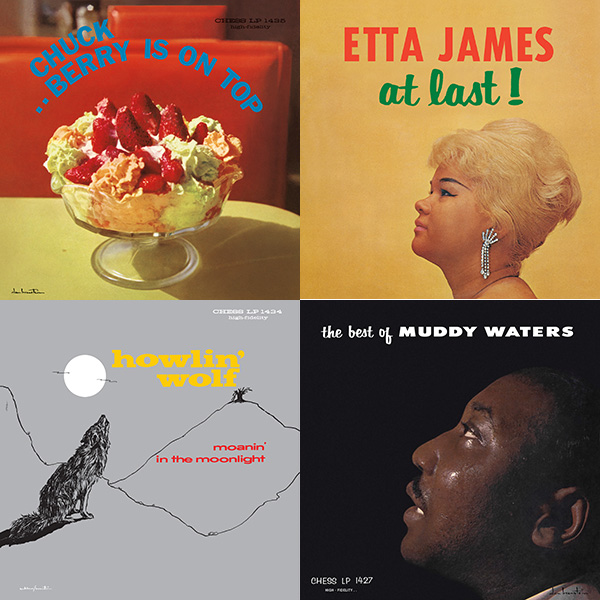
The first name on that list was recently celebrated with the launch of the Chess 75 Acoustic Sound Series, along with three other deserving blues artists. A collaboration between UME and Analogue Productions, these $40, 180gm LPs were, according to official paperwork, remastered from original analog tapes. They're pressed at QRP—the pressing plant owned by Acoustic Sounds—and come in tip-on jackets of heavy coated stock.
The first four Chess 75 releases are prime examples of the priceless catalog of recordings Polish immigrants Phil and Leonard Chess built in Chicago in the '50s and '60s. Two short years brought Howlin' Wolf 's Moanin' in the Moonlight (1959), The Best of Muddy Waters (1958), Etta James's At Last! (1960), and perhaps the finest rock'n'roll album ever made (compiled from singles), Chuck Berry Is on Top (1959). Those four albums alone are an indisputable affirmation of Chess's seminal place in the history of popular music. While I treasure my original Chess pressings—most less than pristine, but hey, these were once party records—these reissues sound clear, present, and generally terrific. (Several other albums including Sonny Boy Williamson's The Real Folk Blues, Muddy Waters's Folk Singer, Bo Diddley, and The Best of Little Walter followed soon after in the Chess 75 series.)
Howlin' Wolf, né Chester Arthur Burnett (named for the 21st president), was born poor and raised in Mississippi in troubled family circumstances. After a stint in the US Army, during which James Brown heard him play, Burnett made a brief stop in Memphis courtesy of talent scout Ike Turner. He cut his first sides for Sun Records before moving on to Chicago and Chess.
Moanin' contains many of Howlin' Wolf 's best-known original songs, including "Evil (Is Goin' On)," "Smokestack Lightnin'," and "I Asked for Water (She Gave Me Gasoline)"—the last memorably covered by Lucinda Williams on her self-titled 1988 album (see this week's Recording of the Month for more Lucinda). Wolf's bag was the resonant, often growling bellow of his singing voice—that and his hulking physical presence, which often proved a deterrent to confrontation.
Another Mississippian, laconic and lanky Jimmy Reed, migrated to Chicago during WWII, honed his chops playing in the streets and clubs, and eventually signed with Chicago's African American–owned Vee-Jay Records (the first US home of The Beatles). He later moved to BluesWay, the blues-focused subsidiary of ABC-Paramount Records founded in 1966 by one-time Impulse! Records head Bob Thiele.
Reed's recordings, the best of which were cut in the late 1950s and early 1960s, are all worth a listen. In tunes like "Bright Lights, Big City" and "Baby What You Want Me to Do," his relaxed blues shuffles and iconic vocal drawl are timeless. The 1961 album Jimmy Reed at Carnegie Hall is a highlight, containing all his hits except "Shame Shame Shame." Because he often wrote in a few familiar modes, Reed can be heard best on compilations of singles, of which there are nearly 100. While Chameleon Records' Bright Lights, Big City (LP and CD, 1988), Rhino Records' The Very Best of Jimmy Reed (CD, 2000), and Bear Family's Rocks (CD, 2021) all have everything needed to understand Reed's gifts, the six-CD The Vee-Jay Years (1994) on the UK's Charly label is the ultimate deep dive.
Reed died young, age 50, during an epileptic seizure surely complicated by alcohol abuse. His greatest fame lies in how his music crossed over into rock'n'roll. Many early rock acts covered his tunes, including The Rolling Stones, The Yardbirds, The Animals, Van Morrison, The Grateful Dead, Elvis Presley, and Steve Miller. Bob Dylan even wrote a tune about him, "Goodbye Jimmy Reed," recorded on the 2020 album Rough and Rowdy Ways.
A Texan by birth, mighty Freddie King was a powerful guitarist, fond of Gibson Les Pauls; his stinging leads were reminiscent of Buddy Guy's. He was also an impassioned singer. Migrating to Chicago, where he eventually played with stalwarts like Willie Dixon, Little Walter, and Jimmy Rogers, King was turned down several times by Chess. He recorded for Cincinnati's King Records before moving to Atlantic subsidiary Cotillion, then Shelter, then RSO. While his earliest albums, Let's Hide Away and Dance Away with Freddie King and Sings (both from 1961), are the anchors of his catalog, King hit his stride again later, on Texas Cannonball (1972) and the funkier, brass-accented Burglar (1974). After years of constant touring and hard living, King was the youngest blues legend to die, in 1976 at the age of 42.
It's been five decades since good men feeling bad sounded this good.















