

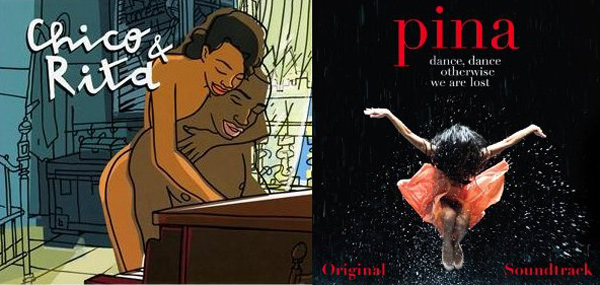
And now for two soundtrack albums, Chico & Rita and Pina: the first explicitly jazz, the other prancing all around its borders, both completely captivating.
Chico & Rita is an extremely stirring animation movie about the flustered-then-redeemed romance between a Cuban pianist and singer (Chico & Rita) against the backdrop of Havana and New York City in the late '40s to early '60s, all evocatively captured, not just in the era's looks but also—unsentimentally—its feel.
Bebo Valdes, the great 81-year-old Cuban pianist, plays on the soundtrack (the movie and the album). Many years ago, the film's director, Fernando Trueba, made a documentary about Valdes, Calle 54, which made the world aware of his story—his existence—and Chico & Rita draws on some pieces of that life, and that of other Cuban jazzmen who got caught up in the joys of the music and the nightmares of its crass, often tragic surroundings.
Also on the soundtrack Valdes' wife, Idania, a spectacular singer, as Rita; Freddy Cole doing a more-than-passable imitation of his brother, Nat; Jimmy Heath raising eyebrows as Ben Webster; and two musicians I don't know—Michael Phillip Mossman and German Velzco—sounding just like Dizzy Gillespie and Charlie Parker.
It's an enchanting movie. And the soundtrack, much of which was recorded by ace engineer Jim Anderson, is a sonic treat, too.
Pina, Wim Wenders' tribute to the late choreographer Pina Bausch, featuring her longstanding dance troupe, performing her most adventurous pieces, is a wondrous film (see it in 3D if you can) and—more pertinent to this space—a terrific soundtrack CD.
It's a mélange of jazz, Latin, African, hip-hop, classical (ranging from Purcell to Glass-style minimalism), all of it more infectiously rhythmic than just about anything I've heard in a long while. It is dance music after all, music for some of the freest yet also most rigorous dancers out there; and listening to it, you feel like dancing wildly too.
The sound quality is quite good: a bit of an electronic gauze (my guess is some of these works are recordings of recordings), but the guitars, drums, and (on those tracks that have them) vocals are eye-blinkingly palpable.
I wish only that the liner notes identified the musicians and said something more about the main composers, Thom Heinrich and Jun Miyake. I'd like to hear more of what they do.















