

Chuck Berry's passing on Saturday, March 18, 2017 at 90 is the most momentous death in all of American popular music since Robert Johnson's death at age 27 in Greenwood, MS. in 1938. He is, after all, without exception, the man who created rock'n'roll. Berry wrote, often in league with pianist Johnnie Johnson, many of what are now considered the classic songs of rock 'n' roll.
Berry is also the man who confirmed the guitar as the central instrument of rock 'n' roll—he was a perpetually underrated guitar player. Devoted to using a Gibson ES 350 arch top guitar (often in red), Berry created many of the guitar riffs—the opening of "Johnny B. Goode" stands out—that people now think of as rock'n'roll. He was also a crafty lyricist, particularly adept at telling stories like "Back In the USA," making up terms like "world wide hoodoo" (from "Thirty Days"), and forcing rhymes, "I must admit they have a rockin' band/ Man, they were blowin' like a hurricane" ("Rock and Roll Music").
And then there was the man's swagger. A mix of biting crankiness and yawning insecurities, he was the original rock'n'roll pirate—the man who put the devil in the devil's music.
Chuck's life story is a tangle of triumph and self-sabotage. He was famously moody and difficult, traits that were on full display in Taylor Hackford's ageless and wonderful rock documentary, Chuck Berry, Hail! Hail! Rock 'N' Roll. Along with writing many of the classic rock 'n' roll hits like "Roll Over Beethoven," "Sweet Little Sixteen," and of course "Johnny B. Goode," about the country boy who could play his guitar like "a-ringin' a bell" and doing his patented duck walk across stages all over the world, the articulate and cagey Berry suffered from racial prejudice and his own mistakes. In 1962 he served time in jail for transporting an underage girl across state lines. In 1979 he served time for tax evasion, which was most likely a product of his habit of wanting to be paid in cash. In 1989 he was sued for allegedly videotaping women at his Missouri restaurant. And in 2000, Johnnie Johnson sued him for songwriting royalties. That case was dismissed. An infamous 1993 Spy magazine article dug even deeper into Berry's dark side.
A star at Chess Records in the later 1950s/early '60s, Berry's recording career trailed off in the 1970s, though some of his later studio records like 1969's Concerto in B Goode and his 1970 return to Chess, Back Home, are surprisingly listenable and contain a number of memorable Berry tunes. His music was kept alive through countless cover versions. The Rolling Stones' "Around and Around," The Kinks' "Beautiful Delilah," versions of "Johnny B. Goode" by The Sex Pistols and Jimi Hendrix, Emmylou Harris's "(You Never Can Tell) C'est La Vie" and George Thorogood's "It Wasn't Me," all come to mind. While his touring schedule slowed considerably as he aged, Berry continued, almost to the end, to play one night a week at the Blueberry Hill restaurant in the University City neighborhood of St. Louis. His final album, which at the time of his death was self-titled, is supposedly coming out on the Dualtone label later in 2017.
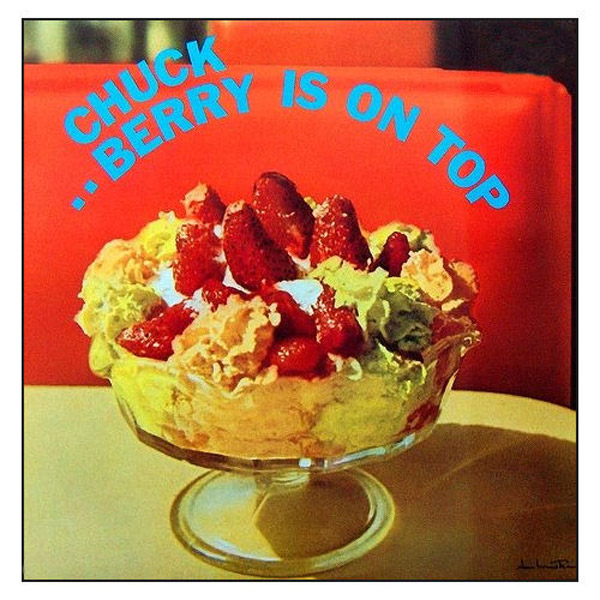
All lovers of vintage vinyl know that Berry's second Chess LP 1435, 1959's black-label mono Chuck Berry is on Top, which is very tough to find in good condition today because it was such a party record, is an astonishing display of songwriting prowess. Out of 12 tracks, 8 are bonafide hits. "Almost Grown," "Carol," "Maybellene," "Sweet Little Rock & Roller," and "Johnny B. Goode" are all on side one. "Little Queenie," "Roll Over Beethoven," and "Around and Around" are on side two. Also on the record is "Blues For Hawaiians" which is one of the first of Berry's odd island tunes, the best known of which is "Havana Moon."
Not surprisingly, John Lennon, may have said it best: "If you tried to give rock'n'roll another name, you might call it 'Chuck Berry.'"















