

Even though I'm the editor of Stereophile, I sometimes struggle to get my audio system to play. It's a little bit embarrassing. Just last night, I put on a record and there was no sound. I figured out the problem immediately: I'd forgotten to turn on the amplifiers. But the reason isn't always so obvious.
Back in the day, our stuff was simple; it just worked. There were power switches, a volume control, a source-selector, maybe a Tape Monitor button. Turn it on, select the right input, set the volume, and put on a record. If there's no music, make sure the Tape Monitor isn't pressed. Easy.
Today, things are more complicated. There are levels of input selection. Most systems still have a preamp, but other components accept multiple inputs. My phono preamp has two. The DAC I'm using has eight hardware inputs, plus Airplay. Certain inputs automatically play music when you send a signal to them, but others must be selected manually. Streaming data can arrive through its Ethernet port from many sources: Tidal, Qobuz, Deezer, Apple Music, Amazon Music HD, podcast networks, thousands of internet radio stations. I usually control all my music with Roon (which—another complication—encompasses only Tidal and Qobuz among the music streaming services), but it also has its own supporting app (which I use to fine-tune the hardware settings), and you can use many other apps to play music.
Today, many components are little computers, their operation controlled by microprocessors. That means bugs. (It's not just hi-fi of course: I'm in the process of replacing my refrigerator mainly due to a computer malfunction.) Sometimes a component stops working and you have to reboot it. Just a few nights ago, after much pointless troubleshooting, I rebooted the DAC and got music.
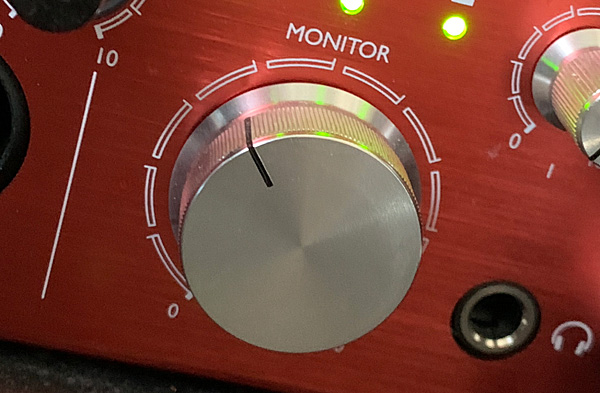
Currently, three components in my system have mute buttons. Two of those—the DAC and the preamp—have volume controls. Both have physical knobs, but they're drive-by-wire: I can control the DAC's volume with either the knob or various apps.
A couple of weeks ago, my son, who was between apartments and living with us for a short time, had friends over. I stayed away. When I returned home just after midnight, his little party had dispersed. I looked around, decided I'd tackle the mess in the morning, and went straight to bed.
The next day, I put on some music—internet radio; WFMU I think—and cleaned. Background music. Later in the day, as I started to pay more attention, I realized the volume was lower than it usually is for the chosen volume setting. According to Roon, the volume in the DAC was set to "Fixed," as always. The DAC's maximum output voltage was set at 2V, same as usual. Everything seemed okay, but the music was definitely softer than usual.
Eventually I figured out that my son and his friends had been playing music with Spotify, connecting with Airplay, controlling the volume with the Spotify app. Roon considered the volume fixed, but Spotify was changing it behind the scenes. Switching in Roon from "Fixed" to "Device Volume," I saw it was now "fixed" at 80%. Silly me: I thought "fixed" meant "fixed."
A few months back, John Atkinson was testing a pair of expensive loudspeakers. He had his DAC's software-based volume control set to some modest level, but a glitch caused it to switch back from variable to fixed—full volume this time. The result: strained eardrums and blown tweeters.
Is there a solution to this creeping complexity? Manufacturers could start by creating software with fewer glitches. There's something to be said for components that do just one thing.
I suppose the industry could embrace a common control system, with apps to sort it all out, but, as much as I appreciate technical standards, I don't really like that idea: When those systems failed, which they inevitably would, we'd be in even worse shape.
Good, intuitive design would help; too often, I need instructions to set up a new component, which really should not be necessary. But I can't see an answer to the larger problem. To make things simple again, we'll need a breakthrough, one that's not yet visible (at least not to me) on the horizon. Meanwhile, at least with hi-fi—in contrast to, for example, my ailing refrigerator, which I never liked much anyway—there's a substantial, compensatory payoff.
The pandemic has been kind to Stereophile: Subscriptions are up; our issues have gotten thicker. But we have not been entirely immune to its negative effects. As Julie Mullins reported in her August Re-Tales column, the industry has suffered from parts and materials shortages—microchips, steel, cardboard boxes, you name it—resulting in delays in building components and fulfilling orders. This has led to delays in the delivery of samples for review, so we've often had to hustle to get reviews done. With the November issue, for the first time, we were impacted directly. After the issue had been put to bed, we learned that a shortage of paper was delaying printing and shipping. As a result, you probably received your November Stereophile as much as two weeks late. This could not be helped; nevertheless, we offer our sincere apologies.
As a way of addressing the problem, Stereophile will be changing shape. Starting with the January 2022 issue, the magazine will be the same height as always but a little wider than before. This change will allow us to secure a more reliable paper supply.
The pandemic has been kind to Stereophile: Subscriptions are up; our issues have gotten thicker. But we have not been entirely immune to its negative effects. As Julie Mullins reported in her August Re-Tales column, the industry has suffered from parts and materials shortages—microchips, steel, cardboard boxes, you name it—resulting in delays in building components and fulfilling orders. This has led to delays in the delivery of samples for review, so we've often had to hustle to get reviews done. With the November issue, for the first time, we were impacted directly. After the issue had been put to bed, we learned that a shortage of paper was delaying printing and shipping. As a result, you probably received your November Stereophile as much as two weeks late. This could not be helped; nevertheless, we offer our sincere apologies.















