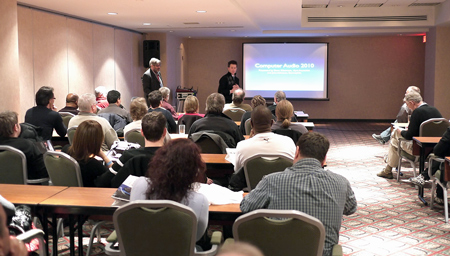
The Computer Audio 2010 seminar on Saturday was very well-attended—I barely managed to get a seat. The presentation was by Steve Silberman of Ayre Acoustics, with technical commentary by John Atkinson. Silberman took an admirably generic and non-partisan approach, barely mentioning Ayre products, and refusing to answer the question "Should I get a Mac or a PC?" I've taken a wait-and-see approach to the whole computer audio subject, and Silberman did not convince me it's time to introduce a computer into my audio system, but I must say that he did an excellent job of describing the options, and if I
were to take the plunge I would certainly use the information on the Ayre web site.
Some of Silverman's statements were intriguing—and sure to give grief to the bits-are-bits folks. In discussing USB cables, he said that the cheap generic cables can significantly limit sound quality. Yes, USB cables have a sound! There are three USB cables that Ayre recommends: Cardas, AudioQuest, and Transparent, none very expensive. For a computer dedicated to sound reproduction, Silberman recommends having 8GB or more memory (for those with 64-bit operating systems; a 32-bit OS will only handle up to 4GB of RAM). Less than 8GB will work, but won't sound as good. Perhaps most puzzling: the sound will be better if instead of a conventional spinning hard drive the computer is equipped with solid-state memory to store the operating system. This is in spite of the fact that the music computer files themselves are stored on an external hard drive of the conventional sort. "Why does this sound better? We don't know. But it
does." There are more things in heaven and earth. . . (In later discussion, JA suggested that some of these effects may stem from hard-drive access stressing the power supply and introducing datastream jitter.)