

My first exposure to current-mode phono preamplification was maybe a dozen years ago, when such products were new. The one I received, though nicely packaged, was not ready for prime time. I never smelled smoke, but I never heard sound, either: If it wasn't DOA, it was at a minimum DSAA—Dead Soon After Arrival.
If you've followed our coverage, you know that prime time has arrived for current-mode phono preamps. Over the last year, Stereophile has reviewed, in columns or regular reviews, The Loco ($8200) and Little Loco ($3400), both from Sutherland Engineering; the Lino C 2.0 from Channel D ($2400); and the pithily named Haniwa HEQ-A03-CI ($12,000). Michael Fremer reviewed van den Hul's The Grail ($9350) in August 2018, and the same issue contained his Follow-Up on his reference, the CH Precision P1 ($31,000, plus another $17,000 for its optional X1 power supply), which has both current- and voltage-mode amplifiers.
If you've followed our coverage, you also know that current-mode preamplifiers have a low tolerance for moving-magnet phono cartridges, preferring low-output/low-internal–impedance moving coils. They must be connected to a balanced circuit—no ground connection on either of the signal leads. Since most tonearms have RCA cables and most current-mode preamps have XLR connectors, you may need to replace your phono cable with a balanced one or buy a set of RCA-to-XLR adapters—which may need modification.
All of those preamps were favorably reviewed, but one got special a special commendation: The Sutherland Little Loco was named our Analog Source of the Year, and Brian Damkroger made it his Editor's Choice. Writing in our Products of the Year issue (Vol.42 No.12), Brian suggested that, while the Little Loco might not have been the first current-mode phono preamp, it was "the first one that mattered." Which brings me to my point.
Stereophile gives reviewers wide latitude in expressing opinions about audio equipment, especially in contexts that allow only a few words. And when I asked Brian about his comment later, he stuck to his guns—while reiterating that his was just one man's opinion.
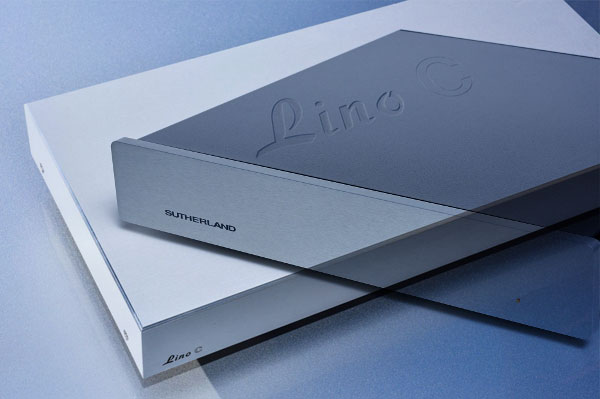
To sort this out, I decided to do some listening. On short notice, I was able to secure two current-mode phono preamplifiers: the Sutherland Engineering Loco—the Little Loco's big brother—and the Channel D Lino C 2.0.
This was not the kind of close examination readers should expect from a Stereophile review. In a review, the reviewer lives with a component for weeks or months and comes to know its every nuance, or at a minimum, most of its sonic nuances. This, in contrast, was just a couple of hours of focused listening one Saturday afternoon.
I auditioned the two phono preamps in a system consisting of the Ortofon MC Windfeld Titanium phono cartridge mounted on an SME V-12 tonearm, which in turn adorned an SME 30/12 turntable. The cartridge was connected to the Lino C 2.0 via a pair of Neutrik RCA-to-XLR adapters with pin 1 removed with pliers. On the Loco I have here, RCA connectors have been custom-installed. The rest of the system was the Audio Research Reference 6 line preamplifier, the Audio Research Reference 160 S stereo amplifier, which I review elsewhere in this issue, and Revel Salon2 loudspeakers, all connected with Clarus Crimson interconnects and Auditorium23 speaker cables.
Both the Loco and the Lino were extremely quiet—indeed, they're the two quietest MC phono stages I've heard in my system: With proper grounding, there is literally no audible hum. Both were detailed and three-dimensional on recordings containing such information, producing rock-solid images in a broad, deep soundstage. They differed in tonal character, the Loco being slightly darker-hued and perhaps a little more forceful; I loved the way it reproduced string bass and bass drum. The Lino seemed subjectively brighter—but not bright—which led to more sparkle on high piano notes. Neither was the Lino a slouch on bass and percussion—far from it.
The more expensive Loco is built to a somewhat higher standard, and I preferred it overall, finding the images it created a little more corporeal and the sounds it produced, in my system, slightly more natural. But it costs more than three times what the Lino costs.
Brian was making a broader point—about sound quality, sure, but also about value, market timing, and overall appeal. But I don't think you should worry about which component won what award. Read our reviews. Shop around. Listen to as many as you can, in your own system if possible. Choose the one you like best. Which one you buy—the Lino, Loco, Haniwa, Little Loco, van den Hul, CH Precision, or something else—should depend on your budget and taste and on matching the tonal character of the preamp with the rest of your system.
The two current-mode phono preamps I listened to in my system both sound amazing, and nothing I've written here should make Brian's Editor's Choice, the Sutherland Little Loco, seem any less appealing. But the world is rich and full of possibilities. As much as Brian loved the Little Loco, you may find you prefer something else.
There's a larger point here about awards and commendations. There are many outstanding products, but there's only one winner. In every category, there's at least one writer who argues passionately on behalf of a different product. Add to this the fact that none of us gets to properly audition every candidate—we often base our votes on brief exposure at shows and in other reviewers' listening rooms—and the only conclusion is that such awards, from Stereophile and other publications, should be kept in perspective. Our reviews deserve far more serious consideration than awards do.—Jim Austin















