

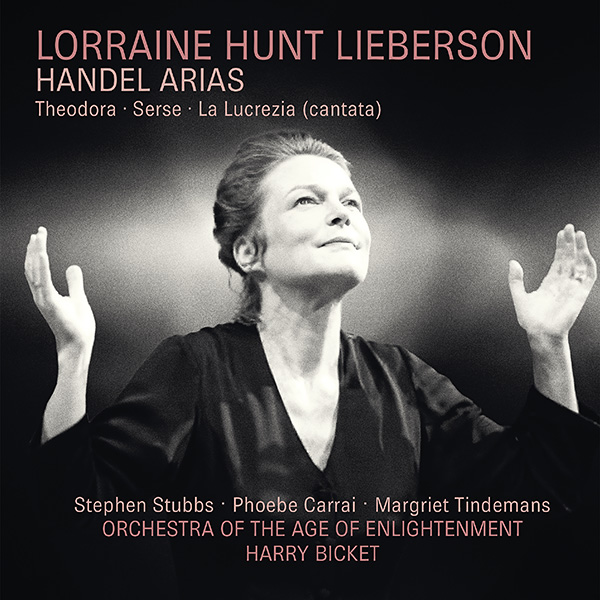
G.F. Handel: Handel Arias
Lorraine Hunt Lieberson, mezzo-soprano; Stephen Stubbs; Phoebe Carrai; Margriet Tindemans; Orchestra of the Age of Enlightenment, Harry Bicket, cond.
AVIE AV2792 (CD; remastered/auditioned as 24/192). 2025. Nicholas Parker, prod.; Everett Porter, eng.
Performance *****
Sonics ****½ Twenty-one years after its initial release on SACD, Lorraine Hunt Lieberson's mesmerizing DSD recording of Handel's La Lucrezia and arias from Theodora and Serse has been remastered and rereleased in three formats: physical CD, 24/192, and Dolby Atmos. Regardless of format, her voice remains as heart-rendingly beautiful as ever. As astounding as Hunt Lieberson's long-breathed phrases and remarkably wide range may be, it is two other artistic virtues that distinguish her from other singers: the unwavering sincerity of her conviction and her ability to infuse her performances with a transcendent spirituality that elevates singing beyond the realm of notes. Only two other singers of early music on record—mezzo-soprano Janet Baker and contralto Kathleen Ferrier—could convey such a sense of chaste soulfulness.
Initially a violist, Hunt Lieberson was drafted by director Peter Sellars to sing the soprano part of Donna Elvira in his racially charged 1990 production of Mozart's Don Giovanni. Soon after she transitioned to the mezzo range. Recording engineer Peter McGrath, who recorded Hunt Lieberson's first issue of Handel arias with Nicholas McGegan and the Philharmonia Baroque Orchestra, once told me that at her unscheduled recording audition—McGegan insisted she be heard—the founder of Harmonia Mundi was so overwhelmed, he broke into tears. As you hear Hunt Lieberson perform "Ah! Whither should we fly, or fly from whom? ... As with rosy steps the morn," from Handel's oratorio, Theodora, you may weep as well. The rapt attention with which she sings "Raise Thou our hopes of endless light" has rarely been equaled on record. Whenever she sings music that reaches to the heavens, we are immersed in the grace of which angels sing.—Jason Victor Serinus
 Dvořák: Slavonic Dances
Czech Philharmonic/Sir Simon Rattle
Pentatone Music PTC5817414 (CD). 2025. Holger Urbach, prod.; Stephan Reh, eng.
Performance ***
Sonics ***½ I shouldn't have praised Tomá Netopil for recording the Slavonic Rhapsodies instead of the seemingly inevitable Slavonic Dances: Apparently he was leaving those for Sir Simon Rattle. The question then arises: How well will Rattle's soft-edged attacks and laissez-faire rhythmic alertness suit the dances' infectious crispness?
In the first four dances—a furiant, a dumka, a polka, and a sousedská—Rattle is reasonably straightforward. The occasional inflective detail turns iffy; otherwise, he mostly stays out of the orchestra's way. (That's never a bad policy with players on home ground.) The furiant's stretto coda is rather a racket, but in the nice, easy polka, the different musical elements are clearly "placed." The sousedská begins gently and graciously, though coordinations are approximate in the climactic statement.
Those problems unfortunately crop up more frequently later. The splattered landing on the last go-round of the skočná (track 5) vitiates the nice bounding energy at the start. The mood in Dance 12 is quietly searching, but here and in the ensuing pacírka, the textures thicken as Rattle goes grand.
Some dances bring strong insights. The starodávný (track 10) is gracefully shaped. Soggy chording doesn't obscure the rhythmic point in the F Major skočná (track 11), and Rattle doesn't overdo the wistful yearning in the lyrical final dance, one of the best things in the set. Still, I wanted more time to savor the harmonies in the flowing Dance 6; the start of Dance 7 doesn't scan properly; and Rattle runs phrases together in the second starodávný (track 14). And throughout the set, he doesn't really feel the folk-like major-minor shifts, which just sit there.
The sound is fine—nothing special in terms of either imaging or depth, an occasionally conspicuous overhang, and a few fierce, edgy tuttis.—Stephen Francis Vasta
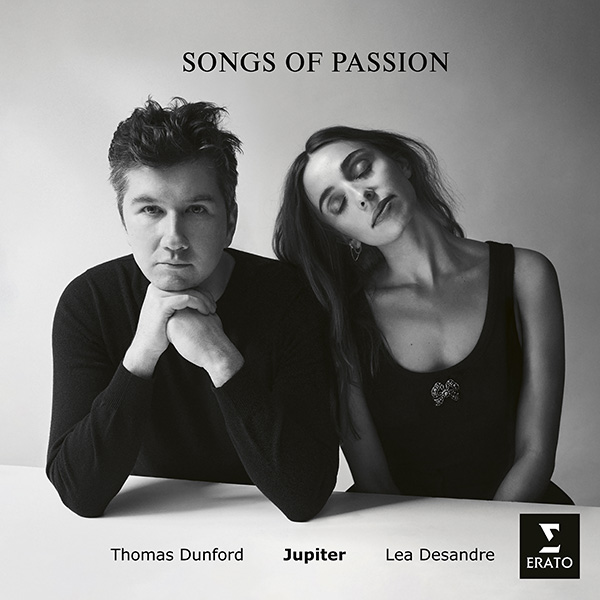 John Dowland/Henry Purcell: Songs of Passion
Thomas Dunford, Lea Desandre, Jupiter Ensemble
Erato 2173282845 (2 CDs; reviewed as 24/96). 2025. Daniel Zalay, prod.; Olivier Rosset, eng.
Performance *****
Sonics **** I cannot be alone in lamenting how much sadness lies at the core of the music of John Dowland (1563–1626). All the more wondrous then that lutenist–musical director Thomas Dunford, his mezzo-soprano wife Lea Desandre, the players of the Jupiter Ensemble, and a superb crop of vocal soloists have made it a joy to listen to Dowland's melancholic music and that of his successor to English composing greatness, Henry Purcell (1659–1695).
Exquisite taste and balance united by a supreme sense of color are the hallmarks of Dunford, Desandre, and Jupiter Ensemble's latest recorded endeavor, Songs of Passion. As many times as I've heard one of Dowland's rare upbeat songs, "Come Again, sweet love doth now invite," I have never heard it performed with such variety, verve, and passion as on this recording. Tenor Laurence Kilsby, gifted with a perfectly produced, mellifluous voice ideal for English music, contrasts beautifully with contralto Jess Dandy's rich, androgynous instrument and Alex Rosen's extraordinarily versatile bass. Rosen stands out each time he sings, not for his volume—the vocal balance is ideal—but rather for his ability to traverse the emotional compass from fetching lightness to thrilling masculine resonance.
The beauty of Desandre's voice anchors the program. If, ultimately, I may be even more moved by Janet Baker, Susan Graham, Joyce DiDonato, and the irreplaceable Kathleen Ferrier's recordings of Dido's music to Purcell's Dido and Aeneas, this does not negate the sincerity of Desandre's performance. Plus, she can be light and captivating in ways that escaped Baker. Baritone Huw Montague Rendall makes but a cameo appearance in Purcell's "If Love's a Sweet Passion," but his voice is unforgettable. Jupiter's baroque instrumentalists, occasional augmented with percussion and recorders, sound heavenly.—Jason Victor Serinus
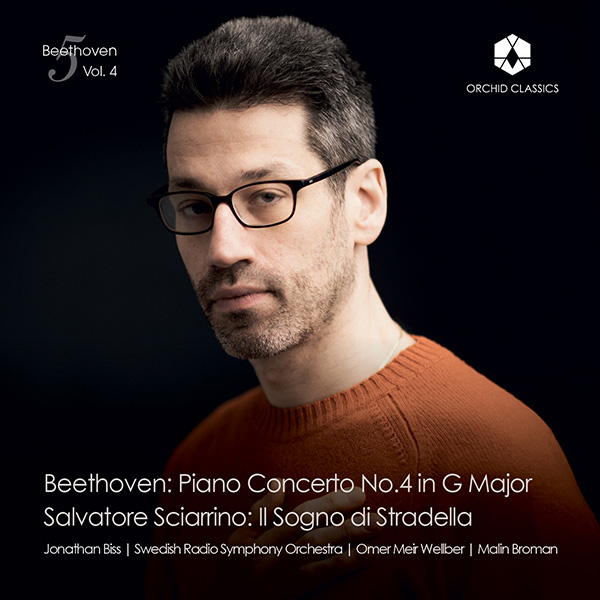 Beethoven: Piano Concerto No.4 In G Major
Sciarrino: Il Sogno Di Stradella
Jonathan Biss, piano; Swedish Radio Symphony Orchestra, Malin Broman, leader; Omer Meir Wellber, cond.
Orchid Classics ORC100399 (CD; reviewed as 24/96). 2025. Carrie Budelman, Jan B. Larsson, prods.; Ulf Östling, Fredrik von der Pahlen, engs.
Performance ****
Sonics ****
I intended to balance my two "earlier music" reviews in this issue with one of contemporary music, but the beauty of Biss's Beethoven pianism won me over. Time and again, I found myself so swept up in the spirit of his performance, well-supported by the Swedish Radio Symphony Orchestra, that it left me grateful to be able to hear it in high-resolution sound.
That is not to say that this live performance, captured in Stockholm in 2021, is the greatest recording of Beethoven's Fourth Piano Concerto. As lovely as Biss's five-minute rendition of the magical middle movement may be, Mitsuko Uchida's slightly longer take on the movement, recorded with the Berlin Philharmonic under Sir Simon Rattle in 2010, is more transfixing. That Uchida seems to play so much more slowly, with extraordinary tenderness, yet only lingers 24 seconds more is due as much to Rattle's supreme control as to her fabled sensitivity. Having said that, I find conductor Omer Meir Wellber's pacing of the final movement less idiosyncratic and ultimately more satisfying than Rattle's.
Happily, Biss jumps far beyond Beethoven's 1803 premiere to a new work he premiered in 2017, Salvatore Sciarrino's Il Sogno di Stradella (Stradella's Dream). Almost 15 minutes long, it's a fascinating piece, which juxtaposes a lovely melody inspired by Stradella with strange and eerie sounds that held me in rapt attention. The "dream's" tension between past and present—its fundamentally uneasy melding of two very different sound worlds—is as arresting as it is delightful. One can say as much about the recording as a whole.—Jason Victor Serinus
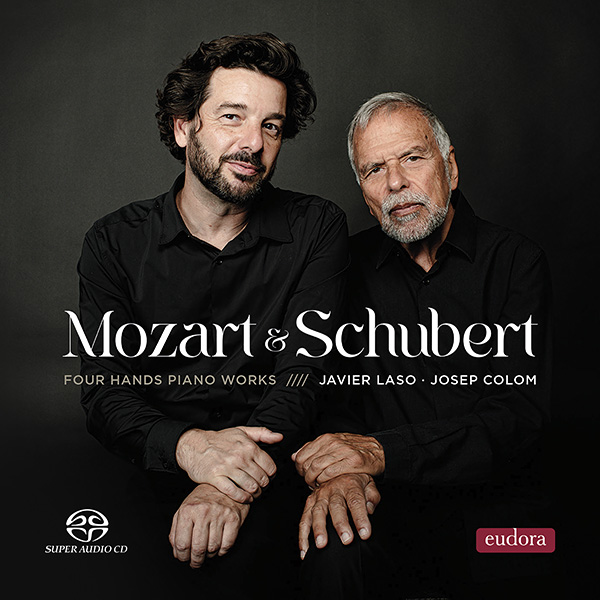 Mozart: Sonata in C; Andante with Variations
Schubert: Duo in A minor; Fantasy in F minor
Javier Laso, Josep Colom, pianos
Eudora EUD-SACD-2503 (SACD). 2025. Gonzalo Noqué, prod. and eng.
Performance ****
Sonics ***** The purpose of piano duo writing, whether for one instrument, as here, or for two, is not primarily to make more noise. Rather, the availability of four hands allows elaborate, layered textures that incorporate extensive, even oppositional counterpoint that would be impossible for one pianist. Since both soloists have figured prominently in Eudora's lists, it's good to hear this collaboration. Their flawless precision should be no surprise; even better is their unanimity of intent, projecting music as if from a single, purposeful consciousness. Beautifully balanced textures expose buried midrange themes as bass lines provide firm support.
Crisp, clear scales ripple through the Mozart in all registers; the primo particularly sparkles. The Andante, beginning simply, expands flexibly to accommodate embellishments, which the pianists handle with poised dexterity. Graceful sectional ritards clarify the structure of the Andante with Variations; the busiest variation is crisp and clean, while the minore is painted in more ambivalent colors. The chordal cadences arrive with gratifying unanimity.
The players, oddly, seem less relaxed in the Schubert. After a peremptory start, the turbulent Lebensstürme Duo is mostly stuck in a single color, with severe contours in the chordal climaxes. The F minor Fantasy—four short movements, played attacca—covers a broader, deeply felt emotional range. High accents in the two middle movements lack depth, though the Allegro vivace's fugal "waltz" demonstrates the possibilities of four-hand writing. After a powerful fugue, the finale's thoughtful ending seems to hang fire. Excellent, unobtrusive sonics.—Stephen Francis Vasta
Lorraine Hunt Lieberson, mezzo-soprano; Stephen Stubbs; Phoebe Carrai; Margriet Tindemans; Orchestra of the Age of Enlightenment, Harry Bicket, cond.
AVIE AV2792 (CD; remastered/auditioned as 24/192). 2025. Nicholas Parker, prod.; Everett Porter, eng.
Performance *****
Sonics ****½ Twenty-one years after its initial release on SACD, Lorraine Hunt Lieberson's mesmerizing DSD recording of Handel's La Lucrezia and arias from Theodora and Serse has been remastered and rereleased in three formats: physical CD, 24/192, and Dolby Atmos. Regardless of format, her voice remains as heart-rendingly beautiful as ever. As astounding as Hunt Lieberson's long-breathed phrases and remarkably wide range may be, it is two other artistic virtues that distinguish her from other singers: the unwavering sincerity of her conviction and her ability to infuse her performances with a transcendent spirituality that elevates singing beyond the realm of notes. Only two other singers of early music on record—mezzo-soprano Janet Baker and contralto Kathleen Ferrier—could convey such a sense of chaste soulfulness.
Dvořák: Slavonic DancesCzech Philharmonic/Sir Simon Rattle
Pentatone Music PTC5817414 (CD). 2025. Holger Urbach, prod.; Stephan Reh, eng.
Performance ***
Sonics ***½ I shouldn't have praised Tomá Netopil for recording the Slavonic Rhapsodies instead of the seemingly inevitable Slavonic Dances: Apparently he was leaving those for Sir Simon Rattle. The question then arises: How well will Rattle's soft-edged attacks and laissez-faire rhythmic alertness suit the dances' infectious crispness?
John Dowland/Henry Purcell: Songs of PassionThomas Dunford, Lea Desandre, Jupiter Ensemble
Erato 2173282845 (2 CDs; reviewed as 24/96). 2025. Daniel Zalay, prod.; Olivier Rosset, eng.
Performance *****
Sonics **** I cannot be alone in lamenting how much sadness lies at the core of the music of John Dowland (1563–1626). All the more wondrous then that lutenist–musical director Thomas Dunford, his mezzo-soprano wife Lea Desandre, the players of the Jupiter Ensemble, and a superb crop of vocal soloists have made it a joy to listen to Dowland's melancholic music and that of his successor to English composing greatness, Henry Purcell (1659–1695).
Beethoven: Piano Concerto No.4 In G MajorSciarrino: Il Sogno Di Stradella
Jonathan Biss, piano; Swedish Radio Symphony Orchestra, Malin Broman, leader; Omer Meir Wellber, cond.
Orchid Classics ORC100399 (CD; reviewed as 24/96). 2025. Carrie Budelman, Jan B. Larsson, prods.; Ulf Östling, Fredrik von der Pahlen, engs.
Performance ****
Sonics ****
Mozart: Sonata in C; Andante with VariationsSchubert: Duo in A minor; Fantasy in F minor
Javier Laso, Josep Colom, pianos
Eudora EUD-SACD-2503 (SACD). 2025. Gonzalo Noqué, prod. and eng.
Performance ****
Sonics ***** The purpose of piano duo writing, whether for one instrument, as here, or for two, is not primarily to make more noise. Rather, the availability of four hands allows elaborate, layered textures that incorporate extensive, even oppositional counterpoint that would be impossible for one pianist. Since both soloists have figured prominently in Eudora's lists, it's good to hear this collaboration. Their flawless precision should be no surprise; even better is their unanimity of intent, projecting music as if from a single, purposeful consciousness. Beautifully balanced textures expose buried midrange themes as bass lines provide firm support.















