

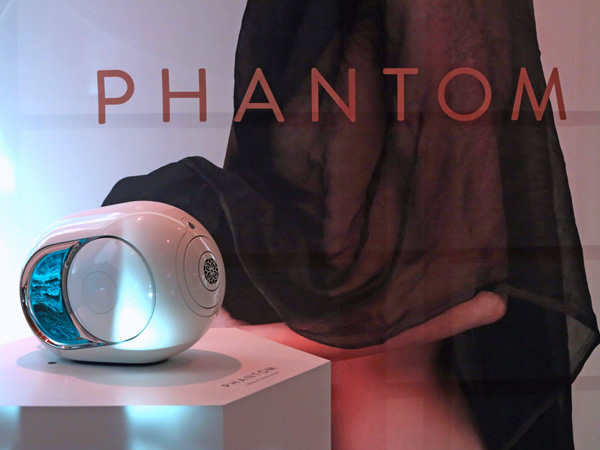
Is it an "implosive sound center" that offers, in Devialet's words, "The Best Sound in the World—1000 Times Superior to Current Systems," or is it an overblown puffer fish? Such thoughts crossed my mind as a young, computer-happy Devialeter, standing behind a curtain, fed techno music to the Phantom ($1990) and Silver Phantom ($2390), whose side panels in turn pumped in and out as it flooded a large suite in the Mirage with the driving beat of increasingly loud music that, if pumped through the water, might lead a poor puffer to puff its last.
Phantom reportedly takes advantage of "three major engineering inventions" involving 77 patents. (At one point, the literature says "close to 100 patents," but math does require a bit more precision that advertising hype.) An analog digital hybrid (ADH) "intelligence," directed by a powerful microprocessor, drives the Phantom's speaker. As explained to me by Devialet's Manuel de la Fuente, that means that a class-A analog amp sets the output voltage and drives the music, while four class-D amps, slaved to the master class-A amplifier, provide current in parallel. "This enables class-A to be more linear, with the lowest distortion on the market," he said. Speaker Active Matching (SAM) processing technology then controls the drive-units, "reproducing the exact acoustic pressure recorded by the microphone."
Second, the Phantom uses a unique "Heart Bass Implosion" system that produces "ultra deep" bass by high pressure beating of the unit's two lateral high-excursion bass driver "wings." Hence the similarity in appearance to the puffer fish that was swimming around in the huge aquarium behind the Mirage's registration desk in the lobby. In truth, the Phantom is far prettier, and, if its not turned on at ear-damaging levels while you're unwittingly standing right next to it, a lot more fun.
Lastly, the Phantom's spherical design creates a "homogenous sound no matter the listening angle." I can't vouch for that, because once this baby began pounding away, I realized that I needed to either capitulate and dance away, or bid adieu.
There was no way, in the middle of a crowded suite, to evaluate Devialet's claims that the Phantom has zero distortion, zero background noise, and zero saturation. Nor is there space to discuss everything laid out in the Phantom's white paper, including the nature of "Magic Wire" and claims of 16Hz–25kHz bandwith, ±2dB, 20Hz–20kHz bandwidth, ±0.5dB, and 105dB maximum SPL (the legal limit in clubs and live concerts).
Most important, there was no way to take a serious listen to classical music, jazz, or other acoustic music, and evaluate just how colorful, musical, and natural-sounding this baby can be. But there is no question that Phantom is a lot more fun than anything I've run into in the audio world in a very long time.
Phantom should net Devialet a fortune. It might even change how people listen to music. Units will ship in Europe on February 15, with prices set for 1390 for the standard 750W Phantom with 99dB peak volume, and 1690 for the Silver Phantom, which claims 2000W and 105dB peak volume. Projected arrival date in the US is March. There are other products in the line to discuss—a separate audio router Dialogue Box ($400) that synchronizes multiple units through their own networks, for example—but their time will come.
Robert Deutsch Comments: One of the products I was determined to seek out at CES was one that has created a lot of buzz on the Internet: the Devialet Phantom. I first read about it in a write-up by Michael Lavorgna on Audio Stream. It's a three-way powered loudspeaker, featuring the technology of the Devialet D/A integrated amp/DACs, with claimed frequency response extending to 20Hz. The Phantom was certainly impressive in a brief listen, playing very loud and with bass that would do credit to a subwoofer. While some of the claims for the Phantom are a little over-the-top ("The Phantom on its own will replace your stereo systems, speakers...it exceeds them at least 1000 times in terms of sound quality") it represents a technological tour de force, as you can see from the from the opened-up view below.
















