My copy of Peter, Paul, & Mary's
Album 1700, which I had bought many years ago for its Bonnie and Clyde album art, wasn't nearly as dusty as
Santana. When I inspected it beneath a lamp, however, I noticed that it was covered by a sort of dull, gray film. The vinyl wasn't black. It was sickly. Indeed, this was one of my many albums that had suffered through the dark, dirty waters of a basement flood. Maybe two or three floods. Maybe four.
I had been living in a small, unfinished room. It wasn't so much of a room, actually, as it was a simple space. More cave-like than anything. One hundred-fifty square feet of cold, gray cement floors and walls at the far, forgotten end of an old redbrick row house on a quiet nothing street of downtown Jersey City. Steuben Street. I'll never forget you, no matter how hard I try. A shoebox of a window looking out to a pile of rocks. A mini-fridge. A hotplate. A narrow walk space carved into a bathroom, a showerhead at one end and a toilet atop three cement steps at the other. My throne.
You had to enter the place through one of those sidewalk access hatches—the steel jammies used by bars and restaurants for loading their goods. At the time, I thought it was romantic. Like on some Zen Buddhist retreat, my mind and body would grow strong and peaceful in that dark hole, beneath that steel hatch. Come winter, when the door was frozen at the hinges and covered in so many inches of snow, I thought otherwise. This was no place to call a home.
It was a cold, heavy winter, and the little place on Steuben Street flooded over and over again. The first time might have been the worst. Luckily, I wasn't even there. I had been in Las Vegas for the Consumer Electronics Show.
My first time at the Show, my first time in Vegas. Got home to find everything was soaked. Judging from the looks of things, the water must have been at least five inches high. The landlord was shocked. This had never happened before, he told me. A couple of weeks later, it would happen again. And then again. The floor was perpetually wet. After awhile, of course, it began to smell. If nothing else, the place helped me pare down my belongings. I ended up throwing away clothes, shoes, paintings, pictures, letters, books, and records.
I decided to keep most of my collection of New World Recordings discs and a few others, including
Album 1700. It's possible that many more could have been saved, but I was fed up. Tired of cleaning, tired of arguing with my landlord. I had had enough. I had had too much. After four months of it, I got out. My landlord insisted that I wait until he inspected the place before I finally left. After all of this, he charged me $10 for a missing fire alarm which had never existed in the first place. I didn't have $10. I handed him the $7 that were in my pocket, and walked away. I left about 100 records and many other boxes and bags of soaked possessions on the sidewalk, and never looked back. The water stains tattooed onto the spines of my albums, flowing up and down through big band and Dixieland and spirituals and swing, like some stupid metaphor for life, remain the final annoying reminder.
Anyway. My copy of Peter, Paul, & Mary's
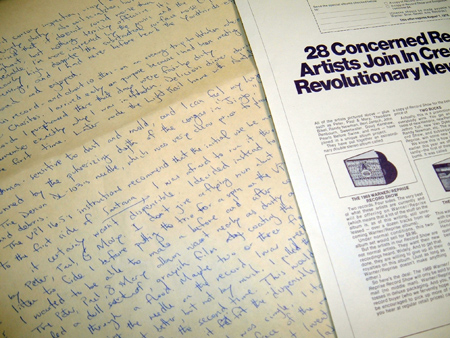
Album 1700 had been through a few floods. And it's an album I've spotted fairly regularly in the used LP bins, so, if I somehow screwed this one up, I could certainly find another. I decided, again, to listen to the record before running it through the VPI. Its inner sleeve was yellowed and brittle and held a little surprise: a mail-in offer for "an extraordinary
double stereo album" called:
THE 1969 WARNER/REPRISE RECORD SHOW
28 Concerned Record Artists Join In Creating A Revolutionary New Album.
Unfortunately, the offer expired on August 1, 1970. I was only 38 years late.
I put the needle on the record, like I was MARRS, and sat back to listen and take some notes. Because I have no paper in my apartment, I decided to write directly on the album's old inner sleeve. It would be replaced, anyhow. Before the music even started, I was greeted by a loud, aggressive snarl, like that from an angry dog. Things soon got better, but not by much. This record sounded awful. Just around the time that PP&M were about to take their second trip on a jet plane, I decided to stop the record. I had had enough. I had had too much.
Album 1700 would be a fine test for the VPI. Perhaps it would be too good of a test. If nothing else, it certainly fit the "dispensable" criteria.
I introduced the old slab of sickly vinyl to the VPI 16.5, keeping the machine's excellent instruction manual nearby. For the most part, I followed the instructions precisely. Until I got to the part where you squirt the cleaning fluid onto the record. The instructions read:
With one hand, squirt cleaning fluid onto the grooved area of the record while pressing the brush against the grooved area with your other hand.
I read this sentence about four or five times, thinking, perhaps, that if I read it enough times, I would actually gain the motor skills to accomplish it. But I know myself too well. I can hardly even imagine how this two-handed maneuver is achieved. There's little chance that I'd be able to pull it off without breaking something. I devised my own plan: With the record clamped in place and the turntable activated, I simply squirted some fluid onto the record's surface. I started with a little fluid, and carefully added more. When I was satisfied, I took the VPI brush and gently pressed it against the surface of the record, thus spreading the fluid over the entire grooved surface. I did this all with my right hand because that's the kind of guy I am. Just as the VPI's manual states, "As you gain experience using the HW-16.5, determining the right amount of fluid will become easy."
When you use too much fluid, it spills off the record and into the VPI's reservoir. No harm is done to the machine, but record cleaning fluid is valuable. You won't want to waste it. In time, I was able to gauge just the right amount of fluid so that very little went to waste. And a beautiful thing happens when you get it just right. The fluid spreads so perfectly across the record's surface and into the grooves that it looks like the ocean at night, when the blackness is so constant and deep you can barely tell where the sky begins.
Once you've spread the fluid and scrubbed the record surface, you can activate the vacuum. In a couple of revolutions, all of the dirt and fluid will be sucked away. You're left with impossibly clean, gleaming vinyl—a very special thing.
VPI recommends that the used cleaning fluid be emptied from the machine after every six records (or twelve record sides) are cleaned. Draining the machine is a hoot. It's not something that comes gracefully, and I suspect I'll never quite get the hang of it. As I mentioned in
last week's entry, the 16.5 comes equipped with a drainage hose which extends from its rear panel. To drain the machine, you must place a small container of some sort at the end of the hose (Footnote 1!). Once you've got that hose positioned to drain the fluid into your container, you release the hose's clamp, and tilt the machine back at approximately a ten degree angle (Footnote 2!). And, voila! The fluid pours into the container.
Ha!
Ideally, you'll have your VPI record-cleaning machine sitting on something larger than my bedroom dresser, so that you can place your drainage container on a hard surface. Because my dresser isn't much deeper that the machine itself, I had to hold the container to the side of the dresser, in the open air, while attempting to direct the hose into the container. This is a recipe for silliness. After my first couple of attempts (not to mention my last attempt), I found myself sopping up cleaning fluid from my floors and walls. Good times.
It would be pretty swell, I imagine, if the 16.5 had some sort of inner receptacle which collected used fluid and could easily slide out from the machine for drainage. I've heard that something like this actually existed in past versions of the 16.5, but leakage led to warped cabinets. In any case, implementing it properly would most likely raise the price of the machine. The drainage hose works, though it is a bit of a hassle and requires patience and care.
I've omitted a few steps from my personal record-cleaning process. During my first record-cleaning session, I treated six albums: John Handy's brilliant
Projections; Herbie Hancock's
Secrets and
Crossings;
Santana;
Celia & Johnny by Celia Cruz and Johnny Pacheco; and
Album 1700. I've since cleaned over a dozen other albums. In doing so, I've come up with a cleaning method that works for me. I imagine that my method will change over time, and I'm fairly certain that other VPI owners have their own techniques and preferences. Part of the fun of the HW-16.5 is that you can customize your cleaning process to reflect your needs and the needs of the particular record. The end result, however, should always be the same: A delightfully clean slab of vinyl, something that you can be proud to own—a beautiful piece of art, one that will not only look better than it did before cleaning, but will also
sound better. Listening to
Album 1700 again, after giving it a good bath, I could follow bass lines that I hadn't even noticed previously, and I felt as though I was seeing deeper into the music. The strumming of the acoustic guitars and the rise and fall of the gentle backing vocals were now alive and present. Overall, there was much more music and much less non-musical crud.
Perhaps equally important was the effect produced on the Denon DL-103 cartridge. After listening to the dirty record, the cartridge was contaminated by a frightening load of thick, ugly gunk. After listening to the clean record, the cartridge was smiling.
And so was I.
***
Footnote 1: On my first try, I used a teacup; on my second try, I used Tupperware.
Footnote 2: I'm not so hot at geometry, but ten degrees seems a little shy of the mark. In an attempt to get every last drop of used fluid out of my VPI, you'll find me tilting the machine back something more like, I dunno, 50 or 60 or 70 degrees, making an obtuse angle with myself.