

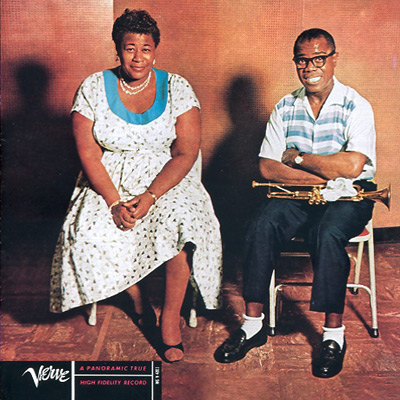
If you follow jazz, you know that Ella & Louis, the 1956 Verve album of duets with Ella Fitzgerald and Louis Armstrong, is one of the most delightful vocal recordings ever.
If you're an audiophile, you've read that Chad Kassem, proprietor of Acoustic Sounds, in Salina, Kansas, has bought the finest vinyl-pressing equipment, hired some of the hottest engineers to modify and operate it, and come up with a new line of LPs called QRP, for Quality Records Pressings.
One of his first QRP products is a 45rpm, 200-gram pressing of Ella & Louis. If you're a jazz-following audiophile, go buy this right away. Flummoxed by the $50 price tag? How much would you pay for the most palpable illusion you'll ever experience that Pops and the First Lady of Song are back among the living—standing, breathing, singing, and blowing, right in front of you?
You hear not just Ella's smooth and perfect voice, but the puff of air that carries each note of lyric from her lips out into the room. When Louis dips his parched voice down into the nether octaves, you hear the vibrations in his chest. When the two sing together, they don't merge (except spatially, by definition; the album was recorded in mono); they remain distinct, whether in unison or in harmony.
I've played this album for several people now. They never fail to let out a laugh, of wonder, at how real they sound. When the stylus hit the one five-second passage where the (otherwise dead-silent) vinyl surface sported a bit of dust, which produced a couple very light ticks (this was before I cleaned the album, after which the ticks vanished), one friend said he was relieved to hear the evidence that this was a record album; it had been getting a bit too spooky.
A few caveats. First, on a few songs, Armstrong's trumpet sounds a bit harsh. In part, this is due to his technique (which, this pressing reveals, wasn't in the finest shape); in part, I think, it's due to the microphone. (The slight harshness is there on another pressing I have of this album, too. It's also worth noting that on the songs that begin with Pops blowing the horn, it sounds fine—rich and warm—which suggests that microphone placement may be a factor.)
Second, the piano sounds a bit hooded, but this is definitely on the master tape; that's just the way a lot of mid-1950s jazz recordings sound.
Third, I wish Chad had designed a gatefold cover (like the folks at Music Matters Jazz, who reissue Blue Note classics in two-LP 45rpm pressings). Cramming two thick slabs of vinyl into a single slot (even protected, as they are, by nice rice-paper sleeves) can't be good for the records or the cover.
Fourth, Chad has numbered the covers for each of the first 1000 pressings, suggesting that they're part of a limited edition. But they're not. After those 1000 are sold, he plans to press more, the only difference being that the newer covers won't be numbered. Chad tells me that some customers like this, even to the point of requesting the same numbered copy for all the albums they order. Whatever turns you on . . .
But back to the main point. This is an amazing-sounding album. It's the only QRP Verve I've heard so far, but if it's a harbinger of things to come, it's what Satch would call a mitzvah!















