

One of my biggest surprises since I became the editor of Stereophile—and so started focusing more on all things audiophile—is how often I find myself thinking about the ethics of this hobby. This is unusual for me: I dislike moralism and prefer aesthetics to ethics.
A small example: Recently, while I was writing an audio review, I started to type the phrase "pride of ownership." I don't know who coined it, but I know I've read it more than a few times, and I've probably written it myself. It's so common that it's practically a cliché.
But that's not why I didn't type it. Rather, as I lifted my fingers from the keyboard, I was thinking that "pride" isn't quite the right word. A person can be proud of having gleaming white teeth, or owning a gold-plated toilet, or earning loads of money doing despicable things. Sure, there are people who like to show off their stuff (including their audio stuff), but that's not our crowd, or at least I don't think so.
What I want from owning my audio system—what I think most audiophiles want—isn't pride, precisely. I want to feel unambiguously good about the whole experience. I want to feel that glow inside when I think about the music that awaits me at the end of a long day. That requires making good choices—choices consistent with not just my musical values but also my ethical values.
So pride isn't quite the right word— but then, what is? Affirmation? Equanimity? Simple pleasure? I welcome suggestions.
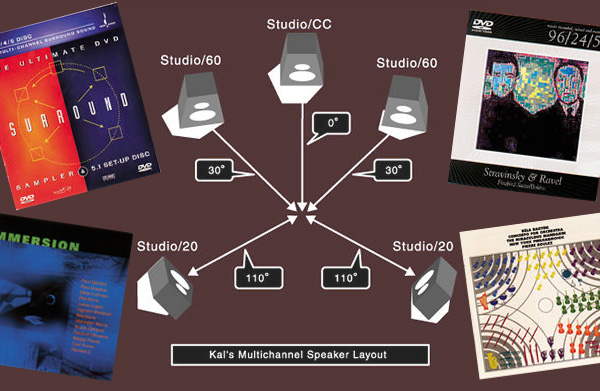
"Multichannel music is the future," wrote Kal Rubinson in his first Music in the Round column, published in the June 2003 issue of Stereophile. "The two-channel reproduction that we have enjoyed for the past four decades is but the first step from monophonic (single-source) sound to true stereophonic reproduction."
Kal's use of "stereophonic" here was intended to make a point. As he went on to explain, "stereo" doesn't mean two-channel—or at least it didn't in the 1920s, when Western Electric coined the word, well before two-channel sound was introduced and rose to prominence. "Stereo" goes back to Greek (stereós) and means "solid"—a characteristic usually regarded as requiring a third dimension. A stereo image might be just a bas relief and not a true 3D sculpture; what it's not is a projection on a flat screen. But I digress.
If two channels of information provide a glimpse of a 3D image, Kal argued in his inaugural column, then surely three channels would provide a better look, and four channels better still. Commercially, we made the transition from one channel to two— enthusiastically—nearly 70 years ago. So why stop at just two?
Kal wrote about his very first time hearing stereo sound, in the 1950s. It was, he wrote, a defining moment, but in retrospect he felt that "something was missing. . . . The performers were in one acoustic environment; I was in another. It was as if the listening room had grown a large, almost completely transparent window onto the performance space" (footnote 1). Much later, Kal climbed through that window. In his column, he has urged us to do the same and shown us how.
Home theater has established a significant beachhead, but multichannel music hardly made it past the first sandbar. The multichannel-audiophile community has remained a niche within a niche (perfectionist audiophiles) within a niche (committed music-lovers). It's a very small community.
Late last winter, shortly after my appointment as Stereophile's editor, I sat down with Kal at e's, a bar frequented by Columbia University students, to discuss Music in the Round. Kal surprised me. "I want to end my column at number 100," he told me.
This month's Music in the Round is that column. Kal's enthusiasm for multichannel music hasn't wavered, but its failure to catch on has presented challenges. Fewer and fewer perfectionist-quality multichannel components are released each year, so there is less and less to write about. It's hard to write something interesting on a regular schedule when there isn't much that's new.
Just last week, I attended a preview of the Anniversary Edition of the Beatles' Abbey Road at a screening room in Dolby's offices. Alongside a new stereo mix—they played all of side 2—they also played tracks from the Dolby Atmos mix. (By the time you read this, you'll likely own a copy of the reissue in one or another format; it drops September 27, more than a month before this magazine hits mailboxes and newsstands.) I preferred Giles Martin's new stereo mix, but the very existence of the Atmos mix—there's also a 5.1—was interesting. Apparently, multichannel music isn't over.
Stereophile's multichannel coverage isn't over, either. We're just taking it mainstream—or as mainstream as an obscure topic covered by an enthusiast mag like Stereophile can be. Whereas before you'd find multichannel coverage only in Kal's column, now you may find it anywhere in the magazine, from this first page to My Back Pages (footnote 2).
Speaking of afterlives: In his final column, Kal reviews the Merging+Anubis, a pro-audio device he has cleverly integrated into his multichannel music system. Elsewhere in this issue, Ken Micallef considers a very different product: the Trenner & Friedl Osiris loudspeaker.
Anubis and Osiris: This, then, is surely the first time that both Egyptian gods of the underworld have been examined in the same issue of Stereophile.
Happy reading.—Jim Austin
Footnote 1: Curiously, elsewhere in this issue, Michael Fremer uses similar language to describe his experience listening to darTZeel designer Hervé Deléltraz's Klipschorn-based system. Listening to those vintage speakers was, he wrote, "like listening through an open window." Footnote 2: Old-fashioned two-channel 3D sound will remain our highest priority. But when there's a compelling multichannel story to tell, we'll tell it.
Footnote 1: Curiously, elsewhere in this issue, Michael Fremer uses similar language to describe his experience listening to darTZeel designer Hervé Deléltraz's Klipschorn-based system. Listening to those vintage speakers was, he wrote, "like listening through an open window." Footnote 2: Old-fashioned two-channel 3D sound will remain our highest priority. But when there's a compelling multichannel story to tell, we'll tell it.















