

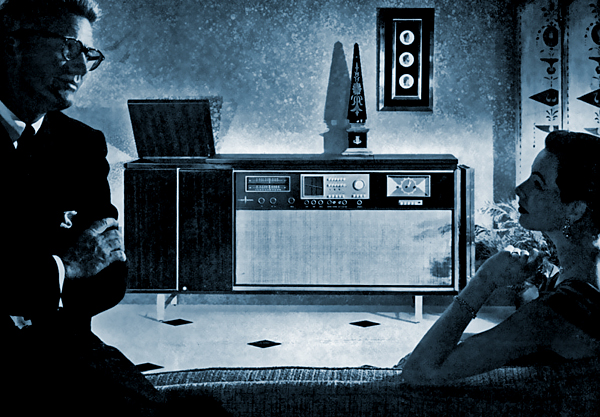
For the longest time, I've found the label "hobby" inadequate to describe the audiophile goal of better sound reproduction. Yes, for some, the mechanics of the High End have become an end in themselves—a way to tinker and tweak, build and rebuild in classic hobby fashion. But for many others, specifically earbud listeners, folks with whole-house systems, and those who'd rather push a button on a remote and sit back or dance rather than roll tubes or tinker, the descriptor hobby falls woefully short.
Recent conversations with high-resolution advocate Marc Finer, of the Digital Entertainment Group (DEG) and Stream the Studio; Meredith Gabor, of cable manufacturer Nordost; and Craig Allison, of retailer Lavish HiFi, in Santa Rosa, California helped clarify my belief that, to the extent our industry continues to cling to the hobby paradigm, we're hanging a noose around our necks. In an age when the traditional outlets of man-cave tinkerdom are closing down—witness the fate of bankrupt RadioShack—and increasing numbers of women are pursuing quality audio reproduction, retailers and manufacturers who fail to adapt their sales approaches to the tens of millions of people who've made new ways of listening to music central to their lives are doomed to failure.
As much as I may cringe at the taints of market manipulation and branding that the word lifestyle is saddled with, the vibrant truth is that music has become an essential part of the modern lifestyle for entire generations of people worldwide. Music's initial roots in tribal rituals intended for prayer, healing, and transformation may have shifted, but the 21st-century phenomena of music-pumped raves and yoga/cardio workouts, file sharing, families cooking and eating to music, and home-theater systems suggest that music retains its central role in our individual and communal lives.
Allison cited a 2016 two-pronged study conducted by Sonos and Apple Music, in part with the help of neuroscientist Daniel Levitin, author of This Is Your Brain on Music: The Science of a Human Obsession. The first part of the study involved an online and global survey of 30,000 smartphone users, aged 18–79, all of whom lived with at least one other person, which explored how listening to music together affects their lives. Among the interesting discoveries: 71% of households who engaged in what Levitin terms "communal listening" saw a marked increase in kids helping with cleaning. On the adult side, 59% of people reported finding others more attractive if they liked and listened to the same music, and couples reported having twice as much sex.
Granted, this study's results may have depended, in part, on people using music as a kind of wallpaper or soundtrack for their lives. But since it can easily be argued that better-quality sound contributes to positive feelings about one's life and a desire to improve it even further, anyone in the industry who pooh-poohs these findings is missing the point.
Levitin worked on the second part of the study, in which all members of 30 different families spent five years using Apple watches, iPhones playing through Sonos speaker systems, and iBeacons to measure their heart rate and activity throughout the home. In an interview in Billboard conducted by Andrew Flanagan (footnote 1), Levitin noted what he considered the study's most surprising findings: People tended to spend more time in closer proximity when they heard music playing in the room compared to when they didn't and stayed together in the room more often (with 12% literally moving closer).
In a paper published in May 2015, Levitin showed that listening to music increases dopamine levels in the brain and enhances empathy. As he explained in the interview, "If you listen to music out loud with somebody for fifteen or twenty minutes, it can have the same effect as actually being their friend, even if they were a stranger. There's this binding force." Levitin related this binding force to the release of oxytocin, which he dubs "the social salience drug."
In terms of musical genres, Levitin declared, "genre is a red-herring . . . One man's Mozart is another man's Madonna. And one person's Grieg is another person's Gaga." I may love classical music, but heavy metal can have the same effects.
Allison, a longtime audio retailer who spent three decades as front singer for the Bourgeois Blues Band, summarizes the study's message thusly: "Music is an integral part of the good life, like good water and food. Raise your music-intake quality up to the level of the rest of your lifestyle and your whole life gets upgraded."
There are, of course, infinite ways to reframe these words, some of which have less of a West Coast/Northern California ring. But the message that retailers, marketers, and publicists need to hear is clear: Listening to music in high-quality sound is not an ancillary aspect of our lives, or something that can be dismissed as a "hobby" pursued by the members of one small niche: audiophiles. Rather, it's an essential component of better-quality living and sense of self.
Let's have some vision, folks. The promise of easily accessible, high-quality streaming, as presented by MQA, Tidal HiFi, and multiple other streaming services poised to jump on the hi-rez bandwagon, as well as the increased availability of vinyl, make the embrace of affordable playback devices that fill entire rooms with music in high-quality sound not only practical but inviting. With a paradigm shift from hobby to life enhancement, our industry will soon discover new life in those old audiophile bones, and a new way to share the truth that better-quality music playback equals better-quality lives.—Jason Victor Serinus
Footnote 1: Andrew Flanagan, "What Does Music Do to Us When We Listen Together? Neuroscientist Daniel Levitin Helps Sonos Find Out: Q&A." Billboard, February 9, 2016.
Footnote 1: Andrew Flanagan, "What Does Music Do to Us When We Listen Together? Neuroscientist Daniel Levitin Helps Sonos Find Out: Q&A." Billboard, February 9, 2016.















