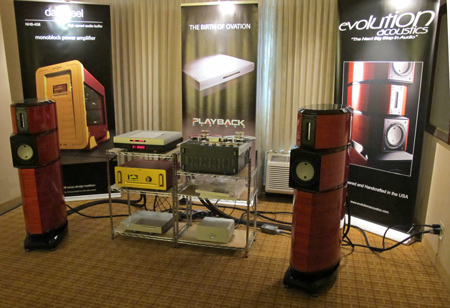
I confess. Ever since I heard Evolution Acoustics loudspeakers at T.H.E. Show Las Vegas some years back, I have lusted after a pair. In fact, one of the big excitements on my trip to China a few months back—story forthcoming sometime before the Twelfth of Never—was visiting the same Aurum Cantus factory that manufactures Evolution's tweeter. The combination of Evolution Acoustics MM
two loudspeakers ($35,000/pair), darTZeel NHB-458 monoblocks ($135,000/pair), and darTZeel NHB-18 NS reference preamplifier with MC phono section ($29,000) earned my
personal best of the show for the systems I auditioned at CES and T.H.E. Show 2010.
This time around, Jonathan Tinn's Blue Light Audio was showing the small Evolution Acoustics MM
MiniTwo loudspeakers ($27,000/pair), darTZeel CTH-8550 Reference 250Wpc integrated amp with phonostage ($20,300), Playback Designs MPS-5 SACD/CD player ($15,000), and Audience Adept Response aR12-T power conditioner ($8600), along with the Wave Kinetics A10-U8 Component Control system ($700/set of 4) and 2NS Loudspeaker Interface system ($1600/set of 8). Cabling was all Evolution Acoustics: DRSC speaker cables ($6000/pair), The Link Reference 50 Ohm BNC interconnect ($6000), and PC2One power conditioning power cord ($2000). Not auditioned, in part because Jonathan wasn't in the room at the time, was the Studer A810 open-reel machine or the hi-rez files on a Music Servers Direct music server.
So how was it? When I entered the room, two young men were playing soft rock. On both Jack Johnson's "Sleep Through the Static" and Katie Melua's "Piece by Piece", the sound was exceptionally clean, extremely quiet, and distinguished by completely controlled deep bass. (Note how many other rooms lacked bottom octave control, even with the addition of ASC Tube Traps and other devices). I loved it.
When I played Joan Sutherland singing "Bel raggio" from Rossini's
Semiramide, the system conveyed the marvelous sense of space that London/Decca's engineers caught in 1960. The covered midrange of the voice was especially brought to the fore, as was the extreme size of
La Stupenda's instrument.
I would have stayed for the second half of the performance, where Joanie dances around the stratosphere and lights up the area above the stave like no one else on record, but the sound of one of the greatest operatic sopranos of the 20th century drove a few people from the room. (The man next to me, on the other hand, was disappointed when the music stopped). In retrospect, I wonder if the middle register of Joanie's voice wasn't a bit blown out of proportion when compared to the gleaming top. Yet another reason to hear this system again in the future.