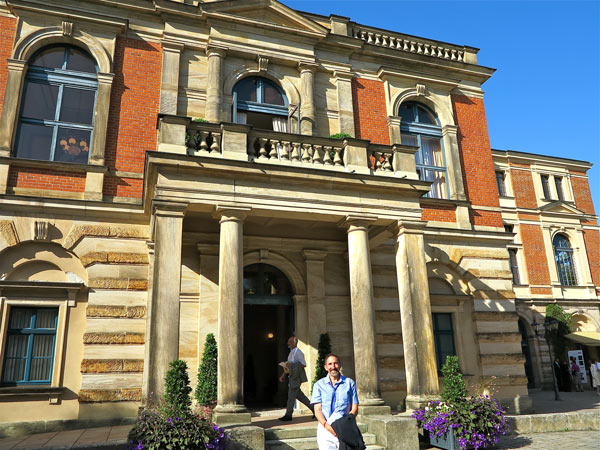
Photo of the author in Bayreuth: Paul Hyde
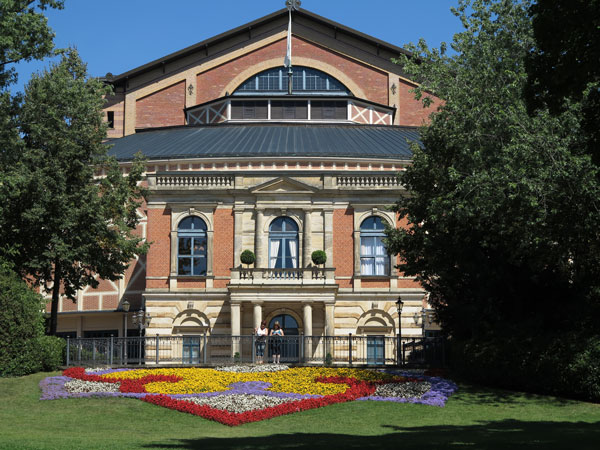
For audiophiles, the acoustic of the Bayreuth Festspielhause in Germany, home of the annual festival of Richard Wagner's operas, vies with Amsterdam's Concertgebouw and Vienna's Musikverein as one of the most fabled for recording as well as listening. As a participant in the Music Critics of North America 2012 institute at the Festival, I had the opportunity to not only explore the venue from a near-ideal seat in Row 25 Center, but to also visit the fabled "covered pit" from which many of the greatest Wagner conductors of the last 136 years have led exalted performances.
The tiered pit, which I was asked not to photograph, lies mainly beneath the stage of Festspielhause. Brass harps and percussion are located in the rear, furthest submerged from the audience, with the first row of strings and the conductor (seated so as to be seen by all players) at the top. Sound travels out an opening in front of the stage, approximately the same width as the second tier of strings on which sit two rows of strings. No one, not even the conductor, can be seen by the audience.
Although the covered, submerged pit hardly subdues the orchestra—it sings loud and clear in the house during forte passages, and sounded gossamer-like when appropriate—it does create a truly unique sonic environment. Under the baton of music director Christian Thielemann, who continues to establish himself as a Wagner conductor of the highest order, the orchestra at the start of the first production, The Flying Dutchman (Der Fliegende Holländer), possessed a powdery luminescence the like of which I had never before experienced. The slight subterranean softening of timbres lent to the sound a unique warmth and glow, over which voices could potentially float with far greater ease than they can in most other houses.
 Upsides and Downsides
The hall's acoustic superiority is also due to its non-traditional interior layout. Instead of a horseshoe-shaped tiered design, with levels set aside for boxes and galleries, seating is arranged, continental style, in a single, steeply-shaped wedge. Basic construction is wood, rather than plaster and stone. This includes the very thinly padded seats whose hard, short backs are reminiscent of uncomfortable pews in churches. The most-reflective surfaces are the large glass globes of the lights on both sides of the hall, and they hardly dominate acoustically.