

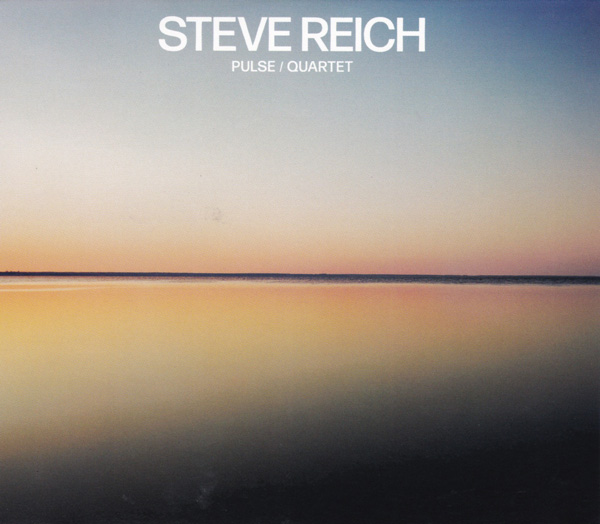
The Nonesuch Records CD Steve Reich: Pulse / Quartet arrived with its sonic bonus unheralded. With no MQA designation on the album cover or disc, few would have known of its MQA provenance had not posts appeared on Facebook that, when inserted in a player capable of decoding MQA, it can deliver high-resolution MQA.
Now that I've heard the MQA-encoded FLAC files courtesy of Nonesuch (owned by "Big Three Major" Warner Music), I can attest that there's every reason in the world to hear this disc in the best-sounding format available to you. The "Masters"/MQA version can also be streamed on Tidal or, I believe, downloaded in some countries other than the US from highresaudio.com.) (The MQA files are 24/48 MQA.FLAC, and unfold to 24/96.) The non-MQA hi-rez version can be downloaded from HDTracks and Acoustic Sounds.
When played as 24/96 FLAC without MQA, the sound is extremely clear and direct. While well-suited to conveying the complex, shifting patterns that are central to Reich's music, the music sounds somewhat dry and studio-bound. (I can't resist noting the irony of a recording that was made at Air Studios, Lyndhurst Hall, London, and mixed by John Kilgore in New York, sounding dry and airless.) Switch to MQA (mastered by Robert C. Ludwig in Portland, ME), and everything opens up. The more realistic vibrancy, color, and body of the instruments themselves, and their markedly increased, natural-sounding resonant interaction with the hall are impossible to miss, even through headphones.
Regardless of how you're equipped to listen, I hope you will, because Steve Reich: Pulse / Quartet contains definitive recordings of two recent works by American minimalist master and Pulitzer Prize in Music winner Steve Reich (b. 1936): Pulse (2015), performed by the same famed International Contemporary Ensemble (ICE) that premiered it in Carnegie Hall in 2016, and Quartet (2013), dedicated to extraordinary percussionist Colin Currie and played by the Colin Currie Quartet. While the combined length of these premiere recordings is a mere 30:57, which is unusually short even by Nonesuch standards, the disc goes for mid-price, and showcases a composer who, as he was approaching his 80th birthday, was very much on top of his game.
I've attended high-energy Reich performances where the optimistic, exultant spirit of his music impelled cheering thousands to their feet. Pulse and Quartet, while not at all brooding or depressed in the Philip Glass sense, are more contemplative than ecstatic in nature. They reflect a baseball cap-topped composer who, as he approached 80, may have been less inclined to jump to his feet with both hands waving wildly in the wind, but continued to affirm the transformative power of slowly evolving and morphing musical patterns, themes, and ideas.
According to liner-note writer Timo Andres, a feted composer who is 51 years younger than Reich, Pulse begins with the same harmonies that begin one of Reich's extraordinary masterworks, Music for 18 Musicians (1976). The music rises and falls in waves, its radiant highs balanced by what, to this heart, registers as contemplative sadness. Its instrumentation—11 high instruments and one very low one—includes violins, flutes, clarinets, piano, electric bass, and a two instrument percussion section.
Andres describes Pulse as "the most vocal of Reich's instrumental pieces." With notes and chords never rising above mezzo-forte, Pulse feels like slowly shifting, luminous rainbow waves washing over a steady bass pulse.
Reich conceived Pulse as a counterbalancing response to his earlier Quartet, which he says "changed keys more frequently than in any previous work. In Pulse, I felt the need to stay put harmonically and spin out smoother wind and string melodic lines in canon over a constant pulse in the electric bass and or piano. From time to time, this constant pulse is accented different through changing hand alternation patterns on the piano."
Quartet showcases the mating of piano and percussion that has played a central role in many of Reich's pieces, albeit sometimes with more pianos or percussion. With its frequent changes of key and rhythm, it is one of the more complex pieces Reich has ever composed. Reich appears to be yet another composer who, inspired by Currie's phenomenal ability to deliver whatever impossible percussive load that is handed to him with ease, dared venture into territory that would be anathema for lesser artists.
Pace is so important to Reich that he names Quartet's three movements "Fast," "Slow," and "Fast." That the whole piece lasts only 16:36 minutes may surprise you; given how much energy is expended, it feels like a much longer work.
Andres notes that Quartet's texture evokes, in all of 16:36 minutes, "Reich's reverence for the French tradition, the effect not unlike Debussy's tone-painting piano Préludes: intoxicating, even dramatic, but at a remove . . . . [Reich's] old obsessions with pulse and harmony have led us into new territory." If that doesn't get you to take a listen, nothing will. I had more than a bit of trouble trying to put Reich and Debussy together at first, but, as you'll read below, eventually came to understand what Andres was getting at.
The opening "Fast" movement—the longest of the three at 6:46— abounds with energy. Melody and rhythm keep morphing as they engage in a constant percussive dance of sorts whose glowing resonances, almost Gamelan-like (and more realistic and convincing with MQA), are filled with surprising rhythmic stops and starts. The middle "Slow" movement sounds particularly compelling with MQA, the luminous, sustained sounds of vibes suspended uncannily in three-dimensional space in a manner that evokes, in a curious sort of way, Debussy's Mélisande, who moved through life with an air of untouchable, suspended mystery.
The final "Fast" movement sounds even faster than the opening, and is one of those echt Reich works that gets you into a groove and carries you away. Virtually bursting with paradoxically contained ecstasy that radiates out into the hall and into your being on its own terms, it will likely inspire you to immediately check out Music for 18 Musicians and the Pulitzer Prize winning Double Sextet. For starters.















