It was my dirty little secret.
Up until a few months ago, I had been plugging my hi-fi into a Furutech e-TP60 power conditioner, with the power conditioner going into the only AC receptacle in my small living room. I was too embarrassed to tell anyone about it, but from the very start of my hi-fi journey, I was concerned about that single electrical outlet: not only was it limiting, it was in desperate need of repair. This thing was no hospital-grade outlet. I’m not even sure if it you could call it “ghetto-grade.” The old and cracked plastic cover plate was pulling from the wall, as if it was tired of being there. The top receptacle could barely hold a power cord and the bottom receptacle’s grip was extremely delicate—the slightest touch could send a power cord to the floor, silencing my hi-fi. Connecting the hefty Furutech AC cable required a balancing act and a little prayer. It was embarrassing. Whenever hi-fi friends came over, I made sure to keep them away from the AC. But how long could this go on? How long could I keep it a secret? Were these old receptacles limiting my system?
The situation invoked feelings of fear and insecurity, and I hate those feelings.
Then, in August, when the weather was warm and the skies were blue, I received an e-mail from Scull Communications’ Jonathan Scull, Furutech’s US PR representative, announcing the company’s new GTX wall receptacles. I had been waiting for this, and I think Jonathan knew it, too. A few weeks later, a small box containing a Furutech GTX dual receptacle arrived at our office.
Soon after, I made plans with my dad and Uncle Omar to install the receptacle. How many Puerto Ricans does it take to replace a wall receptacle? Definitely at least three: One to screw the thing in and two to play the maracas. Seriously: I had no experience with this sort of thing, and I figured it’d be a fun way to spend some time with family. Plus: Maybe I’d learn something new! The only thing I knew for sure was that I had to cut the power to the outlet before we began working on it.
It was a sunny Saturday in September when my dad and Omar came over to help out. Fortunately, just as they arrived, my landlord was walking down the street and I told him what we were planning to do and asked that he turn off the power in my living room. No problem: He went to his truck, reached into a toolbox, and handed me one of those live-circuit tester things and asked me to call him from my living room while he went down into the basement and cut the power. Cool. A minute later, I was back upstairs. As I unscrewed the old cover plate from the electrical outlet, the whole thing pretty much turned to dust in my hands. Yikes. The Furutech GTX receptacle had arrived just in time! I touched the ends of the circuit tester to the slots of the wall socket and the thing lit up. I called my landlord. “Got juice?” he asked. “Yeah,” I replied.
We tried again.
“Juice?” “Juice.” “Juice?” “Juice.”
This went on for like ten or fifteen minutes.
“Something must be wrong,” my landlord said. “Let me call Mo.”
Mo is our maintenance guy.
A couple of minutes later, Mo was at the base of the wall, fiddling at the electrical outlet with a flashlight and a cell phone, making stuff happen. (It’s funny: I almost never see my landlord or Mo, but, on this day, when I needed them, they were there in a flash.)
Anyway, unfortunately, I never found out what the problem was, and I never found out how to install a wall receptacle because Mo wound up doing it all by himself. I was thankful, though: After our initial troubles, I didn’t feel comfortable with the situation. Meanwhile, my dad and Omar sat in the kitchen, playing the maracas, while I took a few pictures.

As I unscrewed the old, plastic wall plate, the whole receptacle pretty much turned to dust in my hands. Yikes!
Furutech’s 104-D carbon fiber cover plate ($85.20) is no joke! I doubt it will be crumbling to dust any time soon—or ever.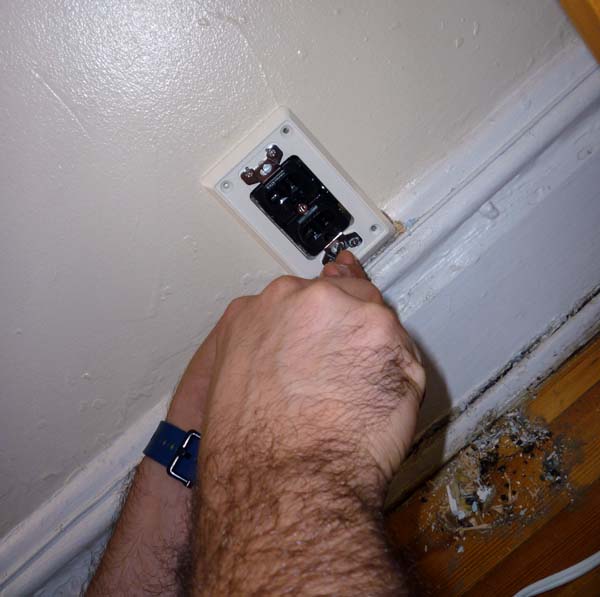
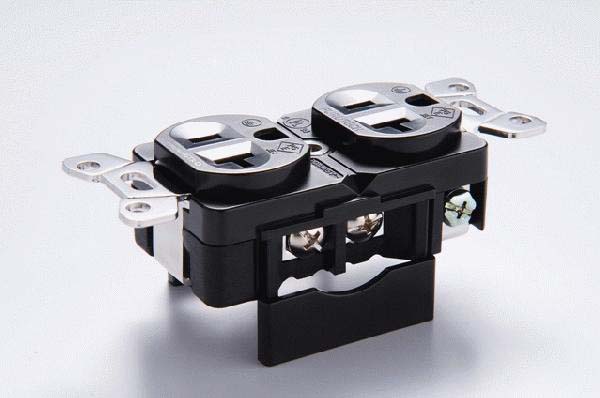
Furutech’s GTX wall plate ($138) was too large (5.3” x 3.4” x 0.5”) to fit in the space where the chintzy old receptacles lived, so we had to cut into the wood trim at the base of the wall. The aluminum, CNC-machined wall plate is finished with a non-resonant coating and is said to shield against RFI. It fit snugly around the rhodium-plated GTX-DR receptacle ($211), which uses pure copper conductors strengthened and sprung by Furutech’s “Stainless Steel Conductor Spring System,” meant to keep a firm and safe grip on connector blades.

Setting the cover plate in place only required one Puerto Rican: Uncle Omar.
The finished product is handsome and strong. I was hoping to hear a dramatic and obvious improvement in the overall sound of my system, but I can’t say that I did, and attempting to perform extensive A/B/A comparisons would just be silly. I do, however, feel a dramatic and obvious improvement in my sense of hi-fi security. There is no way in the world a power cable is coming loose from the Furutech GTX receptacle. The thing has got G.I. Joe’s Kung-Fu grip. It’s well built, seems made to last forever, and looks like serious business. Over time, I have gained the sense that my system is quieter: Sudden stops in music are sometimes almost enough to knock me off my seat. In addition, bass kicks in rock music seem to have a rounder, fuller, and more controlled wallop. I like that. Mostly, I like feeling secure about my AC receptacles. If anything, I’m now embarrassed by how good they are. But that’s my problem.
As I unscrewed the old, plastic wall plate, the whole receptacle pretty much turned to dust in my hands. Yikes!
Furutech’s 104-D carbon fiber cover plate ($85.20) is no joke! I doubt it will be crumbling to dust any time soon—or ever.
Furutech’s GTX wall plate ($138) was too large (5.3” x 3.4” x 0.5”) to fit in the space where the chintzy old receptacles lived, so we had to cut into the wood trim at the base of the wall. The aluminum, CNC-machined wall plate is finished with a non-resonant coating and is said to shield against RFI. It fit snugly around the rhodium-plated GTX-DR receptacle ($211), which uses pure copper conductors strengthened and sprung by Furutech’s “Stainless Steel Conductor Spring System,” meant to keep a firm and safe grip on connector blades.
Setting the cover plate in place only required one Puerto Rican: Uncle Omar.
The finished product is handsome and strong. I was hoping to hear a dramatic and obvious improvement in the overall sound of my system, but I can’t say that I did, and attempting to perform extensive A/B/A comparisons would just be silly. I do, however, feel a dramatic and obvious improvement in my sense of hi-fi security. There is no way in the world a power cable is coming loose from the Furutech GTX receptacle. The thing has got G.I. Joe’s Kung-Fu grip. It’s well built, seems made to last forever, and looks like serious business. Over time, I have gained the sense that my system is quieter: Sudden stops in music are sometimes almost enough to knock me off my seat. In addition, bass kicks in rock music seem to have a rounder, fuller, and more controlled wallop. I like that. Mostly, I like feeling secure about my AC receptacles. If anything, I’m now embarrassed by how good they are. But that’s my problem.