

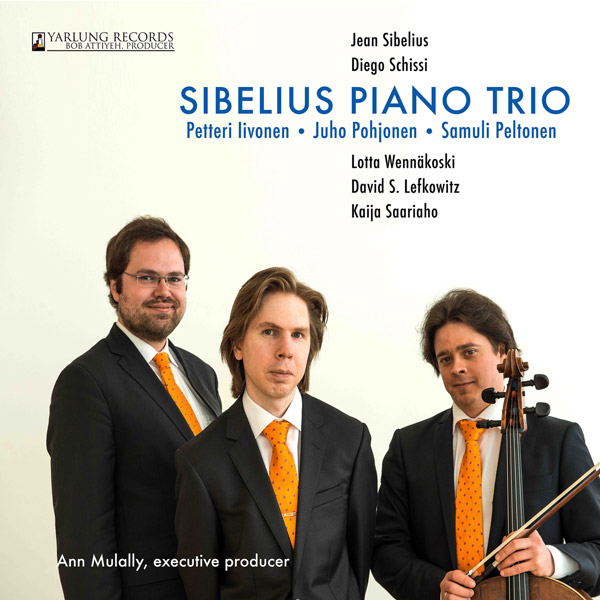
With their matching wide, distinctly un-stylish yellow ties and dark blue suits, the men of the Sibelius Piano Trio hardly look like world-class musicians. But once you hear their two-CD set from Yarlung Records, best appreciated via stereo and multi-channel DSD downloads from NativeDSD.com—click here and here—you'll understand why their debut recording of trios by Sibelius and contemporary composers deserves a place in your collection.
I've actually heard the trio's pianist, Juho Pohjonen (b. 1981), perform live twice, at Music@Menlo in Northern California. While I wish I could convince him to smile more, his internationally celebrated pianism, which is frequently heard with the Chamber Music Society of Lincoln Center, is distinguished by deep sensitivity and lucid insights. Like him, violinist Petteri Iivonen (b. 1987) and cellist Samuli Peltonen (b. 1981) have won top prizes in national and international competitions, and used them to launch international careers. IIvonen is actually famed Finish composer Kaija Saariaho's violinist of choice for her Violin Concerto, which is saying quite a lot.
Together, these three friends formed the Sibelius Piano Trio just two years ago. For a new ensemble that has only performed once in the U.S., and does not yet have a viable website, they've certainly racked up several impressive commissions. The discs contain three intriguing works written for them: Nene by Diego Schissi, Ruminations by David S. Lefkowitz, and Päärme by Lotta Wennäkoski.
Nene's first movement, "Jumping on the walls," sounds just like its title, with lots of nervous energy, energetic jumps, and irregular rhythms. "Dozing on a hanger" is atmospheric and mysterious; "Riding a mosquito" skipping and playful, with light and lovely figures and a marvelous light ending; and the final movement, "Oozing away," jumpy and sudden. Nene is anything but forbidding music.
Lefkowitz's one-movement Ruminations, which lasts almost 12 minutes, demands that the trio conjure up on their instruments the sounds of the oud, Persian nose flute, and klezmer. That they succeed can be heard to best effect on a high-end system. The writing is alternately exotic, unabashedly romantic, and energizing. I expect you will want to play this music again and again. I certainly do.
 On disc 1, those two premieres are paired with Sibelius's gorgeous Korppoo Trio in D (JS 209). The opening movement is extremely beautiful, its youthful optimism enhanced by the wonderful sound of Peltonen's cello. The middle movement is heartfelt and more dramatic, with gorgeous melodies and transitions. Contrary to many of the symphonies Sibelius wrote later in life, the finale is totally joyous, with a fabulous ending.
Wennäkoski's Päärme, which appears on disc/volume 2, contrasts markedly with the opening work, Sibelius somewhat conventional and old fashioned Havträsk Trio in a (JS 207). A 20-year old Sibelius wrote the work in the summer of 1886. It's lovely stuff, albeit with a final movement whose whiff of café society gives no hint of the Sibelius to come. Nor does it prepare you for Päärme's violent thumps, forceful plucks, scrapes and often pronounced, consistent beat. Päärme is one wild if not exactly joyous ride.
Then comes the one contemporary Finnish work not written for the Sibelius Piano Trio, Saariaho's Je sens un deuxième Coeur (I feel a second heart). Commissioned for pianist Emanuel Ax by Carnegie Hall, and premiered in 2004, it communicates, on one level, the reality of a pregnant woman who is attacked and survived.
As much as there is violence in some of this music, it is ultimately about much more. Although the attack is part of the opera on which the trio is based, Saariaho does not mention it in the relatively short introductory program note that she penned for Carnegie Hall. Instead, after citing its connection to the opera that preceded it, she writes: "The last section brings us to the thematic starting point of my opera [of the same name], again very physical: the two hearts beating in a pregnant woman's body. I am fascinated by the idea of the secret relationship between a mother and an unborn child. Musically, the two heartbeats and their constantly changing rhythmic polyphony have already served as an inspiration in my music; now the connections between the two minds added another layer of communication . . . . Finally the title became also a metaphor for music making: isn't it with the "other" we want to communicate through our music? As written over the last movement, Doloroso, sempre con amore."
Left to provide balm after discord is the last work on the program, Sibelius' happy Lovisa Trio in C (JS 208). Written for the three Sibelius siblings' piano trio shortly before it disbanded—Sibelius played the violin—it's his final piano trio, and one of the most positive works he ever wrote.
The recording was made by possible, in part, by distributor Philip O'Hanlon of On a Higher Note and his wife, Pandora Pang. Given music lover O'Hanlon's relative proximity to Southern California's Bob Attiyeh of Yarlung Records, and his dedication to high quality sound, he provided Yarlung's Arian Jansen Studio with a Merging Technologies NADAC and custom-built Luxman 5-channel amplifier to complement the Merging pro gear that Yarlung uses in the recording process.
Downloads are available in DSD and SonoruS Holographic Imaging stereo and multi-channel resolutions up to 256 (quad DSD), as well as in DXD. On my dCS Rossini/Scarlatti clock combo, which can play stereo material up to DSD 128 as well as DXD, I preferred the SonoruS DSD 128 files. Any way you go, you will find the sound, recorded with Ted Ancona's AKG C-24 stereo microphone outfitted with a special new-old-stock RCA 6072 vacuum tube, an Elliot Midwood vacuum-tube microphone preamplifier, SonoruS ATR12 analog tape recorder using Agfa 468 tape made by EMTEC, Merging Technologies Hapi converter recording DSD256 using Pyramix software, and cabling from Yarlung, Genesis Advanced Technologies, and Aural Symphonics, as smooth as can be.
On disc 1, those two premieres are paired with Sibelius's gorgeous Korppoo Trio in D (JS 209). The opening movement is extremely beautiful, its youthful optimism enhanced by the wonderful sound of Peltonen's cello. The middle movement is heartfelt and more dramatic, with gorgeous melodies and transitions. Contrary to many of the symphonies Sibelius wrote later in life, the finale is totally joyous, with a fabulous ending.
Wennäkoski's Päärme, which appears on disc/volume 2, contrasts markedly with the opening work, Sibelius somewhat conventional and old fashioned Havträsk Trio in a (JS 207). A 20-year old Sibelius wrote the work in the summer of 1886. It's lovely stuff, albeit with a final movement whose whiff of café society gives no hint of the Sibelius to come. Nor does it prepare you for Päärme's violent thumps, forceful plucks, scrapes and often pronounced, consistent beat. Päärme is one wild if not exactly joyous ride.
Then comes the one contemporary Finnish work not written for the Sibelius Piano Trio, Saariaho's Je sens un deuxième Coeur (I feel a second heart). Commissioned for pianist Emanuel Ax by Carnegie Hall, and premiered in 2004, it communicates, on one level, the reality of a pregnant woman who is attacked and survived.
As much as there is violence in some of this music, it is ultimately about much more. Although the attack is part of the opera on which the trio is based, Saariaho does not mention it in the relatively short introductory program note that she penned for Carnegie Hall. Instead, after citing its connection to the opera that preceded it, she writes: "The last section brings us to the thematic starting point of my opera [of the same name], again very physical: the two hearts beating in a pregnant woman's body. I am fascinated by the idea of the secret relationship between a mother and an unborn child. Musically, the two heartbeats and their constantly changing rhythmic polyphony have already served as an inspiration in my music; now the connections between the two minds added another layer of communication . . . . Finally the title became also a metaphor for music making: isn't it with the "other" we want to communicate through our music? As written over the last movement, Doloroso, sempre con amore."
Left to provide balm after discord is the last work on the program, Sibelius' happy Lovisa Trio in C (JS 208). Written for the three Sibelius siblings' piano trio shortly before it disbanded—Sibelius played the violin—it's his final piano trio, and one of the most positive works he ever wrote.
The recording was made by possible, in part, by distributor Philip O'Hanlon of On a Higher Note and his wife, Pandora Pang. Given music lover O'Hanlon's relative proximity to Southern California's Bob Attiyeh of Yarlung Records, and his dedication to high quality sound, he provided Yarlung's Arian Jansen Studio with a Merging Technologies NADAC and custom-built Luxman 5-channel amplifier to complement the Merging pro gear that Yarlung uses in the recording process.
Downloads are available in DSD and SonoruS Holographic Imaging stereo and multi-channel resolutions up to 256 (quad DSD), as well as in DXD. On my dCS Rossini/Scarlatti clock combo, which can play stereo material up to DSD 128 as well as DXD, I preferred the SonoruS DSD 128 files. Any way you go, you will find the sound, recorded with Ted Ancona's AKG C-24 stereo microphone outfitted with a special new-old-stock RCA 6072 vacuum tube, an Elliot Midwood vacuum-tube microphone preamplifier, SonoruS ATR12 analog tape recorder using Agfa 468 tape made by EMTEC, Merging Technologies Hapi converter recording DSD256 using Pyramix software, and cabling from Yarlung, Genesis Advanced Technologies, and Aural Symphonics, as smooth as can be.
On disc 1, those two premieres are paired with Sibelius's gorgeous Korppoo Trio in D (JS 209). The opening movement is extremely beautiful, its youthful optimism enhanced by the wonderful sound of Peltonen's cello. The middle movement is heartfelt and more dramatic, with gorgeous melodies and transitions. Contrary to many of the symphonies Sibelius wrote later in life, the finale is totally joyous, with a fabulous ending.















