

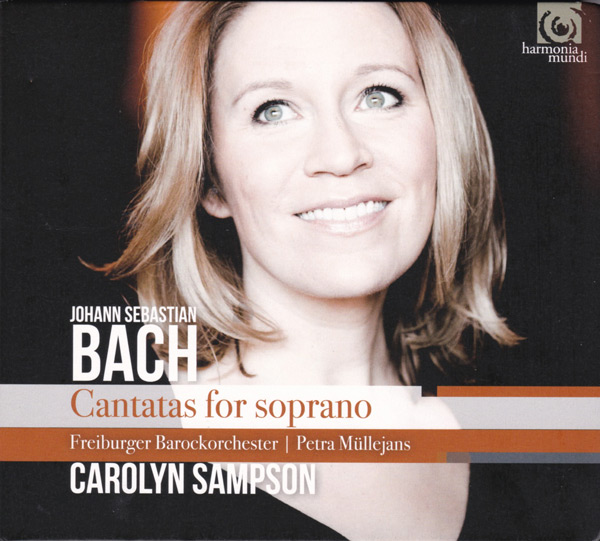
Actual Internal Dialog: "Jason, you cannot review another recording with Carolyn Sampson. You've already reviewed two, and given one a R2D4. People will think you believe there's no other soprano worth listening to."
"True. But one of the Brit pubs just gave her latest recording for Harmonia Mundi, Bach Cantatas for Soprano with the Freiburger Barockorchester under Petra Müllejans, its 'best of the month.' And the recording includes the joy-filled Wedding Cantata, Weichet nur, betrübte Schatten, BWV 202" (Begone now, Gloomy Shadows) that you first learned from Karl Richter and the Munich Bach Orchestra's early stereo rendition with Maria Stader. Plus, it's got two other cantatas, including the infrequently heard, intimate "dialog cantata" for soprano and bass that surrounds the voices with an unusual combination of recorder, oboe, viola d'amore, and viola da gamba. Besides, you've already got the 24/96 hi-rez download of the recording from HDTracks, and you can use it to evaluate dCS Vivaldi 2.0/Network Bridge combo that's here for review."
Unable to resist temptation, I hit "play" and was smitten. There is good reason why Carolyn Sampson, who has sung on at least 60 recordings since 2003, has succeeded the divine Emma Kirkby as the leading British early music soprano of our time. Listen to the eponymous opening aria of the Wedding Cantata and see how, when the music speeds up, Sampson brightens her voice to sound more youthful and innocent. Notice the tasteful, period appropriate ornaments—ornaments that Stader and earlier generations of Bach singers were not trained to include—and the perfectly executed trills which Sampson integrates into the vocal line with an ease that belies their difficulty. Admire as well the gorgeous instrumental timbres, and the manner in which Bach and Müllejans circle instrumental lines around the voice in a manner that suggests true union.
The spring and lilt in Sampson's voice, as well as her effortless runs and innocent joy, add to the dance-like quality of the cantata's second aria, "Phoebus eilt mil schnellen Pferden" (Phoebus races with his swift horses). What I believe is Frauk Hess' viola da gamba sounds wonderful. The smile on Sampson's voice in the ensuing recitative conveys her excitement and anticipation, as does the way she joyfully skips through the sunny high notes on the irresistible melody, "Wenn die Frühlingslüfte streichen" (When spring breezes blow). The next aria is so tuneful that I defy anyone who can whistle to resist joining in. (If I play it an audio show, you may have to hold me back from joining in.) Sampson's interpolations in its recap are perfect, and the pause before she and the orchestra launch into the final phrase adds to the delight.
The sonics are superb. Transparency, depth, and ideal color saturation and contrast distinguish a recording in which engineer René Möller achieves perfect clarity of line within the naturally resonant acoustic of Teldex Studio Berlin. It's an achievement that enables listeners to fully appreciate the truly sensual feast created by the contrasting timbres of period instruments. Simply delicious.
The cantata for soprano and bass, Tritt auf die Glaubensbahn, BWV152 (Tread the path of faith!), is one of those reject the pleasures of the world, accept suffering and follow Jesus to Heaven cantatas in which Bach counters all the downer stuff by imbuing instrumental and vocal lines with one delight after the other. Isabel Lehmann's recorder is a special joy. Bass-baritone Andreas Wolf may not be very strong at the bottom of his range—he certainly sounds more baritone than bass—but Sampson's highs are simply angelic.
The recording's other famous cantata for solo soprano, Mein Herze schwimmt im Blut, BWV199 (My heart swims in blood), is anything but a rallying cry for the alt-right. Sampson is at her most outgoing in the opening recitative, and sounds extremely beautiful in her first aria. If there's any weakness here, it's that she sounds a bit too innocent to be filled with so much sadness. What she displays instead, in the aria "Tief gebückt und voller Reue" (Bowing low and full of remorse), is supreme grace. This aria's bass line is simply wonderful.
The final aria of Mein Herze schwimmt im Blut is a succinct statement of pure joy, and the perfect cap to a recording where delight follows delight. They who resist shall not perish, but neither shall they experience heaven as quickly as those who listen and cherish.















