 Photo: HeadRoom.
Fang Bian, designer of the Head-Direct HiFiMAN HM-801 portable music player, is a 31-year old audiophile, music lover, and student of Nanotechnology at Hunter College in the City University of New York. In the early 1990s, Fang bought his first CD player, and, with it, discovered his curious attraction to audio. It was 1993, and a Sony ad running in a Chinese audio magazine caught Fang’s attention. The ad was for one of Sony’s portable music players. Fang was so impressed by the looks, obvious convenience, and promised performance of this thing that he bought one. It was not a negligible expense, but Fang could not resist. It was just the first of many similar purchases Fang would make. At graduate school in Tianjin, China, Fang found relief from his studies by attending the weekly flea markets, where he would soon complete his collection of Sony and Aiwa cassette players. In 1997, he helped his parents set up a home theater system, and he has been hooked on audio ever since.
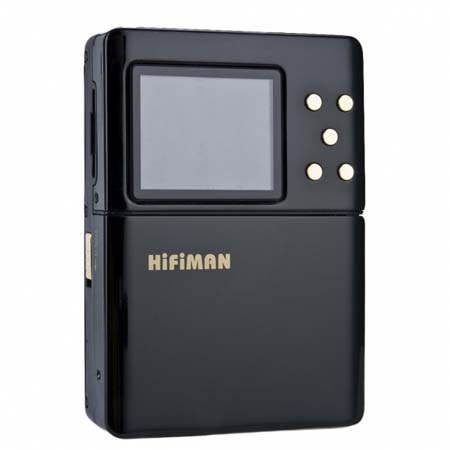
In Head-Direct’s HiFiMAN HM-801 portable music player, which measures a chunky but tidy 4.5” by 3” by 1” and weighs just a few ounces, you can easily see the influence of those weekly visits to the flea market: The HM-801 sort of resembles a Sony Walkman. But it’s nicer. With its gold highlights and its fine metallic finish, which sometimes seems a deep green and other times seems a smoky charcoal, the HM-801 exhibits a kind of certainty, almost an air of arrogance.
Photo: HeadRoom.
Fang Bian, designer of the Head-Direct HiFiMAN HM-801 portable music player, is a 31-year old audiophile, music lover, and student of Nanotechnology at Hunter College in the City University of New York. In the early 1990s, Fang bought his first CD player, and, with it, discovered his curious attraction to audio. It was 1993, and a Sony ad running in a Chinese audio magazine caught Fang’s attention. The ad was for one of Sony’s portable music players. Fang was so impressed by the looks, obvious convenience, and promised performance of this thing that he bought one. It was not a negligible expense, but Fang could not resist. It was just the first of many similar purchases Fang would make. At graduate school in Tianjin, China, Fang found relief from his studies by attending the weekly flea markets, where he would soon complete his collection of Sony and Aiwa cassette players. In 1997, he helped his parents set up a home theater system, and he has been hooked on audio ever since.
In Head-Direct’s HiFiMAN HM-801 portable music player, which measures a chunky but tidy 4.5” by 3” by 1” and weighs just a few ounces, you can easily see the influence of those weekly visits to the flea market: The HM-801 sort of resembles a Sony Walkman. But it’s nicer. With its gold highlights and its fine metallic finish, which sometimes seems a deep green and other times seems a smoky charcoal, the HM-801 exhibits a kind of certainty, almost an air of arrogance.
The owner's manual for the HM-801 informs us: “This is not just your father’s music listening device. You have just invested in a ground breaking, earth shattering, ‘changing life as we know it’ music device that is going to transform the way that audiophiles listen to music, ‘while on the go.’” So, is the HiFiMAN HM-801 really the portable music device audiophiles have been waiting for? Is it better than Apple’s iPod? Is it worth $790? (Yes, that’s how much it costs.) Let’s take a look.

Remember the Sony Walkman? Head-Direct's Fang Bian does. The front of the HM-801 is dominated by the compartment for its 15V rechargeable battery. The size and placement of this battery dictated the layout of the five primary menu keys, which occupy a small space to the right of the LCD screen. Getting used to those menu keys took a little bit of time. The Left arrow goes back one screen; the Right arrow moves forward one screen; the center button pauses playback; the Up arrow moves back one song or moves up one option on a menu list; and the Down arrow moves forward one song or moves down one option on a menu list. At first, navigating the HM-801 had me longing for my iPod’s click wheel, but I got the hang of the HiFiMAN’s buttons over time. Even after I’d become proficient, however, I found the response of the HiFiMAN’s buttons to be a little slow. Strangely, I never could figure out how to utilize the “Favorites” feature. I tried: If you press the right arrow while a track is playing, HiFiMAN asks you if you’d like to add that track to your favorites. “No” is the default answer. Click the up arrow to highlight “Yes” and click the center button to confirm. HiFiMAN pauses the song and lets you know that it’s updating the media. This process takes just a couple of seconds. When HiFiMAN is done updating, the song resumes. If you’re like me, you’ll then assume that the song has been added to the “Favorites” folder. When I later accessed my favorites, however, I found the folder was still empty. A mystery. So, while the HM-801’s functions are fairly user-friendly, they aren’t as intuitive as the ubiquitous iPod.

Buttons, switches, ins and outs. Photo: HeadRoom. Along with the headphone minijack, four more gold buttons are positioned on the top panel of the HM-801: A round Power button, a Play/Pause button, and Forward and Back buttons—convenient placement if you’ve got your HM-801 clipped to a belt loop or poking from a pocket. Hold down the Power button for a couple of seconds and HiFiMAN comes to life with an on-screen logo that’ll bring back fond memories of your Atari 2600. On the HM-801’s left hand side, you’ll find a slot for an SD card—the HiFiMAN accepts up to 32GB Class 4 SDHC memory cards—and a gold Hold key, which slides down to lock all function buttons. On the right hand side are the volume control, 3.5mm line out, USB/coax selector switch, Player/DAC selector switch, and a 3.5mm coax input. On the rear panel, there is an amplifier bay for the HM-801’s headphone amp; users can remove the stock GanQi amp module and replace it with custom-built amplifiers. The HM-801’s manual comes with pin-out and topography diagrams for alternative amp designs and instructions for replacing the stock amp module—amp-rolling fun for the tweaky audiophile. On the bottom of the HM-801, you’ll find the charger input sockets, and two USB sockets—one for data transfer and one for connection to a USB DAC. The HiFiMAN HM-801 uses a high-quality Burr-Brown PCM1704 DAC chip and OPA627 op-amp. This is a small but versatile machine with very big ambitions.

There is an actual album called "Best Audiophile Voices." Who knew? Best Audiophile Voices
The HiFiMAN has an on-board flash section. Fang had loaded this with some of his favorite tunes. I figure a good way of getting to know any audio component is to get to know its designer, and a good way of getting to know any audio designer is to get to know his or her favorite music. Fang says he was a rock fan in high school, but now listens to mostly jazz and classical. His favorite is Bach. He also enjoys vocal music, and the HiFiMAN was stocked with a folder called “Best Audiophile Voices.” Inside, I found selections by Eva Cassidy, Alison Krauss, Jane Monheit, Jheena Lodwick, Cheryl Wheeler, Jeanette Lindstrom, Karrin Allyson, and Nnenna Freelon. With the exception of Alison Krauss, familiar through Raising Sand, her successful collaboration with Robert Plant, all were completely foreign to me. Interestingly, while each track was pleasant, though sort of innocuous, there was a certain sameness to the selections. It was almost as if they were eight separate tracks from the same album, by the same artist. In any case, they did work to reveal some of the HiFiMAN’s qualities: Impressive scale; a good sense of air; a slight emphasis on the leading edges of transients resulting in a certain quickness; an ease; and full, authoritative bass. My favorite of all these songs was Alison Krauss’s “It Wouldn’t Have Made A Difference.” This is a lovely, although terribly sad, pop song featuring churning acoustic guitar, slightly overdriven electric guitar, gentle percussion, and some tinkling piano. After noting the clarity and sweet tone of the guitars, the roundness and tautness of the bass and percussion, and the sweet, airy presentation of the vocals, I put my head back, closed my eyes, and just enjoyed the song. Then I did it again.
 I saw this message, baby, shimmering in the water
Armed with a better understanding of what the HiFiMAN was all about, I turned to some more familiar tunes. Using a 1GB SanDisk MicroSD card, I stocked the HiFiMAN with just a few WAV files and I loaded my iPod Nano with identical versions of the same tracks. I also transferred some MP3s to the HiFiMAN’s on-board flash. The first song I listened to was a 192kbps MP3 download of Grizzly Bear’s “Southern Point” from the band’s outstanding Veckatimest. Immediately, the HiFiMAN impressed me with the size and authority of its presentation. This was some seriously dramatic, large-scale music-making: Big dynamic swings, nicely textured and shimmering acoustic guitar, and great forward momentum marked by an addictively resonant bass drum that had a pure, clean wallop. The iPod could not come close to achieving the size, weight, bass impact, or overall drama of the HiFiMAN. Loud bits were louder through the HiFiMAN, and quiet bits were quieter. In addition, there was a sense of ease and control to the HiFiMAN’s presentation that the iPod lacked. While certain aspects of “Southern Point”—a bass line, a distorted guitar lead, a rising backing vocal—came loose when played back through the iPod, the HiFiMAN kept all of these threads in place, offering a more holistic view on the music without highlighting or favoring any individual element. Listening to Grizzly Bear’s “Two Weeks,” I was again impressed by the HiFiMAN’s bass impact and clarity, top-end air, transient speed, and overall control. I easily followed the backing vocals as they rose and fell, hitting notes that I hadn’t previously noticed. While the iPod had a way of highlighting the backing vocals and missing their subtleties, the HiFiMAN again exhibited an ability to bring together the many musical elements to create a more meaningful whole.
 A blister in the sun
I was anxious, therefore, to find out how the HiFiMAN would perform when connected to my stereo. Using a cable loaned to me by Fang Bian and made specifically for the application, with XLO HT PRO single-ended plugs at one end and a Pailiccs 3.5mm termination at the other, I went from the HiFiMAN’s line out into the Aux 2 input on my Exposure 2010S integrated amplifier ($1295). The track was a WAV file of “The Sun Smells Too Loud,” from January 2009’s “Recording of the Month,” Mogwai’s wonderful The Hawk is Howling. This song is all about texture and is a good test of a player’s resolving abilities. Listening first with the HiFiMAN, I became aware of something I’d never before noticed—a sort of tugging, rolling moan, like that of a large, sick animal—perhaps a large, sick cow—lurking in the shadows of the mix. I didn’t know what it was, but it was surely wrong, and I couldn’t steer my focus from it. It had forced its large, sick hooves through the densely layered mix and was tugging at my shirt collar—mwhaaaah, mwhuuuuh—begging me to pay attention. Listening next to the CD through my Exposure 2010S player ($1395), I realized that the sick cow was actually a bass line. And not only was this bass line considerably more musical, but the entire sonic presentation was more vibrant and natural, with more realistic tonal color to the guitars, more body and impact to the drums, and cleaner, more tightly focused images. The authority and rhythmic certainty that the HiFiMAN so eagerly exhibited earlier was now missing in action. There’s a point in “The Sun” when the repetitive lead guitar riff finally drops out, and the listener is left with a tight tom beat, the aforementioned lurching bass, and some warbling electronics. The Exposure managed to hold everything together nicely, keeping the music flowing in the right direction and maintaining strong center-fill, but the HiFiMAN became unraveled, almost allowing the song to fall apart. Unable to reproduce the song with its proper flow, the HiFiMAN turned out to be much less engaging. To make sure I wasn’t going mad, I returned the HiFiMAN to my Grado headphones and played the song again. Happily, I found that tonal color and truth were restored to the guitars, impact and life were granted to the drums, that bass line was no longer a dying cow but an essential musical force, and a fine sense of flow was in full effect. What was going on? I reconnected the HiFiMAN to the Aux input on my Exposure and listened again. This time, the right channel was completely silent. I stopped the song and started from the top. Music emerged from the right channel, but suffered intermittent dropouts. I started to sweat. Was something wrong with my amplifier? I can only guess. (I had actually experienced this right-channel dropout problem once before, long ago, after switching to my CD input after months of having listened exclusively to LPs. The problem cured itself, inexplicably, over time.)
 As a last ditch effort, I connected the HiFiMAN to my amp’s CD input. Finally: The sound was so much better. Here the performance was much closer to that of my Exposure CD player. Low-level details emerged from the mix with fine clarity, the bass line was tight and strong, and rhythmic certainty was largely restored. I still felt the HiFiMAN lacked a touch of weight, however, with snare hits lacking their full expression, sounding less resonant and dynamic. Recalling the HiFiMAN’s knack with female voices, I then turned to a WAV file of Cat Power’s delicious “Woman Left Lonely,” from the great selection of covers, Jukebox. I was immediately impressed by the HiFiMAN’s ability to produce a room-filling sound with big, bold images. Chan Marshall’s voice was lovely, if lacking just a touch of body and texture. Turning back to the disc through my Exposure CD player, I perceived images that were placed more precisely within a similarly wide and deep soundstage. Tone and texture of guitars and percussion were more fully developed, backing vocals were more readily apparent, and Chan’s smoky, seductive voice was slightly more present and fully formed. A great thing, indeed. But, overall, the HiFiMAN did a fine job and certainly held its own.

HifiMAN, at home on the orange couch. Not just your father’s music listening device
With the Head-Direct HiFiMAN HM-801, young designer Fang Bian has devised a portable music player for the demanding audiophile. Partnered with my Grado SR60i headphones, the HM-801 had a big, authoritative quality that made my iPod Nano sound as small as it is. However, when introduced to my stereo, the HiFiMAN couldn’t quite live up to my high hopes. I ran into trouble with the Auxiliary inputs on my Exposure, and I haven’t tried taking the digital output from my Exposure CD player into the HiFiMAN’s coaxial input, so, for now, this evaluation remains incomplete.