

A recent e-mail from a reader asked why we list the recordings and systems used by Stereophile writers in their reviews. I responded that we do so in order that readers can place our value judgments in context, and predict how those products might sound with different ancillaries and recordings when they audition the products reviewed at their local high-end audio retailer.
"What local retailer?" was this reader's response. The nearest audio retailer was 200 miles from where he lived, and even that retailer had a very limited selection of products to demonstrate.
The scarcity of retailers at which audiophiles can audition components, let alone compare them, thus increases the importance of audio shows, and it is perhaps no coincidence that, as Jason Victor Serinus reported last January, 2011 sees more shows taking place in North America than in previous years. Because shows are a major conduit through which to pump energy and enthusiasm into the audio market, I decided at the end of last year that Stereophile should be represented at as many of the 2011 shows as possible, and should take part in dealer-sponsored events elsewhere as well.
As I write this, we're halfway through the 2011 audio-show season, and some events have done better than others. Salon Son et Image, in Montreal at the end of March, took place in a good venue, was well supported by manufacturers, distributors, and dealers, had a full program of musical performances and educational seminars, and was well attended. However, I was told that it didn't generate as many sales for the retailers who participated as had been expected.
AXPONA, which took place in Atlanta in mid-April, was also held in a good venue with plenty of good-size rooms, and its list of exhibitors included plenty of marquee names. And while it, too, had a full program of musical performances and educational seminars, attendance was poor. Still, more than one exhibitor told me that having exhibited at AXPONA generated enough sales in subsequent weeks to cover their show expenses.
Michael Fremer writes about his experience at AXPONA in his column this month (p.31), as well as about T.H.E. Show Newport Beach, which took place in southern California in early June. T.H.E. Show was held in a good venue and boasted about the same number of major brands as AXPONA—but attendance was approximately three times greater than at the Atlanta show, and even twice that at the 2010 edition of the well-established Rocky Mountain Audio Fest. Partly this may have been because the ticket price was low. But no matter how you look at it, T.H.E. Show Newport Beach must be judged a success.
By contrast, AXPONA New York City, held at the end of June, was a disappointment, with only a small number of exhibitors. Partly this was because of a very short lead time—the New York event was first announced at the Atlanta show, just two months before—but the hotel was shabby, the signage poor, and attendance low. However, while attendees complained to me about the small number of exhibit rooms, this did mean that almost every exhibitor enjoyed a packed room for the entire length of the show.
Two weeks after this issue goes to press, I am off to the Capital AudioFest, in Rockville, MD; the week after that, Stephen Mejias will report from the California Audio Show, in San Francisco. September sees the TAVES Show, in Toronto, and October the Rocky Mountain Audio Fest, in Denver. As far as audiophiles are concerned, the more shows, the better—but which of all these shows will survive into 2012 will ultimately depend on how many exhibitors get a commensurate benefit from what they spend supporting them.
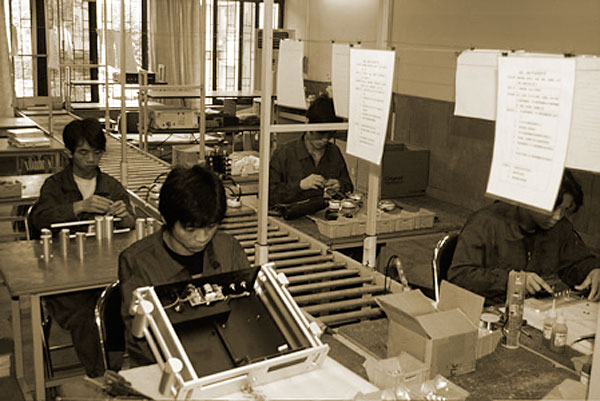
Returning home on the subway from AXPONA NYC, I realized something about the loudspeakers reviewed in this issue. The KEF Q900 is ostensibly English, the Pioneer SP-BS41-LR Japanese, the Atlantic Technology AT-1 American—yet all three are made in China. I then ran down the list of the other products we write about this month. Just one, the Ares phono preamplifier from Rogue Audio, is made in the US. The Oppo BDP-95 Blu-ray player, featured on our cover, is Chinese, as are the AudioQuest and RadioShack cables Stephen Mejias auditions in "The Entry Level." The EAR 324 phono preamp, Giant-Killer cables, and Musical Fidelity AMS100 come from England; the Furutech GT40 and Integra DHC-80.2 ostensibly from Japan; the Stein Music Harmonizers, MBL 9007 power amplifier, EMT TSD 15 pickup head, and Dr. Feickert Analogue Blackbird turntable from Germany; the Kuzma 4Point tonearm from Slovenia. And though the Classé CT-M600 is made in Canada, that is only because, at its high price, the cost of manufacture is less critical in that it can be passed on to potential customers.
My late father always told me that wealth comes from people making things and selling them; bankers, stockbrokers, and realtors move money around, he said, but they don't create wealth. It was only years later that I realized that he was channeling what 18th-century philosopher and economist Adam Smith had written in his The Wealth of Nations (1776): "Labour was the first price, the original purchase—money that was paid for all things. It was not by gold or by silver, but by labour, that all wealth of the world was originally purchased."
But it was also Adam Smith, called "the Father of Modern Economics," who first defined the concept of the free market. Smith proposed the theory of how the invisible hand of self-interest allows a free market to operate. (It is often overlooked that for the invisible hand to operate efficiently, customers need access to all relevant information, and that a free market mandates freedom of information.) In a global marketplace, the efficient operation of the free market demands that manufacturing be done where it costs least—which you see in today's migration to China of the manufacturing of audio products.
It remains to be seen if, in China, the rise of a prosperous middle class and the growth of stricter environmental laws in that pollution-ridden country will increase the cost of manufacturing there. Some US audio manufacturers are already talking about moving production back to North America. But if manufacturing continues to leave North America, while some of us may still have money, we might not necessarily have wealth. As Adam Smith also wrote in The Wealth of Nations, "No society can surely be flourishing and happy, of which the far greater part of the members are poor and miserable." And no matter where it is made, poor and miserable people don't buy high-end audio equipment.















