

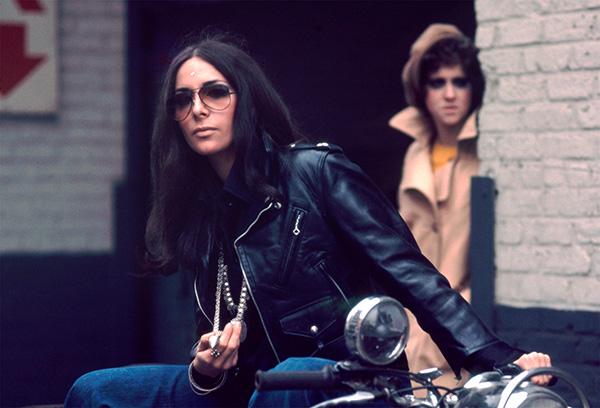
Her life became a whirlwind. Taking the train in from Brooklyn to Manhattan to pitch songs and experience the East Village scene, she landed a song-publishing deal at age 14. In 1968, at 18, after a chance meeting in an elevator, a legendary songwriter/record producer was interested in assisting her in making her debut album. Released on Atlantic Records in 1969, Lotti Golden's Motor-Cycle was wildly experimental and ahead of its time. Seemingly poised for success, the album and her career suddenly vanished.
Often described as "Motown meets the Velvet Underground," Motor-Cycle, which has become a rich source of samples, is a blend of the counterculture street scene in New York City with touches of psychedelia, jazz, soul, and spoken word. Even today it's beguiling. Original tunes like "Motor-Cycle Michael" and "A Lot Like Lucifer (Celia Said Long Time Loser)" still seem strikingly inspired.
Showered with praise by Atlantic co-owners Ahmet Ertegun and Jerry Wexler at the time of its release, Motor-Cycle has now been remastered and reissued for the first time, by a new indie label, High Moon, complete with a 32-page softbound book of photos and essays. A 7" picture-sleeve single is available as an add-on to the LP set.
Golden, who still lives in New York City, released a second album, Lotti Golden, on GRT Records. Later, she wrote about music for Creem and Crawdaddy magazines, produced electro hip-hop with Warp 9, and wrote hit singles including "With Every Beat of My Heart" for Taylor Dayne and "Keep on Pushing Love" for Al Green. The disappearance of Motor-Cycle didn't break her, but it left her pondering what might have been.
"Looking back and understanding the industry now, I think that 90% of it was that I didn't have management," Golden told me in a recent Zoom call. At 75, Golden is still an entertaining raconteur, a classic New Yorker who's lost none of her spunk and verve. "Everybody had a manager. Laura Nyro had a manager. Bob Dylan, Janis Joplin, they had great managers. If I had had Albert Grossman or David Geffen, they would have fought for me. "Ahmet Ertegun, he was like a mentor. He loved the record, and he was such a good supporter/friend. I have pictures of him in the studio when we were recording. He loved to go nightclubbing to find new talent, and I would go out with him late at night. It was either a sleazy dive or a really cool club. And Jerry Wexler, he was, like, in love with me. He was fawning, telling me 'Oh you sound like Aretha, the same chops as Aretha.'
"They were supportive, but things were changing at Atlantic. First of all, they sold to Warner Brothers, and the whole company was being restructured. And Jerry hated it, and he wanted to get out of there, so he set up his move to Miami. And in 1969, very last minute, Dusty Springfield pops up. So he's producing Dusty in Memphis—it was really Dusty in New York, they did a few things in Memphis, but then they did a lot of it at Atlantic Studios in New York. So, they got busy with those things. And then Ahmet was in London a lot that year to sign British bands, so he couldn't oversee Motor-Cycle. And guess who came out in 1969? Led Zeppelin. And Crosby, Stills & Nash, and a new Aretha. So you had the roster artists, new artists, so without a manager, forgetaboutit!"
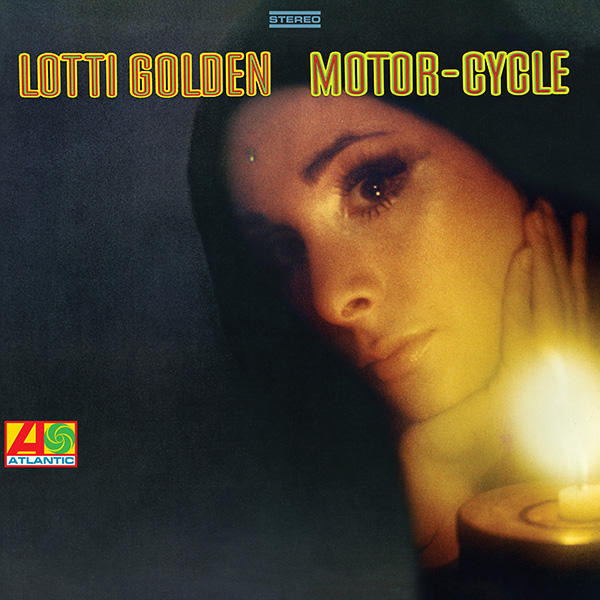 Still an extraordinary listen, Motor-Cycle has the virtue of being one of a kind, a completely original recording that will send for background. The album's seven tracks, recorded at New York's Sound Center and A&R Studio, were produced by Bob Crewe, a musical polymath who through the '60s and '70s wrote and produced a slew of successful hit singles including "Walk Like a Man," "My Eyes Adored You," and "Lady Marmalade." It was Crewe who met Golden by chance in an elevator, was impressed by her pitch, and signed her to a publishing deal.
"It was the literal definition of an elevator pitch. I don't know when that term came into use, but it's so funny," Golden cackles. "Bob Crewe loved the songs, he loved the concept. When it came time to record, I knew what he wanted to do, but when I heard it with all the horns, it was shocking. I didn't imagine it that way. I didn't imagine it just guitar and voice, but I imagined it more rootsy, more basic, without all those overdubs. But as we were working, I saw his vision, which was grand because he really dug into the lyrics and the concept. And so much of it is so tongue-in-cheek, irony and the sarcasm are really present, and he really wanted to illustrate that musically. You can hear the humor in the production."
After more than five decades of consideration, does she consider it overproduced?
"If something's overproduced, what does that mean? It means it's too much for that song, right? It's gratuitous. There was nothing gratuitous in there. Bob had a reason for everything. Overproduced can get into schlocky. Or you didn't need that to get the song across. But the gestalt works in this."
While she likes the sound of this new remaster, which was sourced from a tape copy—"It sounds good considering what we had to work with"—Golden wishes she could have another go at the mix.
"It's too bad that actual master tapes, the 24-track tapes, were lost," she concludes. "It was either a fire or a flood; I got conflicting information. But to go back to the 24-track tape, that would be, oh my gosh, so wonderful to be able to tweak the vocals now with today's EQs. That would be incredible."
Still an extraordinary listen, Motor-Cycle has the virtue of being one of a kind, a completely original recording that will send for background. The album's seven tracks, recorded at New York's Sound Center and A&R Studio, were produced by Bob Crewe, a musical polymath who through the '60s and '70s wrote and produced a slew of successful hit singles including "Walk Like a Man," "My Eyes Adored You," and "Lady Marmalade." It was Crewe who met Golden by chance in an elevator, was impressed by her pitch, and signed her to a publishing deal.
"It was the literal definition of an elevator pitch. I don't know when that term came into use, but it's so funny," Golden cackles. "Bob Crewe loved the songs, he loved the concept. When it came time to record, I knew what he wanted to do, but when I heard it with all the horns, it was shocking. I didn't imagine it that way. I didn't imagine it just guitar and voice, but I imagined it more rootsy, more basic, without all those overdubs. But as we were working, I saw his vision, which was grand because he really dug into the lyrics and the concept. And so much of it is so tongue-in-cheek, irony and the sarcasm are really present, and he really wanted to illustrate that musically. You can hear the humor in the production."
After more than five decades of consideration, does she consider it overproduced?
"If something's overproduced, what does that mean? It means it's too much for that song, right? It's gratuitous. There was nothing gratuitous in there. Bob had a reason for everything. Overproduced can get into schlocky. Or you didn't need that to get the song across. But the gestalt works in this."
While she likes the sound of this new remaster, which was sourced from a tape copy—"It sounds good considering what we had to work with"—Golden wishes she could have another go at the mix.
"It's too bad that actual master tapes, the 24-track tapes, were lost," she concludes. "It was either a fire or a flood; I got conflicting information. But to go back to the 24-track tape, that would be, oh my gosh, so wonderful to be able to tweak the vocals now with today's EQs. That would be incredible."
Still an extraordinary listen, Motor-Cycle has the virtue of being one of a kind, a completely original recording that will send for background. The album's seven tracks, recorded at New York's Sound Center and A&R Studio, were produced by Bob Crewe, a musical polymath who through the '60s and '70s wrote and produced a slew of successful hit singles including "Walk Like a Man," "My Eyes Adored You," and "Lady Marmalade." It was Crewe who met Golden by chance in an elevator, was impressed by her pitch, and signed her to a publishing deal.
"It was the literal definition of an elevator pitch. I don't know when that term came into use, but it's so funny," Golden cackles. "Bob Crewe loved the songs, he loved the concept. When it came time to record, I knew what he wanted to do, but when I heard it with all the horns, it was shocking. I didn't imagine it that way. I didn't imagine it just guitar and voice, but I imagined it more rootsy, more basic, without all those overdubs. But as we were working, I saw his vision, which was grand because he really dug into the lyrics and the concept. And so much of it is so tongue-in-cheek, irony and the sarcasm are really present, and he really wanted to illustrate that musically. You can hear the humor in the production."
After more than five decades of consideration, does she consider it overproduced?
"If something's overproduced, what does that mean? It means it's too much for that song, right? It's gratuitous. There was nothing gratuitous in there. Bob had a reason for everything. Overproduced can get into schlocky. Or you didn't need that to get the song across. But the gestalt works in this."















