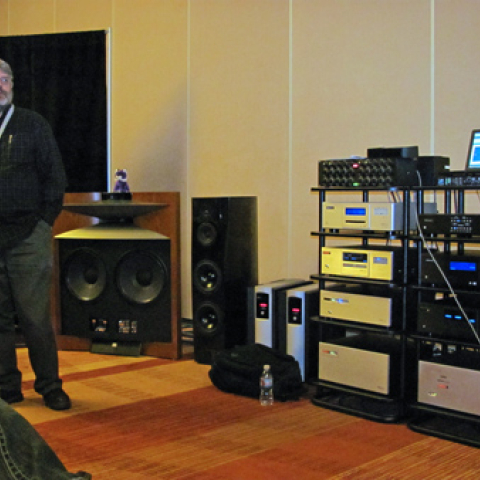
There was a time when Harry Pearson, founder of
The Absolute Sound and one of the high-end's true living legends, rarely ventured from the confines of his kingdom at Seacliff, Long Island. Rather than trolling for equipment at shows like countless other audio reviewers, he invited manufacturers to come to him. Flock they did, hoping that their equipment and set-up expertise would warrant a sales-insuring rave or Golden Ear from HP.
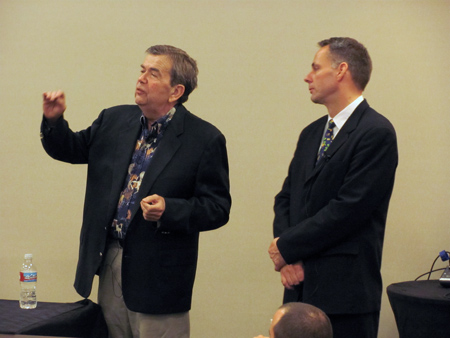
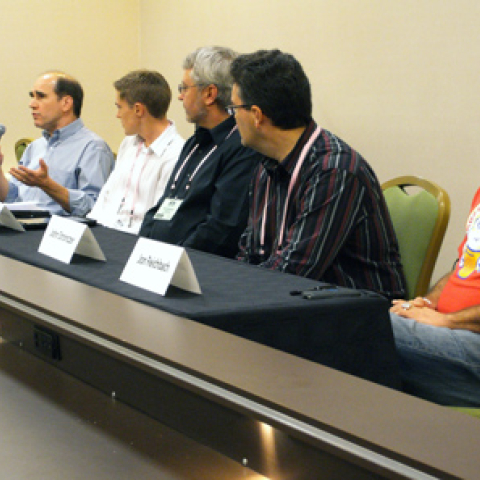
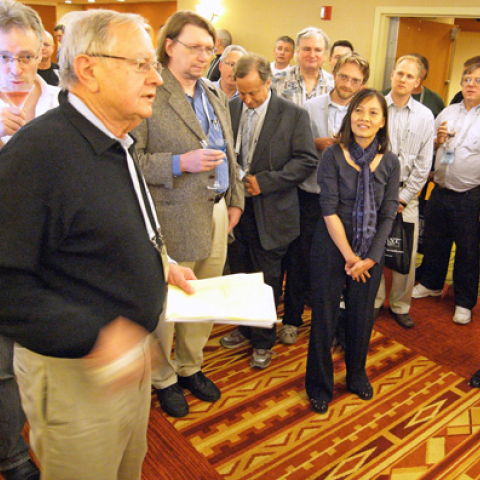
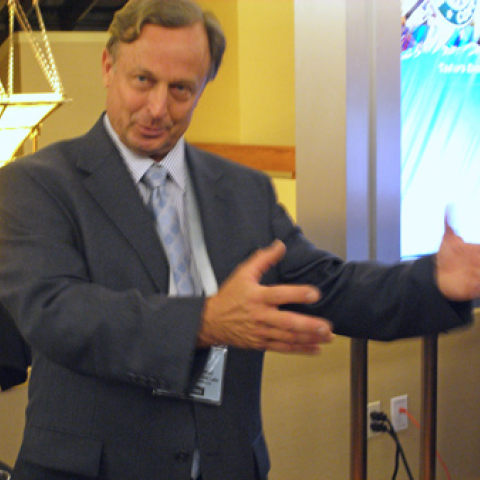
Brava to Marjorie Baumert for convincing Harry, whom I thank for giving me my first opportunity to write for a print audiophile publication, to present at RMAF 2009. Before an absolutely packed house—both me and Harry's co-presenter Roy Gregory (right) had to push our way through the large-framed men who were blocking the doorway—HP held forth on
The High End: Past, Present, Future. Those expecting a capsule history of the high-end were instead treated to 15 minutes of random observations, followed by a long question and answer session.
Among the nuggets dispensed for us to chew on was praise for Telarc's new multi-channel hybrid SACD of John Adams' Pulitzer Prize-winning tribute to the victims of 9/11,
On the Transmigration of Souls, one of the few SACDs Telarc is releasing these days. HP praised the veracity of the surround experience as "overwhelming."
He also urged all audio stores to install computer stations where people can connect their iPods, iPhones, and computers and hear the difference that high-end equipment can make. How many people here have iPhones, he asked? And how many of you have discovered a dealer who understands that in your pocket is a portable media storage device that may contain all the music you listen to? Dealers need to be of the people. Most kids aren't happy with the sound of basic MP3, he said. "They always go for something of higher resolution," even if its 256 kbps, because they can hear the difference." People want something better, but we are not reaching them.
At another point, Harry noted, "If you listen on headphones all the time, you don't really hear the music. You need to feel the energy of the live concert experience." Gregory, former editor of
HiFi+, then chimed in, proclaiming that the big system at Seacliff conveys a visceral experience like nothing he had heard at RMAF. Did I hear strains of "To Dream the Impossible Dream" playing in the background?
"A lot of systems don't sound like music," said Harry. "They sound like hi-fi. When I go to Carnegie Hall, I sometimes close my eyes and try to pretend I'm listening to a hi-fi system, so I can see what I'm missing." Some of the great designers continued to issue great gear even as their hearing declined with age, because they were designing to what they heard in the concert hall. Hence the importance of a life reference, the experience of acoustic music performed in an excellent acoustic.
Harry also reminded us that his magazine was the first to hire women reviewers, and that women's hearing is superior in the crucial 4–8 kHz range. One of the very few women present (were there more than two?) then spoke, noting that she had to flee a number of rooms at RMAF because the sound was too bright. I wonder if she saw me asking people to either turn the music down because it was too piercing, or following in her footsteps and making a quick exit.
Happily, Harry repeats the seminar on Saturday night. After you attend the three seminars John Atkinson moderates and presents on Saturday, and Michael Fremer's "Turntable Set-up," be sure to return to the seminar room early to snatch a seat. You have to be there.