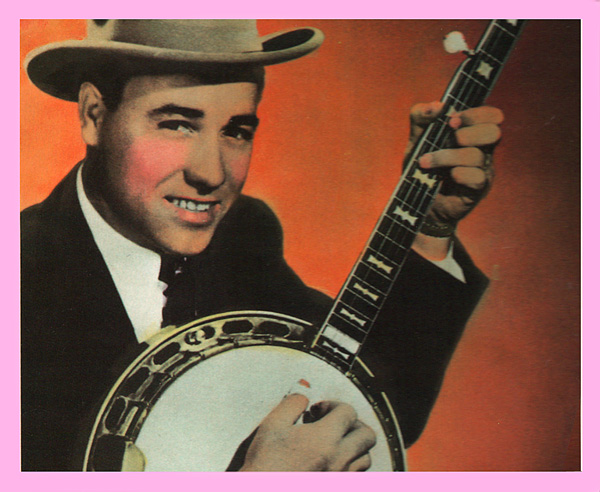
The late Bill Monroe may have been the father of bluegrass music, but it was the distinctive banjo playing of Earl Scruggs that most listeners came to recognize as the voice of an entire style. Scruggs, who died on March 28 at the age of 88, left an indelible imprint on American music, influencing virtually ever player of the five-string banjo to follow.
Born in January of 1924 to a farming family in Shelby, North Carolina, Earl Scruggs began playing banjo at the age of four. A shy, introverted boy, he devoted countless hours to perfecting his right-hand technique, eventually hitting upon a syncopated three-finger "roll" that was distinct from the "clawhammer" picking style typical of American folk and country players. While still in his late teens, Scruggs went to work in a cotton mill—farmwork was too hard on his hands, he said—and began playing with local country groups in the evenings.
Word of his prowess spread fast, and by late 1945 the successful bandleader Bill Monroe was urged to hire Earl Scruggs to fill the vacancy left by the departing banjoist and comedian Dave "Stringbean" Akeman. On the eve of Scruggs's audition, according to Monroe biographer Richard D. Smith, band member Lester Flatt urged his boss not to bring another "clunky" instrumental sound into the group: "This Scruggs fellow can leave his banjo in its case," he advised. Within minutes of hearing the shy banjo player, Flatt reportedly whispered to Monroe, "Hire him no matter what it costs." Earl Scruggs joined the Blue Grass Boys at a salary of $60 a week; his life—and country music—would never be the same.
A little over two years later, both Earl Scruggs and Lester Flatt left Bill Monroe's band and formed a group of their own, the Foggy Mountain Boys (named after the Carter Family standard "Foggy Mountain Top"). Within a year the new group enjoyed far more success than Monroe ever would, with chart-crossing hit records in 1962 ("The Ballad of Jed Clampett") and 1969 ("Foggy Mountain Breakdown.") Notably, Flat and Scruggs and the Foggy Mountain Boys were more willing to reach out to young listeners, as exemplified in their 1969 concert—complete with light show!—at San Francisco's Avalon Ballroom. A few years later, following the dissolution of the Flatt and Scruggs partnership, Earl Scruggs famously performed "Foggy Mountain Breakdown" at an anti-war rally in Washington D.C. (At around the same time, interestingly enough, "Stringbean" Akeman, the man whom Scruggs replaced in Bill Monroe's Blue Grass Boys, recorded a single that was also harshly critical of "this crazy Viet Nam war.")
Earl Scruggs' decidedly youthful approach to bluegrass music continued throughout the 1970s. His next band, The Earl Scruggs Revue, used drums and an electric bass, and drew upon the musical contributions of his sons Randy, Gary, and Steve. And, in 1972, Scruggs raised eyebrows—and ultimately coerced some of his Nashville colleagues—in joining the Nitty Gritty Dirt band for their landmark three-record set, Will the Circle Be Unbroken. (In a 2002 interview for Listener Magazine, the Dirt Band's John McEuen told me that Bill Monroe declined to participate, largely because of Scruggs's involvement; years later, in the wake of the record's success, Monroe approached the young musician at a festival and asked to be included "the next time you do one of those Circle records.")
No doubt most bluegrass fans cherish their memories of seeing and hearing Scruggs perform live. My own favorite Earl Scruggs memory is from relatively late in his career, at the 2005 Grey Fox Bluegrass Festival in New York's Hudson River Valley. Just as Earl and his all-star band took the stage for the Saturday night set, a thunder storm erupted and the sudden, harsh downpour sent the band offstage and the audience running for cover. I took shelter under the awning of a CD vendor located near to the stage, and was prepared to stay there and wait things out—until I heard live music coming from the sound system. As it turned out, Scruggs asked for a single microphone to be set up backstage, and he and his band gathered around it to perform one old fiddle tune after another while waiting for the rain to stop. Priceless.
The importance of banjo player Earl Scruggs to the history of country music simply can't be overstated, and his distinctive, driving sound remains instantly recognizable, nearly 70 years after he left that cotton mill. His passing will be deeply felt.