

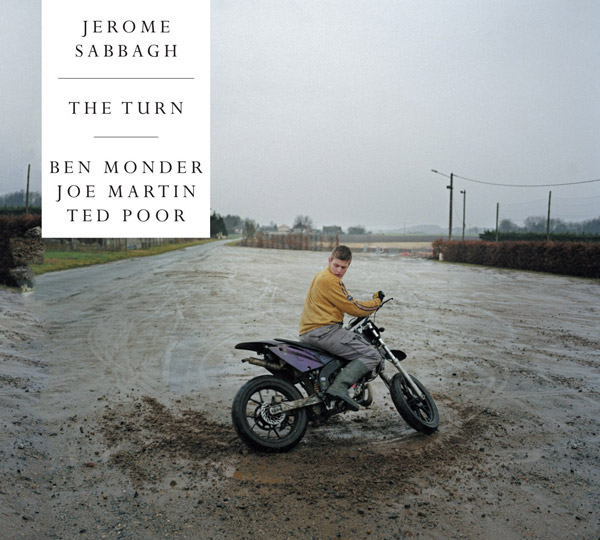
Jerome Sabbagh, 41, born and bred in Paris, a low-key staple of the New York jazz scene for the last decade or so, plays tenor sax with a plaintive tone and moody lyricism reminiscent of Stan Getz. And he's a composer, too, wading more in the vibe of early Sonny Rollins or the sinuous modalism of Paul Motian.
His new album, The Turn (Sunnyside), is a fine display of Sabbagh as player, composer, and bandleader. Seven of the eight tracks are originals; the one cover, tellingly, is of Motian's "Once Around the Park," from Misterioso, one of the late drummer's early recordings with Joe Lovano and Bill Frisell—and the sound of that group bears a clear influence on this band, Sabbagh's regular quartet, with Ben Monder on electric guitar, Joe Marin on bass, and Ted Poor on drums.
The songs pivot from cloudy ballads to rock-out sprinters (as Motian's later, electrified albums often did), though there's nothing vague or meandering about this music. I prefer the ballads to the rockers, but this, all of it, is music to get deeply involved in. There's a surefootedness in Sabbagh's playing, an ideal balance of weighty and airy, and a cohesiveness to the quartet that's at once tight and limber.
Another attraction: the album sounds superb, and this is not happenstance. Sabbagh is an audiophile; he chose to record the session at Sear Sound, in live-to-two-track analog, and put James Farber at the controls. There's one twist, though. Analog tape reels turned out to cost a lot, especially when they spin at 30ips, so once a reel was full, Farber transferred it to 24/88.2k digital and re-used the tape.
But then the tale gets interesting. Sabbagh took the files to the legendary Doug Sax at The Mastering Lab. Sax was impressed with the files, but knew they could sound better still, so he mixed them back to analog before mastering them for CD and digital download—and he convinced his new client to put the album out in vinyl, too. And having made that decision, Sabbagh took the final results to the QRP cutting lathes at Analogue Productions. And to get in all 56 minutes of music without risking inner-groove distortion, he had QRP stretch the grooves out on two virgin-vinyl discs.
The results are spectacular. Sabbagh's sax floats palpably between the speakers, Poor's drumkit crashes and sizzles (I found myself blinking my eyes at the impact), Monder's guitar sparkles or wails off to the left, and Martin's bass plucks and thumps like an anchor. Everything is clear, in a wide, deep, seamless space. The CD sounds quite good, but nothing like this. (I haven't heard the high-rez download.)
Would the LP have sounded better, if the recording chain had remained in analog from start to finish? Probably, but what we have here is more than good enough. Sabbagh says that, if he'd contemplated going vinyl from the beginning, he would have spent the extra money on tape reels. (He was under tight budget constraints; to make the LP, he had to raise money through a Kickstarter campaign.) Maybe next time.
QRP pressed a limited run of 500 copies, and they're almost sold out. You can buy them from Sabbagh's website or, starting today, through normal retail outlets from Sunnyside Records, which also put out the CD last year in much larger (and still very much available) quantity. Sabbagh is thinking about pressing more LPs if the demand holds up. I'd say if this sort of music appeals to you, get it while you can.















