

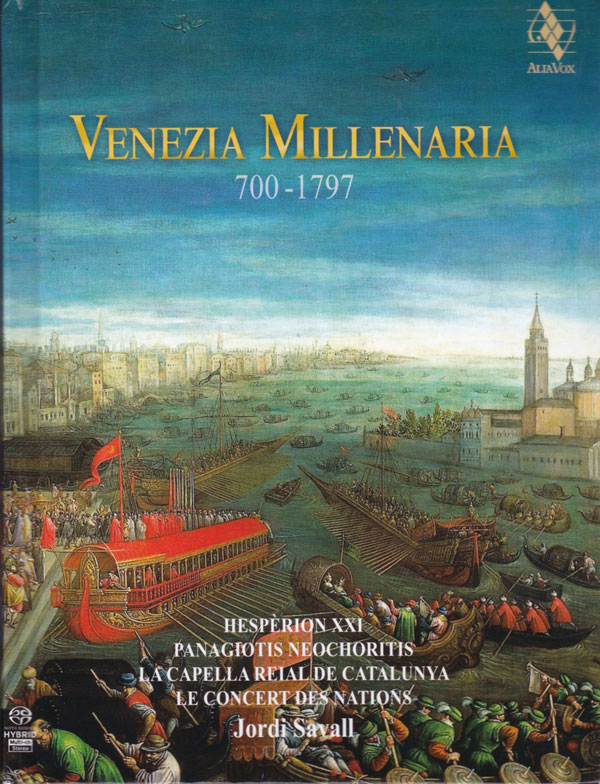
Jordi Savall, the gifted viola da gamba player and ensemble founder who, together with his late wife, soprano Montserrat Figueras, infused early music with inestimable life and color, has released his 16th high-resolution musical history book for Alia Vox. As one might expect from an artist dedicated to promoting music as the great unifier, the 37 tracks, copious illustrations, and five comprehensive essays on the two-hybrid SACD set, Venezia Millenaria 700–1797, along with its copious illustrations and five comprehensive essays in six languages, explore the history of the water-surrounded refuge that, over the course of a millennium, became home to, in the words of Victorian era critic John Ruskin, "the only European people who appear to have sympathized to the full with the great instinct of the Eastern races."
Augmenting the forces of his three ensembles—Hespèrion XXI, La Capella Reial de Catalunya, and Le Concert des Nations—with four superb "Oriental musicians" and the Greek Vocal Ensemble Orthodox/Byzantin under cantor and director Panagiotis Neochoritis—Savall recorded concerts given in the University of Salzbourg's Abby de Fontroide in Vienna and TivoliVredenburg in Utrecht, Holland. Astounding in breadth, the program begins with an 8th century instrumental fanfare meant to celebrate the birth of Venice, and ends with Savall's musically satisfying but nonetheless eyebrow-raising cut and paste of a four-voice setting of French text by Adolphe Joly onto excerpts of the funereal Allegretto of Beethoven's Seventh Symphony and the joyful final Allegro from his Fifth Symphony.
Assuming you have not fled this page in horror at thoughts of Beethoven revised, the musical ensembles alternate secular and sacred excerpts of music from Christian, Muslim, Jewish, and other sources. As enlightening as the similarities and contrasts may be, what is most striking from the audiophile perspective is the huge range of color and texture the musicians draw from instruments as diverse as the oud, duduk, sackbut, theorbo, guitar, and medieval harp. The variety of percussion, gongs, and clanging instruments is vast, and the sonic contrasts between striking, plucking, strumming, and bowing ear-opening. Although the microphones, and or recording decisions deliver the sounds of instruments and voices with heightened polish, their jewel-like beauty, captured within two cavernous acoustics is a thing of wonder.
Even though the longest track on the recording—Monteverdi's epic-defining Il combattimento di Tancredi e Clorinda—lasts less than 17-minutes, and most selections are in the 2–4 minute range, excerpts of overtone chanting and sacred drones from multiple religions offer ample opportunities to trance out. What keeps the attention focused is the fascinating musical cross-pollination between Byzantine, Christian, North African, Armenian, Ottoman Empire, Greek, French, Jewish, and German cultures.
While most of the material is handled with great respect for authenticity, improvisational freedom and instrumental choices add Savall's stamp to virtually everything. For an absolute hoot, do not miss his adaptation of the famous Alla turca Allegretto from Mozart's Piano Sonata No.11, KV331. While Savall has made any number of recordings in which traditional orchestration is followed to a "T," he settles for anything but a piano in the context of this musical melting pot. To find out what he does, you must listen to either the SACDS or 24/88.2 files that are downloadable from multiple sites.
I won't pretend that everything on this recording is perfect. The voices of La Capella Reial de Catalunya's soprano and mezzo-soprano have their limitations, for example. But the extraordinary opportunity to learn about and hear how the music of Venice reflected the politics and culture of its creators during 1100 years of peace and disruption is not be missed. (Nor is the opportunity to discover how well your system can handle it all.) I highly recommend this remarkable contribution to understanding from the indefatigable Savall.















