Anthony Chiarella, director of sales and marketing for Gryphon NA, was joined by Command Performance AV CEO Jeff Fox and sales manager Jessie Bentley to present two debuts.
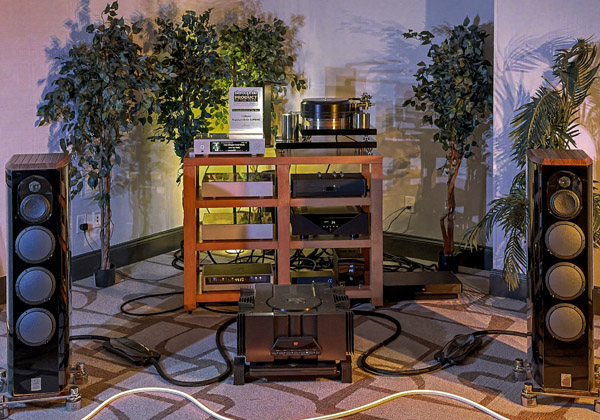
The US debuts of the Aurender N50 music server ($38,500) and the Gryphon Audio Designs Antileon Revelation stereo power amplifier ($49,800) were joined by an equally celebratory system.
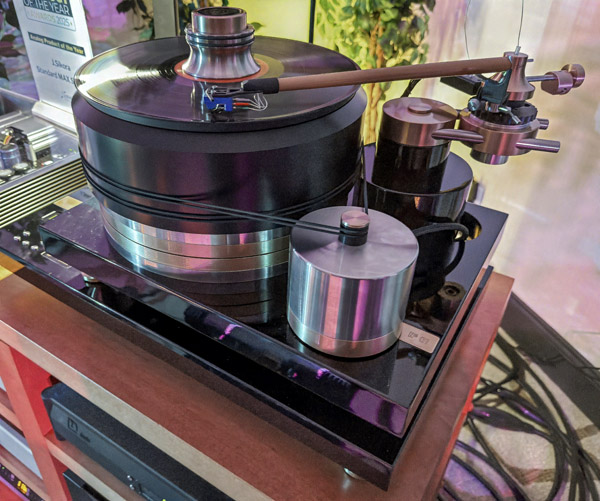
A J.Sikora KV Max 12" tonearm ($15,680) was mounted on a J.Sikora Max Supreme turntable ($40,785) and held an Aidas Violet Gold LE cartridge ($7535). That cartridge's tiny output ran into a Doshi Audio EVO phono preamplifier ($23,995). For digital playback, a Berkeley Audio Design Alpha DAC Reference Series 3P ($34,000) combined with a Berkeley Audio Design Alpha USB Reference Series ($5995) and that debut Aurender N50.
 Amplification included the Gryphon Essence preamplifier ($21,500), which fed signal to the Antileon Revelation stereo power amplifier (Stereophile review forthcoming), which drove Marten Mingus Quintet 2 Statement Edition loudspeakers ($120,000/pair; review forthcoming of big brother Marten Mingus Septet Statement Edition). A Gryphon Audio Designs PowerZone 3.10 power optimizer ($15,700) and Transparent Audio's connoisseur-level XL and Opus cables realized the full system.
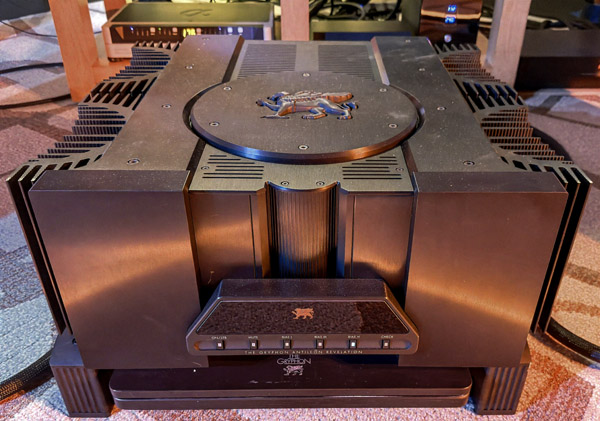 "Each chassis of the Antileon Revelation stereo amplifier is outfitted with 40 high-current bipolar Toshiba output transistors—identical to those used in Gryphon's flagship Apex—and 335,000µF of power supply capacitance per channel, or 670,000µF per chassis," the press release said. "A pair of discrete, custom-made 1150VA toroidal transformers are fitted to each chassis while a third, independent power supply is dedicated to digital control circuitry. As with all Gryphon power amplifiers, both stereo (165Wpc) and mono (180Wpc) versions are available. Sonically, Revelation advances its predecessors' considerable strengths, boasting subterranean, pitch-perfect bass, more extended and airy treble, and the grainless, palpable, three-dimensional midrange that only pure class-A output circuitry can deliver."
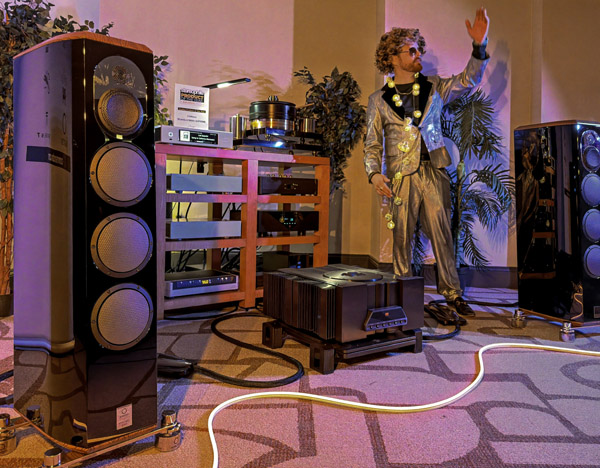 Wearing their best 1980s throwback costumes and wigs, Fox and Bentley played Led Zeppelin's "Going to California," Duke Ellington's "Love You Madly," and Herbie Hancock's "Chameleon." Zep was uber articulate and sweet; Duke's music soared from the system with wide-span dimensions and superb treble crispness; Hancock strode upon funk rhythms with urgency and refinement. This entire system played like a chameleon, letting the music flow unhindered and free.
Amplification included the Gryphon Essence preamplifier ($21,500), which fed signal to the Antileon Revelation stereo power amplifier (Stereophile review forthcoming), which drove Marten Mingus Quintet 2 Statement Edition loudspeakers ($120,000/pair; review forthcoming of big brother Marten Mingus Septet Statement Edition). A Gryphon Audio Designs PowerZone 3.10 power optimizer ($15,700) and Transparent Audio's connoisseur-level XL and Opus cables realized the full system.
"Each chassis of the Antileon Revelation stereo amplifier is outfitted with 40 high-current bipolar Toshiba output transistors—identical to those used in Gryphon's flagship Apex—and 335,000µF of power supply capacitance per channel, or 670,000µF per chassis," the press release said. "A pair of discrete, custom-made 1150VA toroidal transformers are fitted to each chassis while a third, independent power supply is dedicated to digital control circuitry. As with all Gryphon power amplifiers, both stereo (165Wpc) and mono (180Wpc) versions are available. Sonically, Revelation advances its predecessors' considerable strengths, boasting subterranean, pitch-perfect bass, more extended and airy treble, and the grainless, palpable, three-dimensional midrange that only pure class-A output circuitry can deliver."
Wearing their best 1980s throwback costumes and wigs, Fox and Bentley played Led Zeppelin's "Going to California," Duke Ellington's "Love You Madly," and Herbie Hancock's "Chameleon." Zep was uber articulate and sweet; Duke's music soared from the system with wide-span dimensions and superb treble crispness; Hancock strode upon funk rhythms with urgency and refinement. This entire system played like a chameleon, letting the music flow unhindered and free.