As one of the Top Five KEF dealers in the United States, AudioVision San Francisco was chosen as the site for the country's first in-store demo of KEF's Blade ($30,000/pair) on January 19. Given that the Blade's previous three quasi-public demos were either at shows—CEDIA 2011, where the environment was reportedly too noisy for anyone to get a good listen, and RMAF 2011, where the room was too small—or KEF's 50th Anniversary Party in the British Embassy in New York City, this was actually the first time that anyone on the West Coast, or any bloke who happened to wander in off the street, had a chance to hear KEF's long-awaited speaker in more supportive surroundings.
Braving the long-awaited rains, which came as something of a shock after what seemed like almost a month of rainy season drought, was not the oft-lamented, homogenous group of lily white, aging audiophiles but a noticeably youthful and middle-aged crowd that included people of different ethnic and racial backgrounds.
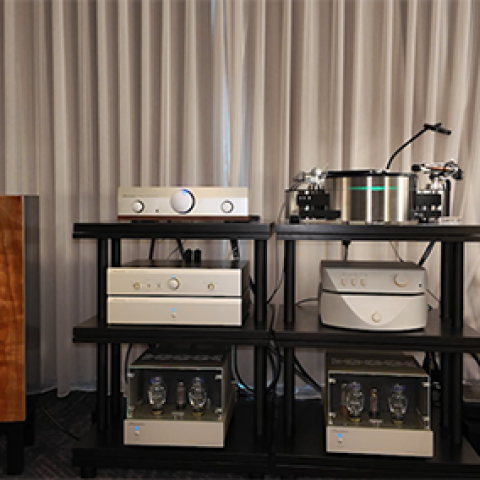
 Demming the forthcoming Simaudio Moon 180 MIND Network Music Player ($1250) was Costa Koulisakis (left in photo), the company's VP of Sales & Marketing. In his sixth or seventh demo at AudioVisions, of which I have enjoyed at least four, Koulisakis paired the prototype wireless player with the Moon 650D DAC/CD Transport ($9000), flagship two-chassis 850P preamplifier ($28,000) and W-8 power amplifier ($16,000).
 The Moon 180 MIND (Moon Intelligent Network Device) music streamer has been designed to play files up to 24/192 from any storage drive, library, or computer equipped with Simaudio's software. It is an open design that can work with iTunes, Amarra, PureMusic, or the music software of your choice.
It can also stream music to multiple locations simultaneously. (Note: hi-rez files are automatically downsampled to 16/44.1 to allow for wireless streaming). Due to be available in the second quarter of 2012, its playback software is still being completed. Hence, while we got a taste of what seemed to be excellent sound, the prototype's inability to search for specific tracks and genres until its software is complete led us to mainly rely on CD and vinyl sources for the dem of the KEF Blade.
Doing the honors for KEF was April Sanders, the company's Western Regional Manager (top photo). Sanders' 30 years experience in the speaker industry makes her one of the longest-surviving women in the high-end—a feat that, IMHO, deserves at the least a medal of honor and epaulettes covered with brass stars and other emblems of bravery on the front lines.
Completing the signal chain, and essential to the demo's impressive sound, were Shunyata Research's Hydra Triton ($5000), Python Z Tron ($2000) and King Cobra ($3500) power cables, Anaconda Z Tron speaker cables ($4450/3m pair) and Anaconda Z Tron signal cables ($2500/1m pair). Given that this was a major switch for AudioVision—all the other demos of Simaudio gear that I've attended there have included Nordost products—I was especially eager to hear Shunyata's Richard Rogers share details about Shunyata's achievement.
Unfortunately, Rogers was waylaid by the great Seattle snowstorm of 2012. With all airplanes grounded, and automobiles incapable of negotiating the city's many hills, Shunyata Research's ability to lift the music to a higher plane had to speak for itself.
Antonio Long (front in main photo), AudioVision's co-owner with Randy Johnson (right of center), began the proceedings by calling KEF's Blade extremely undervalued for its performance level. Johnson labeled the Shunyata Z Tron "beyond cutting edge," their new Signal cables "amazing," and praised the company's commitment to measuring their cables and posting the results online. (See Michael Fremer's column in the February issue of Stereophile.) As for Simaudio, one of the relatively few high-end companies that continues manufacturing all of its products in North America, it has become one of the store's major lines.
Enter the Blade
The Moon 180 MIND (Moon Intelligent Network Device) music streamer has been designed to play files up to 24/192 from any storage drive, library, or computer equipped with Simaudio's software. It is an open design that can work with iTunes, Amarra, PureMusic, or the music software of your choice.
It can also stream music to multiple locations simultaneously. (Note: hi-rez files are automatically downsampled to 16/44.1 to allow for wireless streaming). Due to be available in the second quarter of 2012, its playback software is still being completed. Hence, while we got a taste of what seemed to be excellent sound, the prototype's inability to search for specific tracks and genres until its software is complete led us to mainly rely on CD and vinyl sources for the dem of the KEF Blade.
Doing the honors for KEF was April Sanders, the company's Western Regional Manager (top photo). Sanders' 30 years experience in the speaker industry makes her one of the longest-surviving women in the high-end—a feat that, IMHO, deserves at the least a medal of honor and epaulettes covered with brass stars and other emblems of bravery on the front lines.
Completing the signal chain, and essential to the demo's impressive sound, were Shunyata Research's Hydra Triton ($5000), Python Z Tron ($2000) and King Cobra ($3500) power cables, Anaconda Z Tron speaker cables ($4450/3m pair) and Anaconda Z Tron signal cables ($2500/1m pair). Given that this was a major switch for AudioVision—all the other demos of Simaudio gear that I've attended there have included Nordost products—I was especially eager to hear Shunyata's Richard Rogers share details about Shunyata's achievement.
Unfortunately, Rogers was waylaid by the great Seattle snowstorm of 2012. With all airplanes grounded, and automobiles incapable of negotiating the city's many hills, Shunyata Research's ability to lift the music to a higher plane had to speak for itself.
Antonio Long (front in main photo), AudioVision's co-owner with Randy Johnson (right of center), began the proceedings by calling KEF's Blade extremely undervalued for its performance level. Johnson labeled the Shunyata Z Tron "beyond cutting edge," their new Signal cables "amazing," and praised the company's commitment to measuring their cables and posting the results online. (See Michael Fremer's column in the February issue of Stereophile.) As for Simaudio, one of the relatively few high-end companies that continues manufacturing all of its products in North America, it has become one of the store's major lines.
Enter the Blade
As much as you may want to know all the technical details about the fabulous-looking Blade, I expect, if you're at all like me, you'll be most eager to read how this speaker, based on KEF's prohibitively expensive, no-holds-barred Concept Blade, sounded with this particular equipment configuration in this particular room. (Note how I've written this sentence; no statement about the "absolute sound" of this or any speaker is possible, and no set of measurements tells the whole tale.) So let's cut to the chase. The sound, in all area except one relatively narrow region in the bass, was extremely impressive and immaculately controlled. The low frequencies have always been difficult to control in AudioVision's main listening room, and the need to radically reconfigure it by bringing in rows of chairs does not help matters. I don't think I've ever heard a speaker successfully control bass in that room. Hence, regardless of the excellence ascribed to the Blade's four 9" LF drivers—two on either side of the speaker, with their vented voice-coils, decoupled diaphragms, discrete bass chambers, and the force-cancelling that is achieved by mounting them back-to-back—the room did not prove their friend. It was not, on the other hand, their enemy. Except for that one frequency bump in the bass, the rest of the low end, as well as everything above and below was supremely under control. Nor did the room-invoked bass anomalies ever intrude on the clarity of midrange or top. I never had the sense that I was losing detail elsewhere because of the booming. As you may well know, this is not often the case.
I began the demo seated in the second row, directly in front of and in the line with the left speaker's single apparent source Uni-Q HF and MF driver combo. With the centers of both drivers coincident, and the four LF drivers symmetrically equidistant from them so that their acoustic centers occupy the same point in space, the sound was extraordinarily airy, yet of one piece.
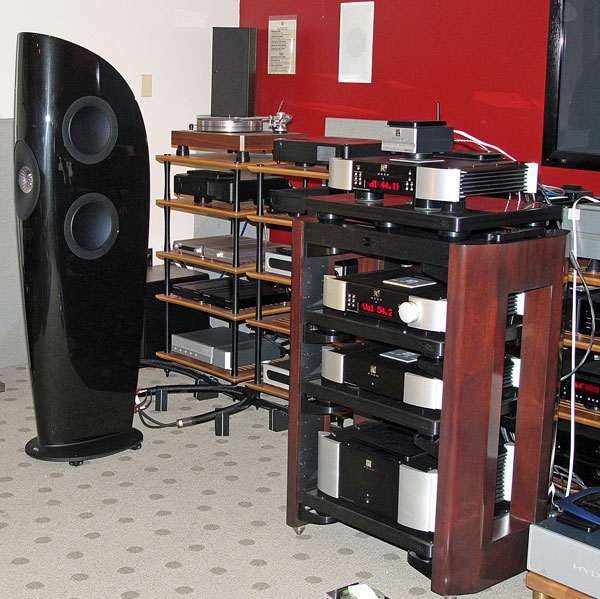 This is not the first time I've sat directly in front of several speakers' tweeters (or, in this case, tweeter/midrange combo) at close range. In all cases but this, I've found myself tightening up, and breathing deeply as overly bright, digitally edged and tilted up sound has assailed my being. This time, I was able to relax fully. Even at high volume levels, this speaker transmitted music, not digital noise and distortion. That is no mean feat.
Playing the LP version of Ani DiFranco's "Knuckle Down," with the help of a VPI Classic III, Soundsmith Cicero cartridge, and Simaudio Moon 110LP phono preamplifier with optional power supply, I was seized by how beautifully the Blade handled electric guitar lines. I also grooved on the great spatial effects, and beautiful air and depth on Peter Gabriel's New Blood album. When the NewBlood Orchestra got going, I especially loved the impressive lateral dispersion of the huge soundstage.
I can't recall if it was on one of these tracks or another that, once I had moved just left of center in the second row at the start of the second demo, I realized just how impeccably this combo handled complex passages. Multiple, powerful lines in the lower midrange and upper bass were intersecting, converging, and going their separate ways all at once, yet everything was clearly delineated and perfectly controlled without in the least sounding clinical or etched.
There are a handful of loudspeakers I've encountered at the countless audio demos and shows I've covered for Stereophile—models from, in alphabetical order, Dynaudio, Hansen, Magico, Revel, TAD, and Wilson come immediately to mind—that I would welcome hearing again, and be thrilled to enjoy in my own listening room. To this list I would add KEF's Blade.
This is not the first time I've sat directly in front of several speakers' tweeters (or, in this case, tweeter/midrange combo) at close range. In all cases but this, I've found myself tightening up, and breathing deeply as overly bright, digitally edged and tilted up sound has assailed my being. This time, I was able to relax fully. Even at high volume levels, this speaker transmitted music, not digital noise and distortion. That is no mean feat.
Playing the LP version of Ani DiFranco's "Knuckle Down," with the help of a VPI Classic III, Soundsmith Cicero cartridge, and Simaudio Moon 110LP phono preamplifier with optional power supply, I was seized by how beautifully the Blade handled electric guitar lines. I also grooved on the great spatial effects, and beautiful air and depth on Peter Gabriel's New Blood album. When the NewBlood Orchestra got going, I especially loved the impressive lateral dispersion of the huge soundstage.
I can't recall if it was on one of these tracks or another that, once I had moved just left of center in the second row at the start of the second demo, I realized just how impeccably this combo handled complex passages. Multiple, powerful lines in the lower midrange and upper bass were intersecting, converging, and going their separate ways all at once, yet everything was clearly delineated and perfectly controlled without in the least sounding clinical or etched.
There are a handful of loudspeakers I've encountered at the countless audio demos and shows I've covered for Stereophile—models from, in alphabetical order, Dynaudio, Hansen, Magico, Revel, TAD, and Wilson come immediately to mind—that I would welcome hearing again, and be thrilled to enjoy in my own listening room. To this list I would add KEF's Blade.
Demming the forthcoming Simaudio Moon 180 MIND Network Music Player ($1250) was Costa Koulisakis (left in photo), the company's VP of Sales & Marketing. In his sixth or seventh demo at AudioVisions, of which I have enjoyed at least four, Koulisakis paired the prototype wireless player with the Moon 650D DAC/CD Transport ($9000), flagship two-chassis 850P preamplifier ($28,000) and W-8 power amplifier ($16,000).
The Moon 180 MIND (Moon Intelligent Network Device) music streamer has been designed to play files up to 24/192 from any storage drive, library, or computer equipped with Simaudio's software. It is an open design that can work with iTunes, Amarra, PureMusic, or the music software of your choice.
It can also stream music to multiple locations simultaneously. (Note: hi-rez files are automatically downsampled to 16/44.1 to allow for wireless streaming). Due to be available in the second quarter of 2012, its playback software is still being completed. Hence, while we got a taste of what seemed to be excellent sound, the prototype's inability to search for specific tracks and genres until its software is complete led us to mainly rely on CD and vinyl sources for the dem of the KEF Blade.
Doing the honors for KEF was April Sanders, the company's Western Regional Manager (top photo). Sanders' 30 years experience in the speaker industry makes her one of the longest-surviving women in the high-end—a feat that, IMHO, deserves at the least a medal of honor and epaulettes covered with brass stars and other emblems of bravery on the front lines.
As much as you may want to know all the technical details about the fabulous-looking Blade, I expect, if you're at all like me, you'll be most eager to read how this speaker, based on KEF's prohibitively expensive, no-holds-barred Concept Blade, sounded with this particular equipment configuration in this particular room. (Note how I've written this sentence; no statement about the "absolute sound" of this or any speaker is possible, and no set of measurements tells the whole tale.) So let's cut to the chase. The sound, in all area except one relatively narrow region in the bass, was extremely impressive and immaculately controlled. The low frequencies have always been difficult to control in AudioVision's main listening room, and the need to radically reconfigure it by bringing in rows of chairs does not help matters. I don't think I've ever heard a speaker successfully control bass in that room. Hence, regardless of the excellence ascribed to the Blade's four 9" LF drivers—two on either side of the speaker, with their vented voice-coils, decoupled diaphragms, discrete bass chambers, and the force-cancelling that is achieved by mounting them back-to-back—the room did not prove their friend. It was not, on the other hand, their enemy. Except for that one frequency bump in the bass, the rest of the low end, as well as everything above and below was supremely under control. Nor did the room-invoked bass anomalies ever intrude on the clarity of midrange or top. I never had the sense that I was losing detail elsewhere because of the booming. As you may well know, this is not often the case.
This is not the first time I've sat directly in front of several speakers' tweeters (or, in this case, tweeter/midrange combo) at close range. In all cases but this, I've found myself tightening up, and breathing deeply as overly bright, digitally edged and tilted up sound has assailed my being. This time, I was able to relax fully. Even at high volume levels, this speaker transmitted music, not digital noise and distortion. That is no mean feat.
Playing the LP version of Ani DiFranco's "Knuckle Down," with the help of a VPI Classic III, Soundsmith Cicero cartridge, and Simaudio Moon 110LP phono preamplifier with optional power supply, I was seized by how beautifully the Blade handled electric guitar lines. I also grooved on the great spatial effects, and beautiful air and depth on Peter Gabriel's New Blood album. When the NewBlood Orchestra got going, I especially loved the impressive lateral dispersion of the huge soundstage.