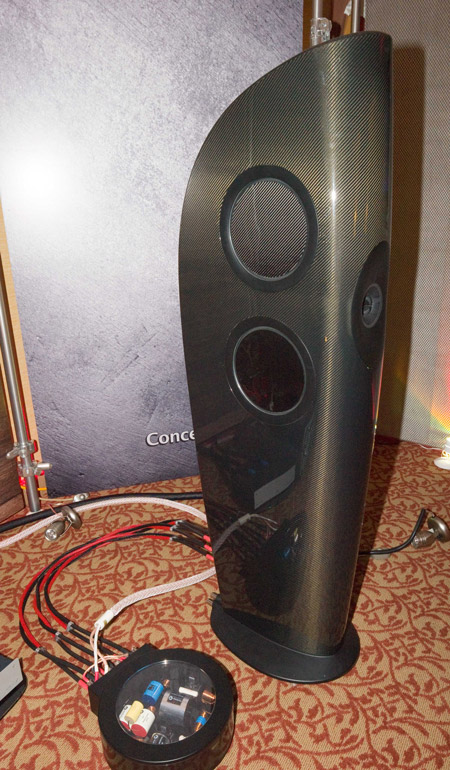
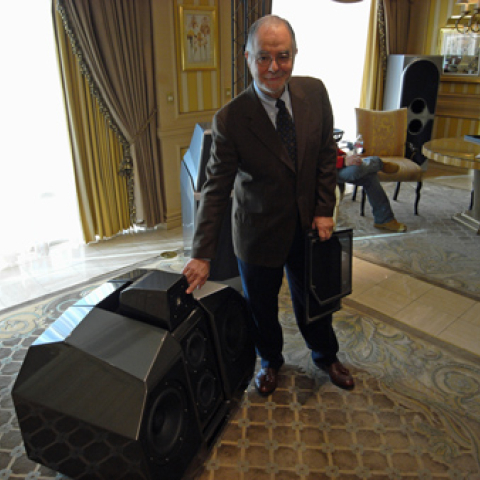
"Go and hear the KEF Concept Blade Loudspeaker," encouraged John Atkinson, "it’s their current statement on the state of loudspeaker art." For reasons unclear, KEF selected a hard-to-find Hilton Hotel suite for their exhibit, far away from the high-end exhibits in the Venetian Hotel. But when I whispered the word "Blade," I was ushered into a dark room where the set of twin loudspeakers, looking like aircraft wings, were standing. The cabinet curvature eliminates cabinet resonances, I was told. The KEF engineer explained that the company had not set a price on the Blade because they regarded it like a concept car, a one-off, handbuilt test model.
At the front of its cabinet, the Blade employs a 10th-generation Uni-Q coaxial driver array, using an injected-molded midrange and a tube-loaded titanium-dome tweeter (positioned at the center of the midrange driver) that has a tangerine-shaped waveguide that functions over 7 octaves without breakup. On the Blade's sides it employs four 10” low-frequency drivers, bonded in pairs symmetrically arranged around the Uni-Q to create both a "single apparent source" that allows for Force Canceling Technology to prevent exciting cabinet walls. The cabinet structure uses resin-impregnated, woven carbon-fiber over a balsa wood core, similar to the cone material Richard Vandersteen developed for his Model Seven loudspeaker. The outboard crossover is hard-wired with air-cored inductors and plastic-film capacitors, all set in a circular container with a glass top..
Driven by an Audio Research DSi200 Integrated MOSFET switching amplifier, the Blade loudspeakers delivered extremely detailed, articulated music, with a dynamic range and clarity that exceeded other the other high-end loudspeaker presentations I had heard at this year's CES. The loudspeaker seemed to be coasting at all volume levels.