

Almost exactly four years ago, I posted a Blog that began like this: "Let's put the main point up front. The new duet album by Keith Jarrett and Charlie Haden, Jasmine (on ECM), is a gorgeous piece of work: all standards, mainly ballads, nothing fancy (not overtly anyway), but such poignancy and quiet passion; it's a glimpse into the intimacy of the act of making art."
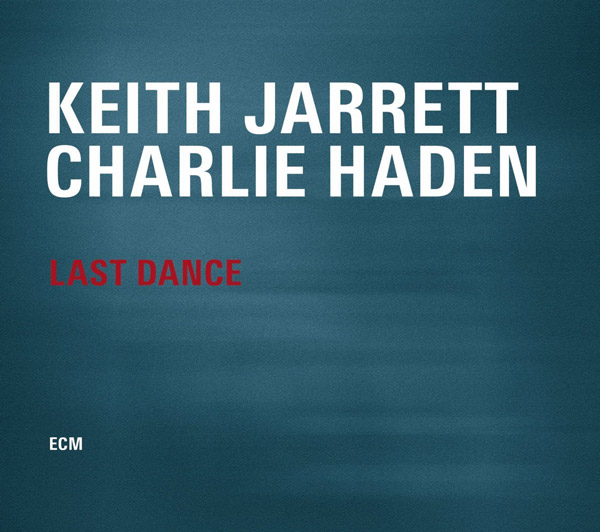
A follow-up CD is out now, Last Dance, and I'd describe it the same way. It was recorded at the same session, in Jarrett's home studio, over a four-day span in 2007. But this doesn't sound like an album of rejects; even the two songs (out of nine tracks) that also appeared on Jasmine aren't clearly inferior, like most "alternate tracks."
After listening to this album a few times, letting it wash over you, play it again and play close attention to Haden's bass lines—not so much his solos, but what he does while Jarrett's playing too. Ornette Coleman once said of Haden that he "plays the music, not the background"—a classically cryptic Ornette-ism, until you listen, and you realize it's spot on: this is exactly what makes Haden special.
Most bass players, even very good ones, focus mainly on keeping time and hitting the root of a chord, sometimes spelling it out in an arpeggio or a fragment of its scale. On many of Jarrett's classic trio albums, Gary Peacock, an excellent bassist, does little more than this. Not that there's anything wrong with that, but Haden's approach is freer. Sometimes he'll do what most bass players do, but then he'll match the melody or pluck a counter-melody, or invert the chord in a strange way, or alter the rhythm (even switching from half notes to a dotted-quarter note, then an eighth note can sow a satisfying moment of tension); or he'll play some notes that have no apparent relation to the song's structure but rouse some mood that somehow fits.
"Free jazz" is a widely misused term, sometimes applied to Haden because of his association with Ornette Coleman, dating back to the classic quartet of 1959. But Haden is above all a romantic; he loves a gorgeous melody, and when he plays along with one, he doesn't want to be boxed in; he wants to take the music where he feels it should go, and when he first heard Ornette play, at an L.A. jam session with other musicians who didn't understand him at all, he detected a kindred spirit.
The term "romantic" shouldn't be misunderstood either. Haden isn't a sentimental bassist; he doesn't squeeze the emotion out of a tune; in fact, he puts no vibrato on a note; his sound is strong, even muscular; he taps into the emotion of the song itself.
There's another quality about Haden. There are many bassists who go outside the box of marking time and chord-roots, but when they do, they tend to get virtuosic, they play a lot of notes—again, not that there's anything wrong with that. But Haden is an economizer. Where some bassists stepping out play all the notes of a slightly dissonant chord, he'll pluck the one note that expresses the dissonance, then move on.
This is why, at first hearing, you might not particularly notice Haden. His playing isn't showy; it seems, again on casual hearing, simple. But after you replay the album, paying close attention to Haden, play it again and listen to the interplay, how what he does affects Jarrett.
Haden was the bassist in Jarrett's quartet of the 1970s, but they hadn't played together since. Compare Last Dance (or Jasmine) with the ballads on Jarrett's trio albums: with Haden, he's more relaxed; he's not as virtuosic (by comparison, he's stripped down), but he explores more avenues, experiments more with melody (check out his variations on Round Midnight), maybe because he knows that Haden will take up the slack and sway, glide, or soar right along.
Both musicians are masters at listening. This is an album that not only demands close listening, it's what the album's about.
There's something else that the album is about, and, given that it was recorded seven years ago, this part is accidental. Haden has been in poor health lately; he contracted polio when he was 15, like many young people in the 1950s, and a few years ago, it returned. (The recurrence is called "post-polio syndrome," and because it's so rare, there's no treatment.) He's played the bass in public a few times, briefly, but it tires him out. Much of the music on this album is elegiac, melancholic, bittersweet. This may be the last Charlie Haden album (the title, Last Dance, reflects this fact—it's not the name of a song), and, once you know this, the emotional resonances deepen.
As with Jasmine, the sound quality is excellent: a bit dry, but strikingly clear and intimate.















