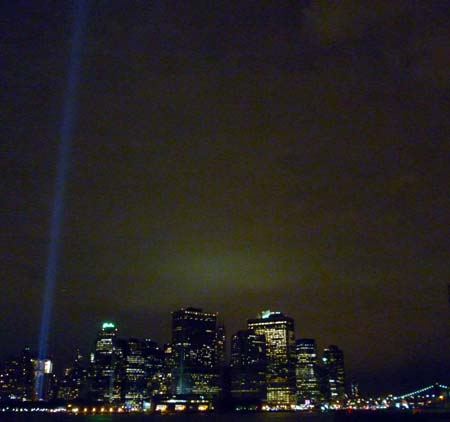
The two Big Eye IPAs I had enjoyed with dinner were doing the trick. I was feeling weightless even before stepping onto the ferry. Beautiful people crowded the front, holding onto railings and each other, while some sat inside the old, wooden frame. Lower Manhattan was soft, quiet, and blue, and two towers of light shot high into the night sky. Suddenly, imperceptibly, the unreal city became smaller and more distant: I hadn’t noticed that the ferry had departed. We could just as easily have been riding a magic carpet. Robert Baird and I were on our way to see John Prine at Governors Island, just a short ferry trip away from Ground Zero in Manhattan.

It was the perfect setting and perfect night for a John Prine concert. From the sandy beach, I could see the lights of my home, Jersey City, with its Goldman-Sachs Building and its Colgate Clock, and I could also see the stunning beauty of Manhattan, its skyline rising from the water like a promise or a memory or a dream. Above, a blanket of white cloud spread across the island and tugged at the Manhattan skyline. From the sand, colorful palm trees exploded into the blackness. And on stage, while the crowd smiled and swayed, John Prine sang songs about lovers and fathers and war.

The songs, Robert said, had a strange sadness to them. All of the humor and joy had been squeezed out of them. Prine’s performance was hushed and so were we. These songs, many of them written when Prine was only in his early twenties, seemed more urgent and alive and true, as if Prine, with rasp and silence and surgery and after all these years, had finally found a way to fill them up and set them down. All of the sadness and heat hiding in the lines of Prine’s simple poetry was brought to the fore. We heard it in “Speed of the Sound of Loneliness” and in “Donald and Lydia” and in “Sam Stone” and especially in the word “love.”

It was as if Prine had found his way to a deeper truth, where faces and fronts of all kinds are completely unnecessary, an unthinkable achievement for a songwriter like this, a songwriter who touches truth with every breath and with every strum, as if he had time only for the essential, the meaningful, the real, there would be no more messing around, unless a little messing around was called for, as it was, when he told a couple of jokes to lighten us up, or when he sang “Six O’clock News,” wry and with the slyness of a beautiful, old man, standing on the edge of the land with his guitar and two towers of white light streaking up into the night beside him.