

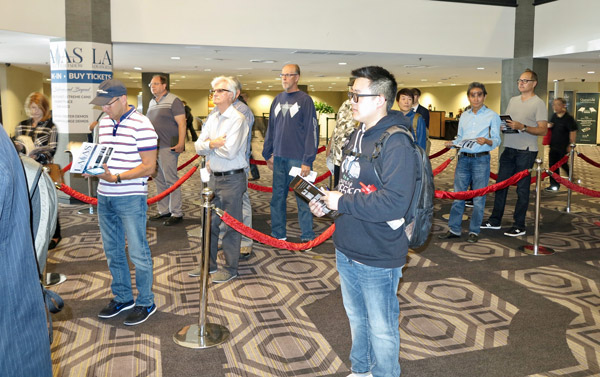
As the second wave of registrants stood in multiple lines in the lobby of the Sheraton Gateway Los Angeles on the morning of Friday, June 2, the Los Angeles Audio Show was already off to a promising start. And what a promise it was. The night before show's open, when I encountered the force behind LAAS, Bob Levi of the Los Angeles & Orange County Audio Society, in a hotel elevator, he told me that pre-registration had already topped 7500 people. That number, it seems, has set new records for attendance at an audio show in Southern California. It also undoubtedly sets a pre-registration record for any first-time high-end audio show in the US that welcomes the general public.
Which is not to say that Friday was a mob scene. Attendance was certainly respectable, with seats in one of the more popular large rooms I entered, the MBL room, at capacity. But smaller rooms often had empty seats, and many tables in the incredibly slow-to-serve hotel restaurant were empty. All of which is to say that Saturday and Sunday, which attract the 21st century's equivalent of 9-to-5ers as well as people who do not have the ability to make their own hours, could very well be a mob scene.
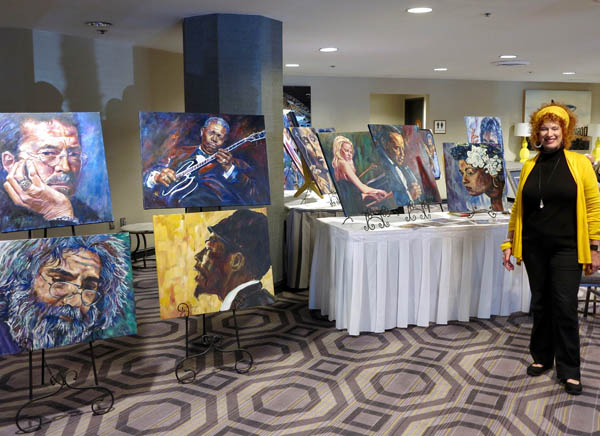 On the hotel's lobby level, amidst ballrooms filled with the Marketplace's LPs, discs, other goodies, and everything connected with portable audio stood long-time SoCal show fixture, artist Meryl Jane. Known for her paintings of musicians past and present, Jane shone like the star she is.
 My initial journey down the hallways to exhibits served as a textbook illustration of the pitfalls of exhibitdom. The door to the very first room I had hoped to visit was locked tight. Instead of a glorious audio system, I encountered a sign explaining that due to shipping mishaps and last-minute scrambling, the room would not open until later that day or Saturday.
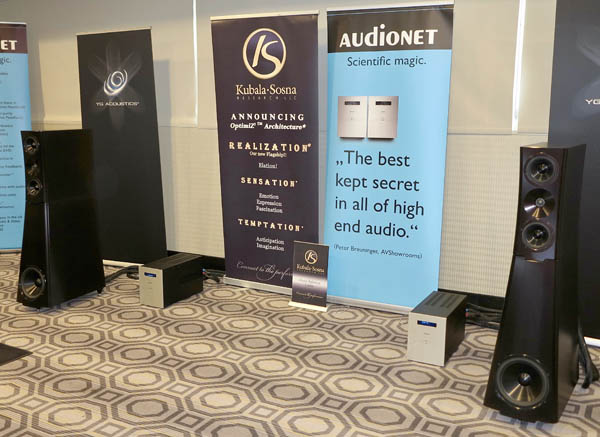
Next, when I entered Alma Music and Audio of La Jolla, CA's room, I discovered the familiar, extremely smooth-sounding, and musically infallible pairing of Audionet's Pre G2 preamp ($23,350), Max monoblock amplifiers ($30,000/pair), Pam G2 phono stage ($10,100), Epx power supply ($10,100), Planck CD player ($18,800), and Ampere power supply ($11,200); Kronos Pro turntable ($38,000) with Black Beauty tonearm ($10,000) and SCPS-1 power supply ($13,500); Air Tight Opus 1 cartridge ($15,000), Kubala-Sosna Realization! cabling (interconnects and speaker cable $10,000/first meter, power cords $2800/first meter), and YG Acoustics Sonja 1.2 loudspeakers ($72,800/pair) playing much softer than usual. When I asked if the volume could be turned up on a reissue of Alexander Gibson's lovely RCA Living Stereo LP of ballet music from Gounod's opera, Faust, I was told, "We have a terrible room here. If I turn it up, it will really ring. So, we're trying to keep it low. We've got a bad 60Hz bump, the wall is flexing, and a lot of the back wall is solid sheet rock.
Given that this equipment has always sounded excellent, I have no reason to question this explanation. It serves as a caution to readers: our writings here constitute show reports, made under frequently adverse circumstances, rather than reviews. If you are drawn to anything you read about or experience first-hand at shows, audition in your personal listening environment is highly encouraged.
My initial journey down the hallways to exhibits served as a textbook illustration of the pitfalls of exhibitdom. The door to the very first room I had hoped to visit was locked tight. Instead of a glorious audio system, I encountered a sign explaining that due to shipping mishaps and last-minute scrambling, the room would not open until later that day or Saturday.
Next, when I entered Alma Music and Audio of La Jolla, CA's room, I discovered the familiar, extremely smooth-sounding, and musically infallible pairing of Audionet's Pre G2 preamp ($23,350), Max monoblock amplifiers ($30,000/pair), Pam G2 phono stage ($10,100), Epx power supply ($10,100), Planck CD player ($18,800), and Ampere power supply ($11,200); Kronos Pro turntable ($38,000) with Black Beauty tonearm ($10,000) and SCPS-1 power supply ($13,500); Air Tight Opus 1 cartridge ($15,000), Kubala-Sosna Realization! cabling (interconnects and speaker cable $10,000/first meter, power cords $2800/first meter), and YG Acoustics Sonja 1.2 loudspeakers ($72,800/pair) playing much softer than usual. When I asked if the volume could be turned up on a reissue of Alexander Gibson's lovely RCA Living Stereo LP of ballet music from Gounod's opera, Faust, I was told, "We have a terrible room here. If I turn it up, it will really ring. So, we're trying to keep it low. We've got a bad 60Hz bump, the wall is flexing, and a lot of the back wall is solid sheet rock.
Given that this equipment has always sounded excellent, I have no reason to question this explanation. It serves as a caution to readers: our writings here constitute show reports, made under frequently adverse circumstances, rather than reviews. If you are drawn to anything you read about or experience first-hand at shows, audition in your personal listening environment is highly encouraged.
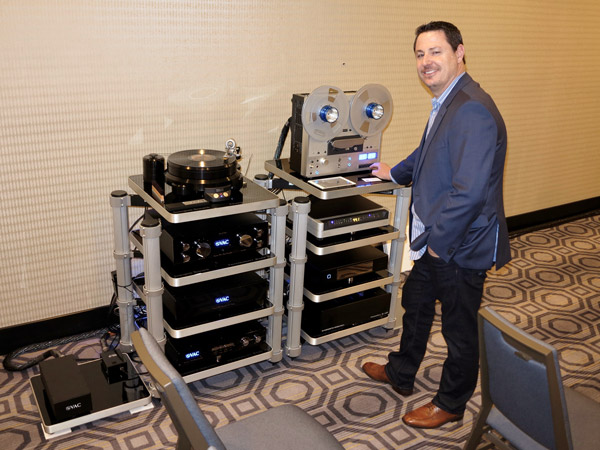 Scott Walker of Scott Walker Audio fame is shown putting a tape of second generation 1970s rock and pop hits on the SonoruS ATR-10 open-reel deck ($18,950). That's what I listened to on an excellent system that also included Magico S5 Mk.II loudspeakers ($38,000/pair); VAC 200iQ monoblocks ($28,000/pair), Signature Mk.IIa SE w/phono ($26,000), and Renaissance phono stage ($9900); Berkeley Audio Design Alpha Reference DAC Series II ($19,500—review coming in the fall); Aurender N-10 music server ($8000); Acoustic Signature Storm Mk.II w/TA-2000 tonearm and Soundsmith Hyperion cartridge ($17,389); and a small collection of Synergistic Research products including Galileo UEF speaker cables ($14,995/pair) and interconnects ($9500), Powercell 12 UEF SE ($5995), Atmosphere XL ($3495), BlackBox ($1995), and HFT's ($499).
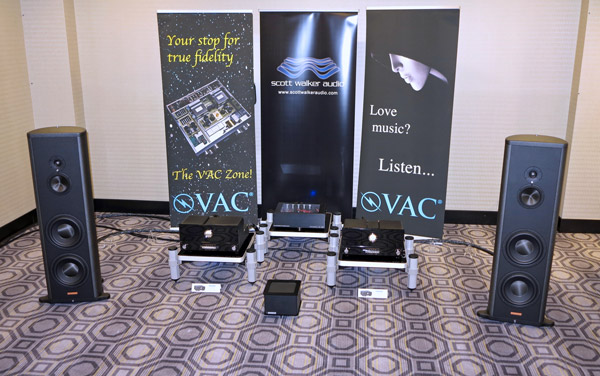 Those little goodies certainly had something to do with the very exciting, full and open soundstage. But beyond that was really fine sound, with a beautiful midrange, believable-sounding electric guitar, and convincing color. When the second system you encounter at a show sounds this good, there's every reason to believe that yes, Virginia, there is a Santa Claus.
On the hotel's lobby level, amidst ballrooms filled with the Marketplace's LPs, discs, other goodies, and everything connected with portable audio stood long-time SoCal show fixture, artist Meryl Jane. Known for her paintings of musicians past and present, Jane shone like the star she is.
My initial journey down the hallways to exhibits served as a textbook illustration of the pitfalls of exhibitdom. The door to the very first room I had hoped to visit was locked tight. Instead of a glorious audio system, I encountered a sign explaining that due to shipping mishaps and last-minute scrambling, the room would not open until later that day or Saturday.
Next, when I entered Alma Music and Audio of La Jolla, CA's room, I discovered the familiar, extremely smooth-sounding, and musically infallible pairing of Audionet's Pre G2 preamp ($23,350), Max monoblock amplifiers ($30,000/pair), Pam G2 phono stage ($10,100), Epx power supply ($10,100), Planck CD player ($18,800), and Ampere power supply ($11,200); Kronos Pro turntable ($38,000) with Black Beauty tonearm ($10,000) and SCPS-1 power supply ($13,500); Air Tight Opus 1 cartridge ($15,000), Kubala-Sosna Realization! cabling (interconnects and speaker cable $10,000/first meter, power cords $2800/first meter), and YG Acoustics Sonja 1.2 loudspeakers ($72,800/pair) playing much softer than usual. When I asked if the volume could be turned up on a reissue of Alexander Gibson's lovely RCA Living Stereo LP of ballet music from Gounod's opera, Faust, I was told, "We have a terrible room here. If I turn it up, it will really ring. So, we're trying to keep it low. We've got a bad 60Hz bump, the wall is flexing, and a lot of the back wall is solid sheet rock.
Given that this equipment has always sounded excellent, I have no reason to question this explanation. It serves as a caution to readers: our writings here constitute show reports, made under frequently adverse circumstances, rather than reviews. If you are drawn to anything you read about or experience first-hand at shows, audition in your personal listening environment is highly encouraged.
Scott Walker of Scott Walker Audio fame is shown putting a tape of second generation 1970s rock and pop hits on the SonoruS ATR-10 open-reel deck ($18,950). That's what I listened to on an excellent system that also included Magico S5 Mk.II loudspeakers ($38,000/pair); VAC 200iQ monoblocks ($28,000/pair), Signature Mk.IIa SE w/phono ($26,000), and Renaissance phono stage ($9900); Berkeley Audio Design Alpha Reference DAC Series II ($19,500—review coming in the fall); Aurender N-10 music server ($8000); Acoustic Signature Storm Mk.II w/TA-2000 tonearm and Soundsmith Hyperion cartridge ($17,389); and a small collection of Synergistic Research products including Galileo UEF speaker cables ($14,995/pair) and interconnects ($9500), Powercell 12 UEF SE ($5995), Atmosphere XL ($3495), BlackBox ($1995), and HFT's ($499).
Those little goodies certainly had something to do with the very exciting, full and open soundstage. But beyond that was really fine sound, with a beautiful midrange, believable-sounding electric guitar, and convincing color. When the second system you encounter at a show sounds this good, there's every reason to believe that yes, Virginia, there is a Santa Claus.














