After John's short talk at THE Show (see below), the two of us decided to make the rounds together until I had to leave for the airport. But it wasn't that easy to just get up and go.
Have you ever tagged along with a rock star? That's how it felt walking with John, as people came up to John to engage in conversation every 15 or 20 steps. The man has been editing
Stereophile for almost 24 years now, and knows just about everyone. And John also likes and values people as much as he likes music. Perhaps he can remain relatively anonymous in the streets of Manhattan and Brooklyn, but at CES, there's a "Hi John" at every turn. So as much as John invited me to lead the way, I'd only take about 15 steps before I'd discover him waylaid by someone.
Somehow, after three stops to chat, we managed to get to the VMPS live
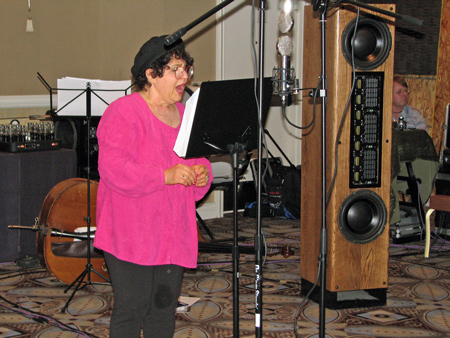
vs recorded demo. As we entered, soprano Lesley Olsher, wife of erstwhile
Stereophile reviewer Dick Olsher, was standing before a microphone array, singing a lovely song in Hebrew. Somehow we managed to listen without disrupting Lesley's singing. My hats off to her for managing to sing a cappella, beautifully, and in tune as a recording of percussion played at a different tempo penetrated the walls.
Brian Cheney of VMPS recorded the demo using a two-channel DSD recorder and tube condenser mics. Then, the recording was played back in both DSD and 24-bit/88.2kHz formats.
It was great to hear the sound of VMPS' new M50 loudspeaker ($12,000/pair), amplified by Atmasphere electronics. The set up was all Audience Conductor e cables and powerChords, and the electronics were powered through an Adept Response aR12-T power conditioner. The speaker, a dual line-source bipole, is 6' tall, weighs 350 lbs., and has built-in digital speaker and room correction plus digital crossovers. It also sounds excellent, faithfully reproducing the timbre of the voice and the instruments that accompanied Lesley on "Summertime" before we arrived.
Most striking was the fact that the recorded playback had far more air and life than the live performance in a very deadened room. John explained that's because we were hearing the acoustic of the same room twice, both at the time of the recording and at the time of playback. No wonder so many recordings sound airier than the real thing.
The comparison of playback formats (DSD and 24/88.2 PCM) only went so far. Different mikes were used for the two different format feeds, and were positioned differently. Hence, a direct comparison between formats was impossible. Nonetheless, recording engineer Atkinson was able to note the different sound quality of the different mikes.
A big thanks to Brian for once again arranging the demo. And equal applause for a fine new addition to the VMPS line.