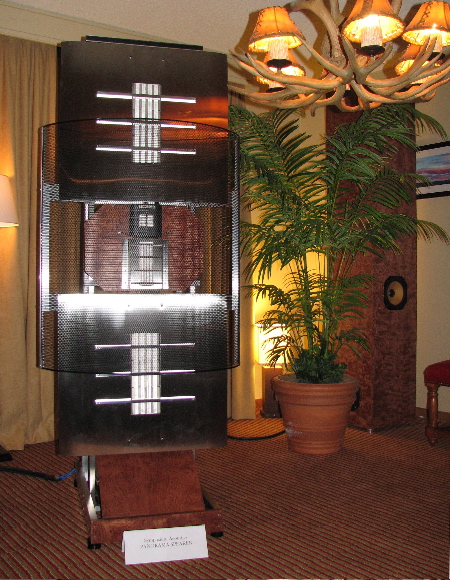
Gazing at the prototypes of Peter Bizlewicz’s forthcoming Panorama loudspeakers, I couldn’t help wondering if our beloved canine Baci Brown would either attack them as hostile intruders or try to mount them in a futile assertion of alpha dominance. Yes, not only the closest thing to alien invaders so far encountered at the show, but also visually hilarious, these speakers demanded a listen.
With me sitting quite nearfield, the Panoramas threw an absolutely fabulous, huge soundstage distinguished by laudable depth. Highs were wonderfully open as well, and pace was fast. The amount of solid bass coming from the separate towering bass modules was also surprising, given the low-watt amplification (more on that below). I did hear a little harshness on highs when the volume was cranked way up, but that vanished as soon as I moved my seat back one row. (Was the harshness a simple case of room interaction? Who knows).
It turns out that, way before Peter developed the excellent line of Symposium isolation platforms and stands, he set out to build speakers. Twelve years in the making, these prototypes, which in their final iteration are projected to cost $50–60,000/system, are a four-way design utilizing a phase-coherent passive crossover and, as mentioned above, a separate towering bass module that surprisingly only weighs about 80 lbs. Said to have a sensitivity of 93–94dB, the speakers easily produced good volume from a 9W integrated amplifier.
As for the amp, a word on Fred Volz’s 9W integrated SKE linear circuit and PP EL 34 E-linear prototypes (I hope I’ve got that right; there was no literature available): Produced by Emotive Audio Designs of Belafonte, PA, Fred’s integrated amp, monoblocks, and preamp utilize a new, trademarked circuit topology which Peter lauds as breakthrough technology. In their final versions, the amps will offer owners some ability to tailor response to their particular system configuration and room.
It should be noted that, as with many demos at the show, speaker and amp response was limited by the source. The LP set-up was hardly the best. Nor was the original version of the truly excellent Muse 11 Universal Player, which excels on SACD, the last word in CD reproduction, I thought. And, of course, speakers and amps were prototypes, whipped together for the show. That everything sounded as good as it did was a minor miracle. These are speakers and amps to watch out for. As if you could miss the speakers as they walked down the block.
PS. Don’t you love the chandelier? Definitely something to keep an eye on. (Literally: I almost cracked my head open on one in another room). Thankfully, it is not included with the speakers.