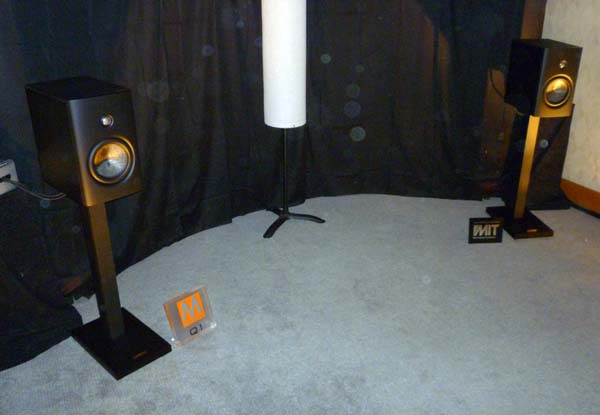
Though they were also seen at the Munich Show, Magico’s Q1 monitors ($24,950/pair) are making their US debut here at the California Audio Show. The speaker incorporates much of the technology and design philosophy used in Magico’s Q5, reviewed by Mikey Fremer, but puts it in a smaller package. Like the Q5 and Q3, the Q1 is a sealed-box design with extensive internal bracing.
Magico’s Alon Wolf explained that he strives to create a speaker which highlights no single aspect of the presentation, but instead offers a strong, top-to-bottom coherence. I asked him about the differences between designing a small speaker and designing a cost-no-object model. “They both have their issues and their triumphs,” he said. “The idea is not to lose anything.” When listening to a smaller speaker such as the Q1, Wolf wants you to forget what you’re missing. The speaker should couple with the room, providing a clean, extended, balanced overall sound, which is exactly what I heard in this smallest of Magico rooms.
The system was completed by Spectral’s SDR4000SL CD processor, DMC-30SS preamplifier, and DMA-360 monoblock power amplifiers. We listened to Triple Concerto & Music for Trio with Bela Fleck, Zakir Hussein, and Edgar Meyer, and the sound was clean and fast, with well-extended highs and lows, and a detailed midrange. Whereas many exhibitors at this show seemed to be making compromises for their rooms, Magico was able to build a system that to seemed perfectly suited to the room. The system seemed truly locked in to the room, offering that tight, well-extended bass, and great spatial effects. The Q1 speakers effortlessly disappeared and the system filled the room with engaging music—fast, detailed, and robust.
Good stuff.
Very similar qualities were also present in the two larger Magico rooms I visited. In the Bayside Hall, Magico’s Q3s were part of a system featuring Audio Research amplification: Reference 250 monoblock power amplifiers ($25,590, making their US debut), Reference Anniversary preamplifier ($25,000), and Reference Phono 2 phono stage ($11,995). Discs spun in either an Audio Research Reference CD-8 ($9995) or Accuphase DP-700 SACD player ($27,000). Berkeley Audio’s Alpha DAC ($5000) and Auraliti’s L-1000 music file player ($3500) were also involved. On the analog side, there was the Transrotor Orfeo ($17,000) with Graham Phantom tonearm ($5995) and Air Tight PC-1 moving-coil cartridge ($6000). Cables and power cords were by MIT (a popular choice at the California Audio Show), the equipment rack was by Rix Rax, isolation devices by Magico, and room treatments by ASC (another popular choice here at the show).
In this much larger room, the Q3 seemed to achieve the same level of overall coherence as its “crazy, little brother,” the Q1. There was a remarkable sense of scale and space, with well-extended highs and very good low-end impact. We were listening to digital at the time, but the system had a very analog-like sense of ease.
In the Plaza Ballroom, Tim Marutani Consulting built a mega-system comprising Magico Q5 loudspeakers ($59,500/pair), Constellation Altair line preamplifier ($65,000), Constellation Hercules monoblock power amplifiers ($140,000/pair, but at least you get two of them), Continuum Audio Labs turntable system ($100,000), Bottlehead Tube Phono phono preamplifier ($10,000), and a custom computer source. Recording engineer Bill Schnee (Amy Grant, Michael Bolton, Whitney Houston, Steely Dan...) gave a fascinating and insightful presentation, detailing some of the behind-the-scenes mechanisms of capturing sounds and working with musicians, and began to demo some of his latest Bravura Records projects when, sadly, the lights flickered and the sound went out—the perils of demming in a hotel. Up until that point, however, the sound was as good as any I'd heard here or elsewhere.
In an adjoining room, Blue Coast Records' Cookie Marenco was hosting live performances, recording them direct-to-DSD, and making them immediately available as free DSD downloads. Awesome!