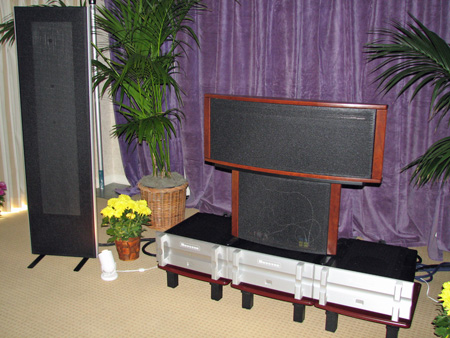
I finished my first day at THE Show, at the Flamingo hotel. (It's wonderful that CES and THE Show are now within easy walking distance.) Over the years, Magnepan has built some of the best-sounding speakers I've heard, and most often ones that perform at the level of speakers several times their price. The MG 1.6 is one of the High End's true classics and has always been one of its most spectacular bargains. One of Magnepan's demo systems was the brand-new MG 1.7. It's physically identical to the 1.6 but rather than planar-magnetic drivers for the bass and tweeter, the 1.7 use Magnepan's "Quasi-Ribbon." Both planar-magnetic and quasi-ribbon drivers are lightweight diaphragms onto which a conducting element is attached, but in the case of the planar-magnetic, the element is wire. In the quasi-ribbon, it's a very fine ribbon, or foil. The latter is lighter and covers more area, so the performance approaches that of a ribbon, where the conducting element
is the diaphragm. The 1.7s sounded truly spectacular and at just $2000/pair, destined to be another winner for Magnepan.
Nearly unnoticed at the other end of the room were the mini-Maggies that JA wrote about in our 2009 CES report, finally ready to be shipped. These are essentially miniature MG3.6s, with a true ribbon tweeter and quasi-ribbon midrange and bass drivers, combined with a Magnepan woofer/subwoofer module to create a very compact three-piece system. I listened to both as a computer speaker and as a satellite/subwoofer system in a normal room layout. It works beautifully in both applications and will likely be priced in the $2k/pair region as well, which makes for an interesting question; in a smallish listening room like mine, which is the better approach, the quasi-ribbon 1.7 or the mini-Maggie 3-piece system? Different form factors, different technologies, same price, same application. Which would I recommend or buy, and why? Maybe JA will agree that it's an interesting question too.
Jason Serinus Comments: As Magnepan's Wendell Diller began playing an excerpt from Pierre Boulez's recording of Mahler No.3 on a multi-channel SACD sampler, the huge soundstage and all-enveloping sense of air produced by the system which used the new MG1.7s at the front for Left and Right, a Magnepan center channel, and Magnepan's motorized, hinged speakers for the rear, were something very, very special. (Source was an Esoteric SACD player and amplification was the Bryston SP2 driving 7BSST2s.) Although there was some brittleness to the sound, the surround presentation was gripping.