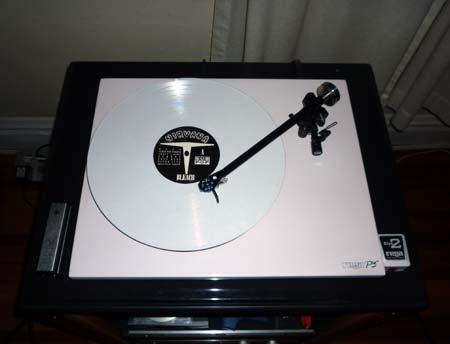
It’s alive! Nirvana brings nirvana to SM’s listening room.
So, yesterday afternoon, I sent a detailed e-mail to Steve Daniels at the Sound Organisation, US importer for Rega. Steve promptly returned my e-mail with a phone call. After reviewing
the static situation, Steve asked me to send my Elys 2 cartridge to his office so that his team could take a good look at it. Maybe the static shocks that I had experienced while lifting the tonearm had done some damage to the cartridge’s inner workings. No problem, I said.
Back at home that night, I figured I’d give the ‘table one last listen before uninstalling the cartridge. First, I made dinner and sat down to listen to the compact disc version of Cat Power’s
Jukebox. Everything sounded fine, albeit digital. After dinner, I stopped the compact disc and reached for the big, beautiful vinyl LP. I turned on the Rega, set the vinyl on the platter, and went through my normal routine: Hunt EDA MK6 carbon-fiber brush across the vinyl, followed by a shot of the Milty ZeroStat gun.
At this point, several of your kind suggestions raced through my mind. Throughout this entire troubling period, I had been directing my energy to the static on the
record’s surface, but many of you seemed to think that
the cartridge was the source of the problem. For instance:
“Bertdw” asked:
Have you checked your cartridge alignment?
“Cybermynd” suggested:
Can't help but feel that if you manipulate the stylus and it changes things, there may just be something wrong with your cartridge.
Jim Tavegia and “KBK” recommended that I check the temperature around my turntable, “KBK” explaining:
Rubber dampers on cartridges are designed for a target zone of humidity and temperature.
“FSonicSmith” had an interesting idea:
Try demag'ing your MM cartridge.
Paul S. and Lionel also felt that the problem was cartridge-related.
Okay, so with all of these thoughts running through my head and with the Milty ZeroStat in my hand, I pointed the gun directly at my cartridge, said a prayer, closed my eyes, and shot two times. Bang, bang!
Then I played the record. And you know what? Everything sounded fine. Indeed, the vinyl version of Cat Power’s
Jukebox offered greater resolution of low-level detail
and more natural-sounding transient articulation. No shit! I got through an entire side without hearing any of the awful distortion that had been marring my vinyl playback for these last two months.
And, when I raised the tonearm from the vinyl and inspected my stylus, I saw no debris! None! At all! Prior to shooting it with the ZeroStat, my stylus had been like a magnet for dust.
I wasn’t ready to get too happy yet. I’ve made that mistake before. A lot of times. This time, I wanted to give my Rega a real test. I reached for my new copy of Nirvana’s
Bleach, a sweet, hefty reissue from Sub Pop (on awesome white vinyl!). I had only played this record once. This was back before I had even realized that I had a problem of any kind. It had sounded so dreadful that I thought I had purchased a bad pressing. I couldn’t get through a single side. I was sad and angry; I didn’t even want to tell anyone about it. I considered returning the record to Urban Outfitters.
That’ll teach me to buy records from hipster supermarkets.
I’m glad I didn’t return it. This record will never sound great—it wasn’t recorded very well in the first place—but it
does capture the mood of a brilliant, powerful band on the verge of superstardom. I played an entire side without incident. Things were looking up.
I was reminded of another album that I had played only once and long ago. PJ Harvey’s 2007 album,
White Chalk, sounded horrible on my turntable. The sound, as I experienced it then, was similar to what I had been hearing more recently: distorted and recessed, as if the sound engineer had done a horrible job or as if the pressing was bad. I was so upset about this record that I mentioned it to my friend, Michael Lavorgna. We had both heard different copies of this album on different systems and we
knew that it was a fine-sounding record. At the time, ML recommended that I return my copy and ask for a new one. I had intended to, but never got around to it. And you know what? I’m glad I never returned it because it sounds perfect.
What the?!
At some point, two years ago, it seems, I had had the same trouble with my turntable that I’ve had over the last two months, but to a much lesser degree—and it only presented itself with PJ Harvey’s
White Chalk. I can’t explain it. I can’t even ask you to believe it. But it’s true. I think.
Next, I played Grizzly Bear’s
Veckatimest, my very favorite album from 2009. This album had been giving me trouble during intense, complex, and loud passages. It, too, now sounded as it should. Perfect. Finally, I played the first LP of Joanna Newsom’s excellent, new 3-LP statement,
Have One On Me, and it sounded glorious.
So, what the hell? Does it make sense that using the ZeroStat on my cartridge would fix the problem? I’m not sure. While everything sounded great last night, I failed to play a record
prior to using the ZeroStat, so I don’t have an informed reference or a control—you know, I screwed up the scientific method, or whatever. John Atkinson suspects that the mistracking I heard was due to a build-up of electrostatic charge reducing the effective tracking downforce, and the ZeroStat cured it.
But is it safe to use the ZeroStat on my cartridge? One source has already suggested that I may damage the cartridge and associated electronics by zapping the cart with the Milty. What else can the ZeroStat be used on safely? Cats? Squirrels? Will it melt snow? Will it woo women?
I don’t know. But, for now, my turntable is making music again, and I’m happy about that.