

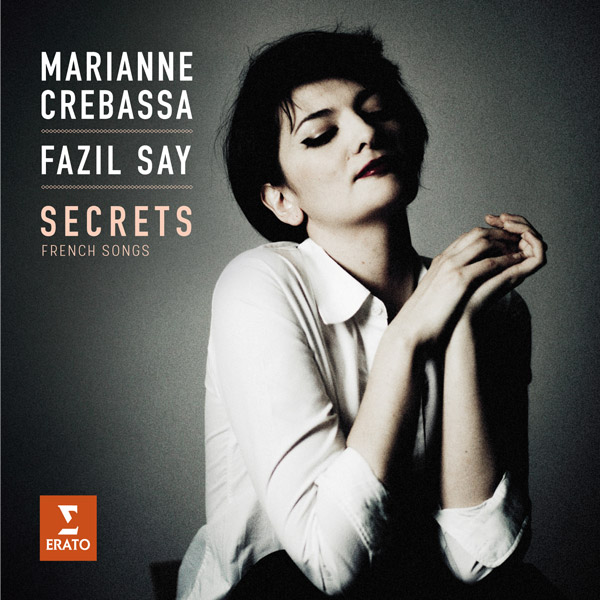
In 2016, when I received Oh Boy!, the first solo album from mezzo-soprano Marianne Crebassa, I thought, "What a cute title for a compilation of male operatic roles that were written for female singers"—"trouser roles" in operatic parlance—and put it aside. Now, having heard Crebassa's newest album, Secrets: French Songs, I realize that I made a big mistake. Crebassa is a major artist, with a sound and temperament that make Secrets a must-listen for lovers of vocal artistry.
Crebassa's superbly vocalized rendition of Debussy's disarmingly sensual Trois Chansons de Bilitis (Three Songs of Bilitis) begins a recital that also includes Debussy's lesser known Trois Mélodies (1891), Ravel's Shéhérazade (1903) and Vocalise-étude en forme de habanera (1907), Fauré's song cycle, Mirages (1919), four mélodies by Duparc, and Say's wordless Gezi Park 3 (2015). Given the quality of the 31-year old mezzo's performances, which were recorded with pianist Fazil Say in the resonant Great Hall of the Mozarteum, Salzburg, Secrets is essential listening for music lovers who lament the dearth of new recordings devoted to French mélodie, as well as for all who wish to explore Debussy's vocal works during the centennial of his death.
Debussy's Bilitis cycle famously sets three poems by Pierre Louÿs that the author fraudulently claimed were translations of works by a lesbian who lived in Greece, on the Isle of Bilitis, at the time of Sappho. Although the sexuality is sanitized—the poems speak of love between a woman and man—the eroticism and melancholic mystery that pervade the poems are virtually naked in their unadorned simplicity, and seem to presage Debussy's later opera, Pelléas et Mélisande.
Crebassa and Say's Bilitis cycle more than holds its own alongside classic renditions by two women who worked with Debussy, Jane Bathori (who accompanies herself—1929) and Maggie Teyte (accompanied by Debussy specialist Alfred Cortot—1936), as well as far newer recordings by Frederica Von Stade and soprano Veronique Gens. Taking a somewhat middle ground between Bathori, whose singing and playing are simplicity itself, and Teyte, whose carefully calculated yet disarmingly emotional word painting and idiosyncratic downward portamenti create a mystery all their own, Crebassa deploys the natural sadness and sensual beauty of her instrument with a dynamic restraint that seems ideal. The coolness of her voice nails the intimacy of "La Chevelure" (below), as pianist Say brings out the colors beneath the words. No one can equal the cold emptiness that, in "Le Tombeau des Naïades" (The Tomb of the Naids), Teyte brings to the line "Les satyrs son mortes" (The satyrs are dead), but Crebassa's version has an integrity all its own. Instead of simply trailing off at the end of that final song, as so many other accompanists do, Say masterfully slows down in a manner that creates a thematic conclusion. Just marvelous.
When the 24/96 version of this recital is played on a good sound system, it is easy to hear how recording engineer Hugues Deschaux invests Say's piano with near orchestral colors and vibrancy. The soundscape works wonderfully for Ravel's Shéhérazade, which was a Bathori specialty. Crebassa's excitement is thrilling as she relates her reverie about the Asian continent, and her ability to lighten her voice when she sings of the enchanted flute shows a deep understanding of Ravel's creation. Thanks in no small part to Say's anything but prosaic, intimate opening to the final song, "L'Indifférent," Crebassa revels in the cycle's exoticism. The Vocalise is equally atmospheric, and Crebassa's low tones a thing of beauty.
Crebassa's intimate delivery, wide emotional range, and tonal luminescence work wonders with the earlier three songs by Debussy and the four Fauré Mirages. The raptness of her reverie and the subtlety of her shadings reflect a brilliance shared only by artists on the order of Teyte, Bernac, Panzéra, and Souzay. Listen to her sadness in Duparc's "Au pays où se fait la guerre" (To the land where there is war), as well as to the tears in her "Lamento" (lament).
If Crebassa's intentionally quasi-operatic Chanson triste (Song of Sadness) lacks the specificity of word painting that makes Teyte's more emotionally contained rendition unforgettable, it may nonetheless be closer to the French tradition that both Bathori and Bernac extol. While the protest at the core of Say's extended la-la-la is more compelling than his music, nothing can detract from the duo's accomplishment in French repertoire. Highest possible recommendation.















