

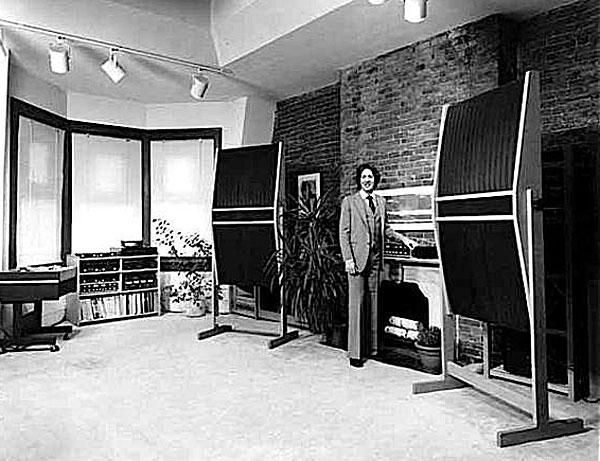
The name "Mark Levinson" has for some years been equated with absolute, no-compromise perfectionism in audio design. Mark Levinson's equipment is highly esteemed by many audiophiles and audio-oriented musicians (most musicians just don't care about reproduced sound), and he has produced some of the best recordings that have ever been made. Each side of his HQD loudspeaker system comprises a pair of Quad electrostatic speakers, one pair mounted upside-down below the other in a wooden frame with the extreme highs reproduced by a central Kelly ribbon unit. two separate cabinets feature Hartley 24" woofers. We were curious about the HQD but never requested one for testing because we felt that its $26,000 price tag put it in a class where it could only be of academic interest to 99% of our readers.
It appears we made a wrong decision there. Readers' letters indicated that, while few had anv intention of purchasing an HQD, they were nonetheless interested in knowing whether or not the system was indeed as good as it was claimed to be. We were considering requesting one for testing when, by sheer chance, we had an opportunity to hear the system in a dealer's showroom. We have decided not to test one in our offices. Here's why:
We had been invited to attend a demonstration of the then-new Sony PCM-1 digital-audio recording system in a Philadelphia store (late in 1978). Sony had brought along a single recorded cassette containing about 30 minutes of short musical selections in the PCM format, and this was played through a pair of Precedent Mod-3 speakers after the spoken presentation. After the demonstration, we proposed that the PCM equipment be moved into the plush upstairs salon where the HQD system was set up, to see how the PCM would sound through them. We were not impressed, but—as we explained to Chestnut Hill propretor Jack Rubinson—there was really no way we could pin down what we heard without our knowing what the program material sounded like.
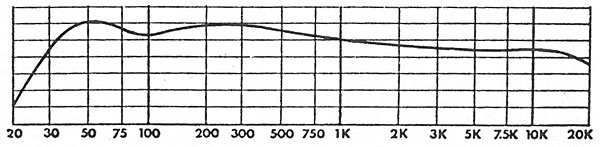
In order to settle that question, we requested (and received) that same PCM demo tape when we borrowed the PCM-1 for the review in this issue, and have since had an opportunity to audition it in relation to other, familiar source material. We are now in a position to report that, while the PCM material left some things to be desired (it was somewhat soft at the high end, for example, although that was the fault of the tape, not of the PCM unit we tested), it was not causing the rather gross aberrations we heard from the HQD system that night. These were: A somewhat heavy, loose low end, a slightly closed-in top (ie, more so than on the PCM tape), and the same kind of super-rich, overly-fat middle range we have heard before when stacked Quads are used without equalization to compensate for their rising lower range when the normal front-to-rear sound cancellation is offset by the doubled radiating area (fig.1).
 So, we wrote a long, rather unkind report on the HQD, pointing out that, if that was typical of the way it was supposed to sound (And why not, after Mr. Levinson had installed and tweaked it?), then it had to be the most expensive bomb ever to be made available for civilian use. Mr. Levinson responded with a phone call during which he:
1) Told us we had not heard it at its best, but refused to address himself to our specific criticisms;
2) Claimed that many practicing professional musicians felt the HQD to be "extremely realistic";
3) Informed us that, since he sold very few HQD systems and would soon be discontinuing them anyway because Quad had ceased making those speakers, the "sensible" thing to do would be to kill the report; and
4) Mentioned, just in passing of course, that he was currently writing a feature article for Time on the subject of "underground" audio magazines.
We could just imagine how our writeup would read: "This irresponsible publication attacks dedicated, perfectionist manufacturers, one of which is a musician (And who can better judge musical sound than a musician?), and reports on products that it has auditioned in stores on the basis of a 30-minute listen to unfamiliar program material."
We agreed to kill the report. We did not however say we would not write another one explaining in more detail how we reached our conclusions concerning the sound of the HQD. Perhaps the system does sound better in some other dealer showrooms. (We were urged to visit a dealer in Florida who has one working "properly.") Room acoustics can do strange things. But we have worked with stacked Quads before, we know what happens to that lower middle range, and we learned from Mr. Levinson that he had taken no measures to correct that problem.
To us, it is then a reasonable assumption that what we heard is characteristic of that system, and will impair its ability to reproduce instrumental timbres in the vast majority of listening rooms.
In view of the former problem, there is little point in analyzing the HQD's sound further, except to hazard an educated guess that the low end would have been much improved had it used an array of smaller woofers (with lower cone mass) and a higher-powered amplifier than the 24W Mark Levinson ML-2 monoblock.
Incidentally, we can well understand why many musicians will like the HQD. Despite its weaknesses, it is one of the few systems that have detail without stridency. And anyone with a musician's familiarity with live-instrument sound can mentally fill in the deficiencies of the reproduction.
There is no question about Mr. Levinson's integrity. We know enough about him to know he is sincerely interested in music and in the accurate reproduction thereof. We simply disagree with what he obviously envisions as accuracy.
He is clearly seeking things in reproduced sound that we consider to be of secondary importance to that rather elusive illusion of aliveness—what has been called the grestait or total impression of live-music sound. It is that quality which we found missing from the HQD that we heard, and which we have reason to doubt the system is capable of in most listening environments.
Just as an afterthought, we called the editor of Time and asked whether he didn't think it constituted a conflict of interest to have a high-end equipment manufacturer "reviewing" magazines that review his products? He didn't know anything about any such article. Maybe, we figured, we had mis-heard the publication's name. Maybe Mr. Levinson had said "The (New York) Times." Their editorial offices didn't know anything about such an article either. Now we are putting it to Mr. Levinson: Who are you writing that article for? Or were you putting us on? (footnote 1)—J. Gordon Holt
So, we wrote a long, rather unkind report on the HQD, pointing out that, if that was typical of the way it was supposed to sound (And why not, after Mr. Levinson had installed and tweaked it?), then it had to be the most expensive bomb ever to be made available for civilian use. Mr. Levinson responded with a phone call during which he:
1) Told us we had not heard it at its best, but refused to address himself to our specific criticisms;
2) Claimed that many practicing professional musicians felt the HQD to be "extremely realistic";
3) Informed us that, since he sold very few HQD systems and would soon be discontinuing them anyway because Quad had ceased making those speakers, the "sensible" thing to do would be to kill the report; and
4) Mentioned, just in passing of course, that he was currently writing a feature article for Time on the subject of "underground" audio magazines.
We could just imagine how our writeup would read: "This irresponsible publication attacks dedicated, perfectionist manufacturers, one of which is a musician (And who can better judge musical sound than a musician?), and reports on products that it has auditioned in stores on the basis of a 30-minute listen to unfamiliar program material."
We agreed to kill the report. We did not however say we would not write another one explaining in more detail how we reached our conclusions concerning the sound of the HQD. Perhaps the system does sound better in some other dealer showrooms. (We were urged to visit a dealer in Florida who has one working "properly.") Room acoustics can do strange things. But we have worked with stacked Quads before, we know what happens to that lower middle range, and we learned from Mr. Levinson that he had taken no measures to correct that problem.
To us, it is then a reasonable assumption that what we heard is characteristic of that system, and will impair its ability to reproduce instrumental timbres in the vast majority of listening rooms.
In view of the former problem, there is little point in analyzing the HQD's sound further, except to hazard an educated guess that the low end would have been much improved had it used an array of smaller woofers (with lower cone mass) and a higher-powered amplifier than the 24W Mark Levinson ML-2 monoblock.
Incidentally, we can well understand why many musicians will like the HQD. Despite its weaknesses, it is one of the few systems that have detail without stridency. And anyone with a musician's familiarity with live-instrument sound can mentally fill in the deficiencies of the reproduction.
There is no question about Mr. Levinson's integrity. We know enough about him to know he is sincerely interested in music and in the accurate reproduction thereof. We simply disagree with what he obviously envisions as accuracy.
He is clearly seeking things in reproduced sound that we consider to be of secondary importance to that rather elusive illusion of aliveness—what has been called the grestait or total impression of live-music sound. It is that quality which we found missing from the HQD that we heard, and which we have reason to doubt the system is capable of in most listening environments.
Just as an afterthought, we called the editor of Time and asked whether he didn't think it constituted a conflict of interest to have a high-end equipment manufacturer "reviewing" magazines that review his products? He didn't know anything about any such article. Maybe, we figured, we had mis-heard the publication's name. Maybe Mr. Levinson had said "The (New York) Times." Their editorial offices didn't know anything about such an article either. Now we are putting it to Mr. Levinson: Who are you writing that article for? Or were you putting us on? (footnote 1)—J. Gordon Holt
Footnote 1: Mr. Levinson could not be reached at his office before this page of the magazine was pasted up. His comments, if forthcoming before our press deadline, will be found in the "Manufacturer's Comment" section. Otherwise, they will appear in our next issue.—J. Gordon Holt [It appears that Mark Levinson never did respond.—Ed.]
Fig.1 Subjective frequency response (ie, as heard, rather than as measured) of the Mark Levinson HQD system as set up in one dealer's showroom.
The system had many things going for it in terms of imaging, smoothness and remarkable inner detail, but the sound of every instrument reproduced by the system was so darkened by that lower-middle-range hype that nothing we heard sounded more than remotely like the real instruments playing in or behind the room.
Footnote 1: Mr. Levinson could not be reached at his office before this page of the magazine was pasted up. His comments, if forthcoming before our press deadline, will be found in the "Manufacturer's Comment" section. Otherwise, they will appear in our next issue.—J. Gordon Holt [It appears that Mark Levinson never did respond.—Ed.]















