

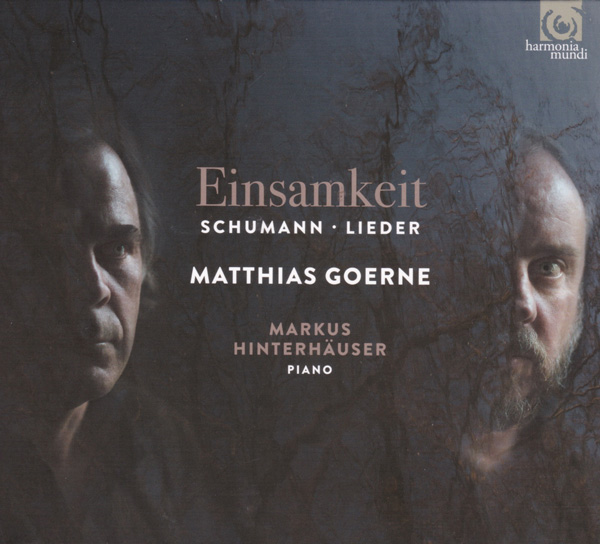
For his fourth Schumann disc since the 1998 Dichterliebe; Liederkreis collaboration with Vladimir Ashkenazy, the great German baritone Matthias Goerne joins pianist Markus Hinterhäuser in a 19-gem collection of heart-touching songs by Robert Schumann entitled Einsamkeit (Solitude). The singing on the Harmonia Mundi recital is gorgeous throughout, and the repertoire deeply communicative. This is especially the case in hi-rez from HDtracks, where the duo's artistic brilliance shines strongest.
Einsamkeit's repertoire choices are less anguished than on many of Goerne's Schubert Edition recitals for the same label. Among them are a number of Schumann's most beloved lyrical creations, not least of which are "Du bist wie eine blume" (You are like a flower), "Die Lotusblume" (The Lotus blossom), and "Meine Rose" (My rose).
While Goerne previously recorded 11 of the collection's 19 songs with Eric Schneider in the fall of 2003—these were released on their Schumann Lieder collection for Decca—the new versions, set down in Berlin in the spring of 2015, are mostly preferable. Goerne's voice may be a bit darker and huskier than of yore, and growl just a bit when declaiming at high volume, but it still radiates the melting sweetness that makes his softer singing so heart-touching, vulnerable and appealing. In addition, Hinterhäuser's piano is given far more sonorous authority lower in the range, and both artists benefit from a more spacious and resonant environment that better flatters their artistry.
There have also been some major changes in tempo. "Meine rose," for example, better coheres when taken faster (from 4:51 to 4:24), while the title song, "Einsamkeit," grows more profound by the addition of almost a minute (from 2:59 to 3:57). Goerne's version of "Meine Rose" may be significantly slower than Carolyn Sampson's on her 2016 R2D4 recital, Fleurs (Flowers), but it also better conveys the sadness of Nikolaus Lenau's poetry.
In general, for a singer known for his sometimes-controversial choice of slow tempi, the shift has been to an even slower pace. Those willing to slow down and listen rather than throwing up their hands in disgust as they cry, "Bring back Fischer-Dieskau," will discover that the slow tempi allow Goerne to sink even deeper into Schumann's emotional landscape.
Taking the time, in fact, is the operative term here. If art song has declined in popularity with the rise of TV and video productions, and the concomitant plummet in music education, it still benefits from a fair helping of brilliant artists who find the intimacy of song most revealing of their interpretive gifts. But since the bulk of great art song composed prior to the advent of Britten, Finzi, Copland, Barber, Rorem, Bolcom, Heggie, and others for whom English is their native language, is in German, French, Spanish and Russian, those who do not speak those languages fluently must rely on printed translations.
Alas, the number of folks who do not wish their music spoon-fed to them, and are willing to sit with translations in hand, is not that large. Witness the decline in art song recitals in the United States, even in the major music capitals of San Francisco and New York.
Should you have read this far, you are probably among the happy minority that cares. To both you and the eternally curious who are reading this, I cannot emphasize enough how beautiful these songs are, and how lovingly they are presented. If art song needs caretakers, Goerne is one of the most gifted and considerate.
In addition, the most profound of the duo's song choices, including "Einsamkeit," are truly wondrous creations. That only a few songs are up-tempo makes the declamatory heart of "Ins Freie" (Into the Open) and the dramatic proclamation of "Requiem" all the more striking. But whether Goerne and Hinterhäuser are virtually transfigured, as they are in "Nachtlied" (Night Song), or tearing up, as they are in "Was will die einsame Träne?" (The solitary Tear), their spiritual integrity makes their artistry indispensable to anyone who seeks, in art, truths about human existence and the universe in which we reside.















