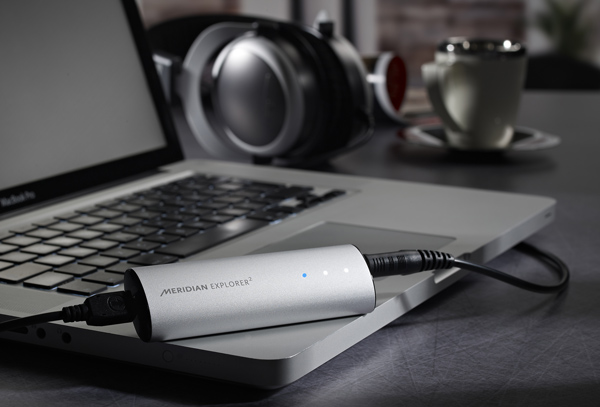
Meridian Audio's hotly anticipated firmware update for its MQA-ready electronics has arrived. Starting February 4, owners of Meridian's Explorer2 DAC (above), Prime headphone amplifier, 808v6 Reference CD player, 818v3 Reference Audio Core, Special Edition loudspeakers and 40th Anniversary systems will be able to upgrade their products and hear the full benefits that MQA-encoded files can deliver.
Free firmware updates for the above mentioned personal audio products will be available for download from the "Support" pages at www.meridian-audio.com on February 4. Owners of 800 Reference Series products and SE loudspeakers must contact their Meridian dealer to learn if the updates can be performed at home, or if they will require a trip to the dealer. Anniversary systems owners should contact Meridian Customer Support to learn what to do.
As detailed in our story of January 4, 2016 could very well turn out to be the year that MQA fulfills its promise to deliver a major improvement in sound quality to large numbers of music lovers. MQA is working with a significant number of partners who are in various stages of planning or implementing the technology. These include music labels, music retailers, and manufacturers of mobile devices and hardware. While Meridian is the first to make a shipping announcement, other companies will no doubt follow when they are ready.
On the label front, Grammy Award-winning audiophile label 2L, as well as labels Camerata and HQM, have already encoded their catalogs with MQA. Still silent are the major labels.
In addition, 7digital, a leading B2B (business-to-business) digital music and radio services company that has 46 clients running digital music services that reach consumers in 33 countries around the world, has announced their first content available in MQA. Onkyo is one of the 46 businesses working with 7digital to include MQA technology in indie label offerings in their high-resolution music store. Once Tidal music service, an MQA-partner that streams CD quality music, comes on board with MQA-encoded content, and then begins to stream high-resolution files encoded with MQA, it is reasonable to expect that the rate at which MQA-encoded music and MQA-capable equipment appears will accelerate.
What is MQA?
To understand what MQA is all about, you are invited to read Stereophile's ongoing coverage. Our first article on the subject, with analysis by John Atkinson and added listening commentary from yours truly, appeared on December 21, 2014. Most recently, we reported on a most convincing MQA listening session, held at CES 2016, that was attended by John Atkinson, Michael Fremer, Peter McGrath, and me.
In addition, Michael Lavorgna of our sister publication, AudioStream.com, has published an excellent nuts and bolts explanation of MQA. The article includes a manufacturer's comment from Bob Stuart, originator of the MQA concept.
In comments posted to some of our articles, as well as on forums, some people claim that unless you have an MQA-enabled DAC, MQA encoding degrades sound quality below that of CD. Still to come are reports of listening tests that both Michael Lavorgna and I will perform independently in which we use MQA and non-MQA enabled DACs to listen to before and after MQA-encoded files and the CD versions. Michael has already published information about this here. It is also quite likely, given my travel schedule over the next three weeks, that Michael will conduct his tests and publish results before I do.
About this future test, Bob Stuart expressed the following by email, "The benefit of backward compatibility is that without a decoder you get better than CD quality. If the original is, for example, DXD or 192k, we don't claim the result would be better than the original without a decoder (and in any case, only the content creator could confirm this). The right test is to compare an un-decoded MQA file to the CD version since this mode covers places where the big files can't be played for whatever reason."
In a face-to-face Skype conversation on January 29, Bob addressed claims that MQA is poised to unleash another format war upon music lovers. "There's no simple dictionary definition of 'format,'" he said. "MQA is a coding of PCM that looks like PCM when the coding is complete. Hence, to listeners, it behaves like PCM. In that sense, it's not a format.
"If, however, you took the view that a format means that the data is laid out in a particular way, then it's a format. The situation is, in some ways, analogous to FLAC. Like FLAC, MQA is simply a means of conveying information. Do you consider FLAC a format?
"It's complete nonsense to claim that MQA is a closed system. I guess what people are addressing is that MQA is an end-to-end system, and we are getting involved at both ends, ie, at both the content creation and playback ends of the chain."
In short, anyone who can currently play CDs or PCM files will still be able to play them once they are encoded with MQA. Our listening tests will either confirm or contradict Bob's claim that even without an MQA-enabled device, you will derive better than CD-quality from an MQA-encoded file.
Finally, Bob addressed accusations as to his financial motivation for developing MQA. "The MQA enterprise is funded by very small royalties on the music, and quite low royalties on hardware. We're talking about modest license fees for software and hardware. MQA is not about world domination; our goal is to improve the sound quality of distributed music and to stay in business while doing so."
To understand what MQA is all about, you are invited to read Stereophile's ongoing coverage. Our first article on the subject, with analysis by John Atkinson and added listening commentary from yours truly, appeared on December 21, 2014. Most recently, we reported on a most convincing MQA listening session, held at CES 2016, that was attended by John Atkinson, Michael Fremer, Peter McGrath, and me.