

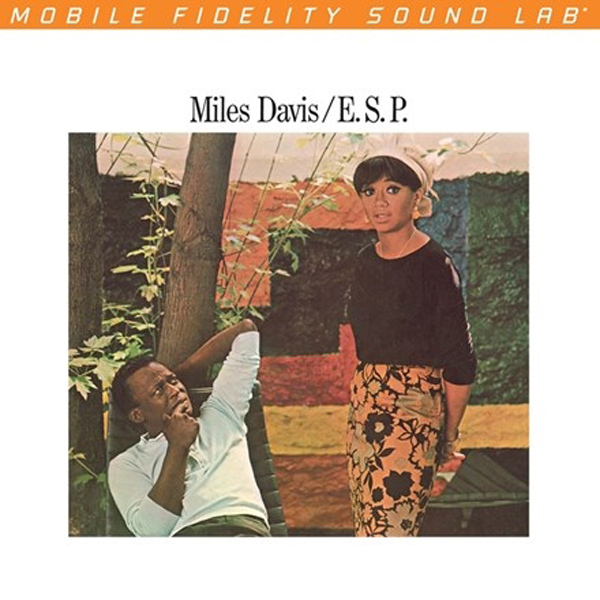
E.S.P., recorded over three sessions in January 1965, marked a major turning point in the music of Miles Davis. Throughout his life—as a sideman to Charlie Parker in the 1940s, a rock-jazz fusionist in the '80s, and the many phases in between—Davis was a restless spirit, a cauldron of change, the spark of several evolutions in the history of jazz. But unlike his earlier shifts, which were followed by brief interludes of backpedaling (for instance, his reversion to hard bop and standards after the modal breakthrough in Kind of Blue), E.S.P. stands as his decisive pivot to modernism.
The key moment in this pivot was the hiring of Wayne Shorter. Miles had shuffled through a few tenor saxophonists after John Coltrane left the band in 1960—George Coleman, Sonny Stitt, Sam Rivers—but none quite gelled with either Davis' trumpet style or the simmering tumult of his new, younger bandmates: pianist Herbie Hancock, bassist Ron Carter, and drummer Tony Williams.
Shorter compacted the elements and lit the fuse. He was an acolyte of Coltrane, possessing a similar hard-brushed tone and fleet energy. But he was also an inventive composer who layered complex harmonies and shifting rhythms over sharp-hooked melodies.
All this galvanized Hancock, Carter, and Williams to a new level. They'd been inspired by the "free" rebellions of Ornette Coleman and Eric Dolphy, and the new direction of Coltrane—movements that left Miles cold (or perhaps envious at being left behind), until Shorter came along and carved an accommodating path. The E.S.P. sessions are ensemble sessions, even more than Kind of Blue had been, with each musician not only composing one or more of the tracks but making indelible, inimitable contributions throughout to every aspect of the sound.
This was especially true of Williams, who, barely 19 years old, laid down a style of propulsive polyrhythms that no one had ever heard, many have since tried, but none have quite matched. Hancock, already a master pianist familiar with Ravelian harmonies, comped with tone clusters more spare and jarring than Bill Evans' did for Miles' previous great combo (and more fitting for this new type of music). Carter fashioned a more pliable anchor for bass, expanding the notion of time-keeping. And Miles was still very much Miles—and very much the leader, choreographing the sudden shifts with the slightest breath or accent.
Mobile Fidelity's 45rpm two-disc vinyl reissue—mastered from the original ¼-inch, 15ips, two-track tapes by Krieg Wunderlich—captures the sound's bloom and detail with more warmth and detail than any previous pressing, including Columbia's original. (In the mid-'60s, the label's producers started messing with post-production EQ and compression. Sony's most recent CD of this album, digitally remastered by Mark Wilder, sounds better than the original, though not nearly as good as this MoFi LP.) The instruments all sound present, especially Carter's bass, which is clearer, pluckier, and woodier than on any other album by this band; I'm left with a deeper appreciation than I've had for his role in shaping the new Miles sound.
My only qualm—and it's slight—concerns the album's provenance. Unlike most of Miles' sessions in the decade before and after, this one was recorded not in Columbia's 30th Street Studio in New York but in its Los Angeles studio, about which little is known, including the name or techniques of the recording engineer. (Some at Sony have researched the matter, so far to little avail.) It seems to have been a less spacious venue, and Fred Plaut—Columbia's New York engineer—wasn't there with his brilliant technique of enhancing reverb in a non-electronic way. Perhaps as a result, E.S.P. sounds a bit more dry and cramped than the best of the New York sessions—but I want to emphasize a bit. This is still a terrific-sounding album, and, for some reason, the final track, "Mood," an adventurous, spare piece composed by Miles and Carter, has something close to that New York sound.
Miles' "second great quintet," as this group is called, recorded six albums from 1965-68—after E.S.P., there were Miles Smiles, Sorcerer, Nefetiti, Miles in the Sky, and Filles de Kilimanjaro. All of them are vital assets of any jazz collection, and MoFi's 45rpm pressings (which exist for all the titles except Miles Smiles, and I hope it's on the way) are the best way to hear them.















