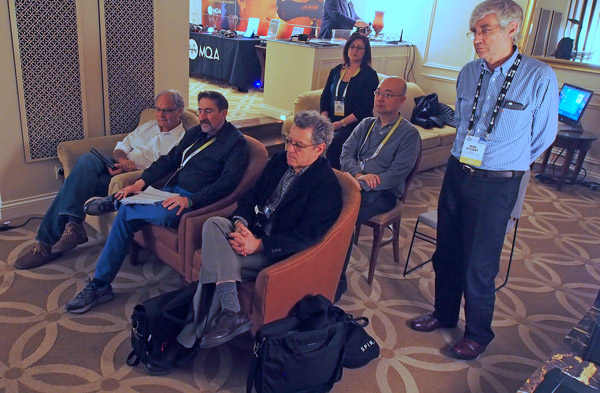
Digging MQA (from L–R): Peter McGrath, Jason Victor Serinus, and Michael Fremer, with Bob Stuart anxiously looking on and Winai Pawitwatana behind. (Photo: John Atkinson)
CES 2016 marked the first time that three writers for
Stereophile—Editor-in-Chief, John Atkinson; AnalogPlanet analog guru, Michael Fremer; and this Contributing Editor—could sit down in the same room with Bob Stuart of MQA/Meridian and spend a concentrated amount of time comparing before- and after-MQA encoded (Master Quality Authenticated) tracks. Joining us were recording engineer Peter McGrath, also of Wilson Audio, who contributed several tracks; Winai Pawitwatana, a consummate music lover whose company, Deco is the distributor for Wilson, Meridian, and other high-end brands in Thailand; and several members of the MQA team.
The timing was propitious. On January 4, at CES Unveiled, MQA
announced the names of major companies that are now offering MQA-capable hardware and music content. Three days later, both 7digital, a leading B2B digital music and radio services company, and Onkyomusic announced their first indie label content available for download and streaming in MQA. With CD quality and hi-rez streaming service Tidal expected to announce MQA encoding once things settle down from the company's acquisition of a
new CEO, it was high time that we all took another listen to the technology that we've been
raving about since the
end of 2014.
The system before us contained before and after MQA files loaded onto a Meridian Sooloos front end that included a QNAP core and HP Touch computer. Also heard were a Meridian 818 digital controller, which included the streaming endpoint, USB and MQA decoder. The rest of the system comprised a Dan D'Agostino Master Audio Systems power amplifier. Wilson Audio Sasha II loudspeakers, and Transparent cabling. I wish we could have auditioned the Mytek MQA-enabled Brooklyn DAC that was first announced at October's Rocky Mountain Audio Fest, but it remained in its late development phase, and was not operation-ready.
First up was a before/after comparison of McGrath's recording of the
Escher String Quartet and pianist Ben Grosvenor performing a Dvorak Piano Quintet. "So much more emotionally compelling, and so much more nuance," I wrote in my notes. "The pacing and accents are more palpable." John Atkinson, commenting from a recording engineer's perspective, praised "the increased clarity of the spatial relationships between the players and the surrounding hall ambience."
McGrath, in turn, said, "Listening to my recording with MQA literally brought tears to my eyes, because it was the first time I could hear what I heard in the hall. MQA could possibly make the recording process less complex if engineers can better hear what they're recording. It would enable less to be more, because engineers would not have to add or recreate if they knew what they wanted listeners to hear was on the recording to begin with."
The final comment, equally telling, came from either Stuart or someone in the back of the room. (Apologies for not turning my head fast enough to catch who was speaking.) "Perhaps you would have mixed the recording differently had it captured the spatial relationships from the get-go," they said.
Next up was McGrath's 24/88.2k recording of Michael Tilson Thomas and the New World Symphony performing the start of Mahler's Symphony 5. Because MQA encoding is most effective when the recording and mastering equipment are known, McGrath had previously informed Stuart and the MQA team that he had used a Meitner ADC and Grado mikes.
It was immediately apparent how much deeper I could listen into the soundstage with MQA. Due to MQA correction of minute timing errors, special relationships were clarified to a significant extent.
I knew that McGrath was happy, because he unconsciously began to sing along with the symphony. When it was his turn to speak, he said, "I heard the winds in the back of the orchestra as I've never heard them before."
"I especially like the tuba," said John Atkinson. "The taps on the timpani and bass drum sound more natural, rather than like generic thwacks, and the sonic signature and dimensions of the hall are clearer," he noted.
In a comparison that had Michael Fremer's ears perking up, we next listened to some music from Keith Jarrett's famed live 1975
Concert in Köln (recorded in the Opera House in Cologne, Germany). Lucky for us, Stuart had been able to get his hands on a 96kHz transfer of ECM's analog master tape.

From L–R: John Atkinson, Peter McGrath, Bob Stuart, Jason Victor Serinus, and Michael Fremer.
In a follow-up call, days after CES ended, Michael Fremer had this to say about what he heard:
The CD of the recording has an unfocused, diffuse image of a piano hanging in space, with the room reverb mixed in and confusing the picture. There was no image, there was no there there. My mind couldn't get engaged with it, which was disturbing, because it didn't make sense. That's why many people don't sit down and listen to a CD with the lights out and stay engaged, as you do with a record. When the MQA version was played, there was a coherent attack, sustain, and decay. Finally, I could visualize Jarrett playing a piano in three-dimensional space, and the space behind it. It was like what a record sounds like. I think that since Jarrett is also an audiophile and likes vinyl that he, too, would hear it the same way.
Herr Fremer was far from alone. When McGrath heard the MQA version, he literally chuckled with delight at the difference. "It sounds far closer to what the piano can do," he said.
As for my impression, the harmonics of the piano were far more in evidence. I felt as if a window had been scrubbed clean, and I could see deeper into the music than before. When Jarrett hit multiple keys simultaneously with full force, the blend between the notes, and the way they reverberated in space, was far easier to discern. I know from experience that, had we been able to listen to the entire track, the emotional impact of the music would have been far greater.
At the end of our session, Stuart played a before/after track from 2L recording engineer Morten Lindberg's first recording, of
piano music by Carl Nielsen. "It was a shock to go back to the DAT original and discover how flat and lacking in harmonics it sounded," he said. "While we only had the CD transfer of the original DAT—the machine itself was unusable—we could also access the original converter that Lindberg used." Our reactions, as you can imagine, were in line with our observations about the Jarrett track.
While Michael Lavorgna of
Stereophile and
AudioStream conducted his listening separately, he sent me the following comment for our CES show wrap:
The biggest word in computer and digital audio replay at CES 2016 was "-Ready." Roon-Ready and MQA-Ready products captured the most attention mainly because Roon makes file-based playback much better in terms of interfacing with stored and streamed music libraries and MQA makes digital music sound much, much better.
There has been a fair amount of pushback about MQA on forums and in our comments section from long-time audiophiles who are either totally dismissive of the process, absolute certain that we are pawns of the MQA organization, or bracing themselves for proclamations that they must now run out and not only replace their third or fourth versions of classic recordings with MQA-encoded versions (when they become available), but also replace their DACs. These, of course, are legitimate concerns.
According to Stuart, MQA technology will make any MQA-encoded recording sound better, even without an MQA decoder. Of course, it will sound even better if you can decode it. But it is not necessary to do so to derive some sonic benefit. That, I might add, is a listening experiment I have yet to witness.
Because MQA was developed with the intent of shrinking the size of large, hi-res files and making transfer/storage more practical, it will certainly affect our ability to stream and download hi-rez content. In other words, MQA will make it possible to hear and store music at 352.8kHz or 384k without overloading computers, music servers, or the Internet. (The last example Stuart played us was of 24/352.8 music streamed from Tidal, and it sounded excellent,) And since MQA, like hybrid SACDs, is backward-compatible, you will be able to play MQA-encoded files on your existing equipment without additional investment. In short, MQA is a win-win for all music lovers.